Introduction
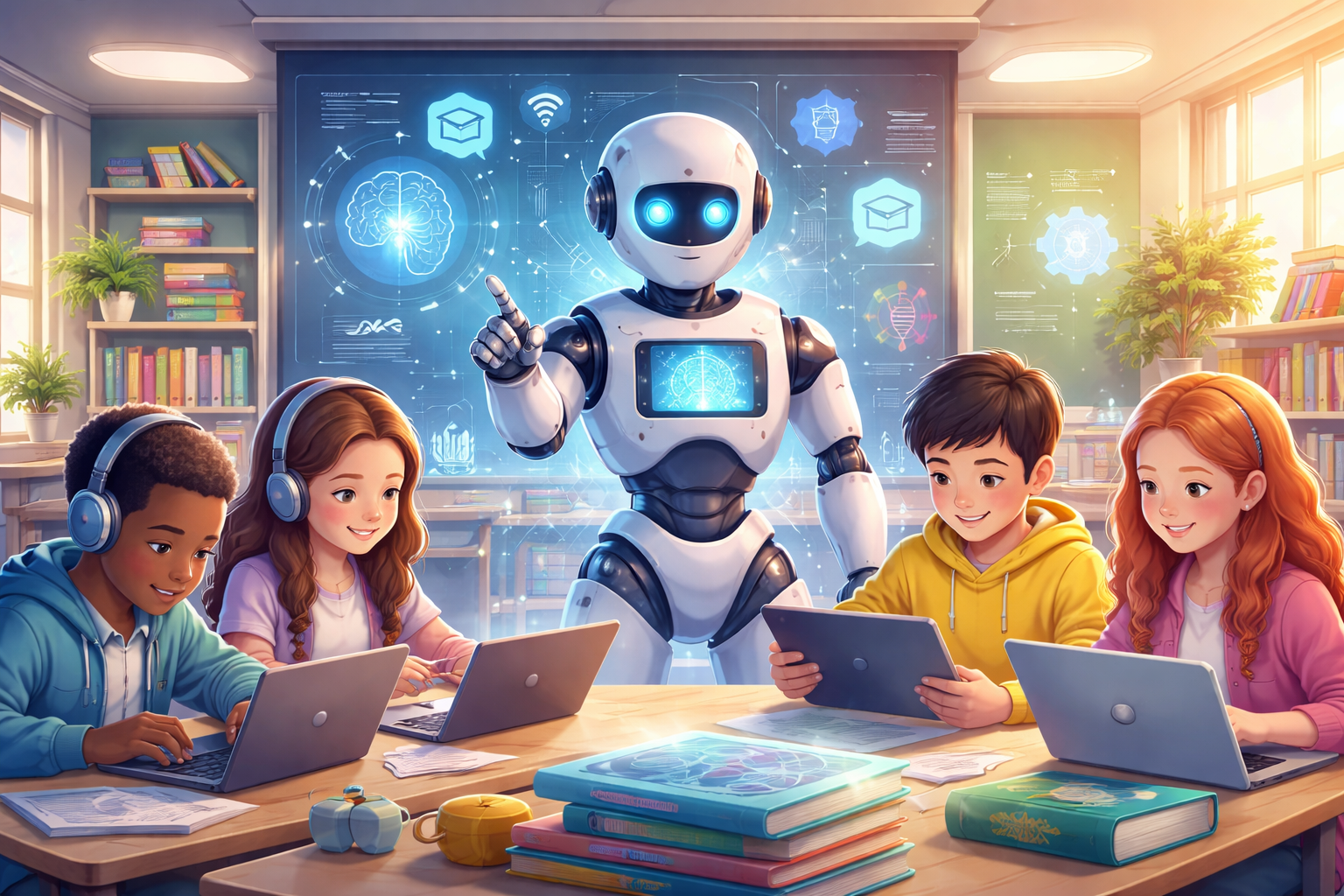
Artificial intelligence is no longer a distant concept in classrooms; it is already here, actively reshaping how students learn, how teachers plan, and how schools operate. From adaptive math programs that adjust in real time to AI writing assistants that give students instant feedback, the technology is embedding itself into the daily rhythms of education at every level.
For school leaders, teachers, and families, this shift raises important questions. What does AI actually do in a classroom? What are the genuine benefits, and what are the real risks? And perhaps most importantly, how should schools approach this technology with both enthusiasm and caution?
This article explores the current landscape of AI in education, what it means, how it is being used today, the advantages it offers, the challenges it creates, and what thoughtful, responsible adoption looks like in practice.
What Is AI in Education?
At its core, AI in education refers to digital tools that use algorithms, data analysis, and predictive modeling to support learning, planning, assessment, and instruction. Unlike traditional software that follows fixed rules, AI-powered tools can recognize patterns in student behavior and performance, adjust content difficulty on the fly, generate personalized feedback, and automate time-consuming administrative tasks.
It is important to note what AI in education is not: it is not a replacement for teachers. Human judgment, relationship-building, and mentorship remain irreplaceable. AI is best understood as a layer of support, one that enhances what educators can do, rather than substituting for them.
How AI Is Used in Schools Today
AI is already active in schools across the world. The most impactful applications fall into several key areas:
Personalizing the Learning Experience
One of AI’s greatest strengths is its ability to tailor instruction to the individual learner. Adaptive AI programs analyze how a student is performing in real time and automatically adjust the difficulty and style of content to match their needs. A student who is struggling receives additional scaffolding and hints. In contrast, a student demonstrating mastery is challenged with more advanced material, all without the teacher needing to manage multiple versions of the same lesson manually.
This kind of personalization was previously only achievable through one-on-one tutoring. AI makes it available to every student, simultaneously, in a single classroom.
Giving Teachers Time Back
Ask any teacher what they need more of, and the answer is almost always the same: time. Time to plan meaningful lessons, provide individualized feedback, build relationships with students, and focus on the work that only a human can do.
AI is already helping teachers reclaim some of that lost time by handling routine, time-consuming tasks, including:
- Drafting lesson outlines and assessment questions
- Creating leveled versions of reading texts on the same topic
- Generating quiz questions and grading rubrics
- Identifying patterns in student performance data
- Flagging common writing errors across a class
When AI handles these administrative layers, teachers gain something far more valuable: the flexibility to focus on instruction, on mentorship, and on the nuanced needs of each student in front of them.
Supporting Early Identification and Intervention
AI tools can detect early warning signs that a student may need additional support, things like declining engagement, repeated errors on specific concepts, rising rates of missed assignments, or irregular attendance patterns. By surfacing these signals earlier than a teacher might notice manually, AI allows schools to intervene before small challenges become significant setbacks.
This capability is especially valuable during data-driven meetings, where administrators and counselors can use AI-generated reports to direct conversations toward the students who need attention most.
Expanding Access for All Learners
AI has a powerful role to play in equity. For multilingual learners, students with disabilities, and struggling readers, AI-powered tools can remove barriers that previously made grade-level content inaccessible. Features such as real-time translation, text-to-speech, captioning, vocabulary support, and visual explanations allow more students to participate fully in learning without drawing attention to the support they are receiving.
Improving Writing and Feedback Cycles
AI writing tools help students get started on assignments, organize their thinking, and revise drafts with immediate feedback, a significant shift from the traditional model where students submitted work and waited days for a response. This faster feedback loop encourages iteration and builds student confidence. Meanwhile, teachers can focus their energy on deeper instructional conversations rather than correcting surface-level errors.
The Benefits of AI in Education
When implemented thoughtfully, AI offers meaningful, measurable advantages for students, educators, and school systems alike.
Enhanced Personalized Learning
AI dynamically adjusts content based on individual student performance, reducing the need for teachers to manually differentiate for every learner. Students receive material at the right level of challenge, neither overwhelmed nor under-stimulated.
Reduced Teacher Workload
By automating lesson drafting, quiz creation, and data analysis, AI reduces the administrative burden on teachers. This allows educators to direct their energy toward what matters most: relationships, mentorship, and high-quality instruction. As one veteran teacher noted, AI gives back time that can be spent working with students rather than creating materials from scratch.
Immediate Student Feedback
Students benefit enormously from receiving feedback right away. AI-powered tools allow students to revise, improve, and grow in real time, a process that builds confidence and ownership over their own learning, while freeing teachers to provide higher-level guidance.
Increased Accessibility and Equity
AI removes barriers for learners who have historically been underserved by traditional classroom models. Translation tools, read-aloud features, alternative formats, and captioning allow students with disabilities, language learners, and struggling readers to access the same content as their peers independently and with dignity.
Better Use of Data
AI helps schools make sense of large volumes of student data quickly. Rather than spending hours analyzing spreadsheets, educators can use AI to surface patterns, identify at-risk students, and plan targeted interventions, all with greater speed and precision.
Increased Student Engagement
When AI-supported tools are used intentionally, they can make learning feel more active and relevant. In STEM classrooms, particularly, students use simulations, interactive models, and adaptive challenges that encourage exploration and critical thinking, replacing passive worksheet completion with genuine inquiry.
The Risks and Challenges of AI in Education
As with any significant technological shift, AI in education carries real risks. School leaders must understand and plan for these challenges, not ignore them in favor of the benefits.
Student Data Privacy
AI tools rely heavily on student data to function. This raises fundamental questions: What information is being collected? How is it stored? Who can access it? Is it used for purposes beyond the educational purpose for which it was gathered? Families have every right to ask these questions, and schools have an obligation to answer them clearly and transparently. Data privacy must be a prerequisite for AI adoption, not an afterthought.
Implementation Challenges
Even the best AI tool is only as effective as its implementation. When adoption is rushed or poorly supported, it creates confusion, frustration, and wasted resources. Teachers need time, high-quality training, and ongoing support to use AI effectively. Without intentional professional development, AI tools are likely to go underused or worse, used in ways that harm instructional quality.
Over-Reliance on Technology
There is a genuine risk that students or even teachers may come to rely on AI in ways that undermine the thinking and problem-solving skills they are supposed to be developing. Learning requires productive struggle. If AI shortcuts that process, it may produce the appearance of competence without the underlying understanding. Schools must be deliberate about when AI use is appropriate and when students should be working independently.
Inaccurate or Misleading Outputs
AI tools can produce incorrect, biased, or misleading information, sometimes with considerable confidence. Students and teachers who accept AI output uncritically are at risk of spreading misinformation. Critical evaluation of AI-generated content must be taught as a skill, not assumed. Schools need to help students and educators develop the judgment to question, verify, and contextualize what AI produces.
Should AI Be Used in Schools?
The question district leaders should ask is not “Is AI good or bad?” but rather: “Does this tool serve a clear instructional purpose?” The answer determines whether AI belongs in a given context.
Before adopting any AI tool, school leaders and teachers should be able to answer yes to these questions:
- Does this tool address a real instructional or operational challenge?
- Does it enhance, not replace, teacher judgment and expertise?
- Does it protect student data and comply with privacy regulations?
- Is it accessible to all students, including those with disabilities?
- Do teachers receive the time and support they need to use it effectively?
- Does it strengthen, not distract from core learning goals?
When these conditions are met, AI becomes a powerful partner in education. When they are not, it risks doing more harm than good.
Using AI Responsibly: What This Looks Like in Practice
Responsible AI adoption in schools requires more than installing software. It demands intentional leadership, clear communication with families, equity-centered decision-making, and a culture that keeps human relationships at the center of schooling.
Districts that are getting this right share several characteristics: they establish clear policies for AI use before deploying tools widely, they provide robust professional development for teachers, they communicate transparently with families about data practices, and they regularly evaluate whether AI is actually improving outcomes, not simply adding novelty.
They also maintain a firm commitment to the irreplaceable role of educators. No AI system, however sophisticated, can replicate the trust a teacher builds with a struggling student, the mentorship that changes a young person’s trajectory, or the leadership that holds a school community together. AI is a tool in the service of those human relationships, not a substitute for them.
Conclusion
AI is already transforming education, and that transformation will continue to accelerate. The schools and districts that navigate this shift most successfully will be those that approach AI with both openness and critical thinking, embracing the genuine benefits while actively guarding against the real risks.
Personalized learning, time savings for teachers, earlier intervention for struggling students, and expanded access for underserved learners are all within reach. But they require deliberate implementation, ongoing evaluation, strong professional development, and a clear-eyed understanding of what AI can and cannot do.
Ultimately, schools succeed because of dedicated teachers, visionary leaders, engaged families, and resilient students. AI, used wisely, can make those people more effective. But it will never replace them. Strong relationships, trust, and human-centered leadership will always matter more than any technology, including artificial intelligence.