

| Key Takeaways |
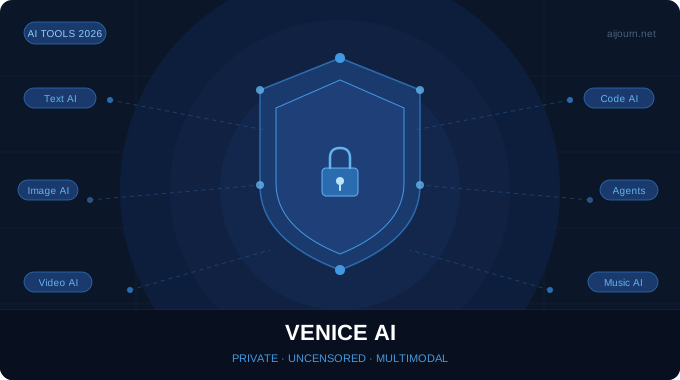
| ✦ Privacy by Design: Venice AI is built on a zero-server-retention architecture — your prompts and responses never leave your browser or get stored on company servers. |
| ✦ Multi-Model Hub: A single platform that hosts dozens of cutting-edge text, image, video, and code models from OpenAI, Anthropic, Google, and open-source providers. |
| ✦ 2 Million Users: Venice reached the 2 million user milestone in early 2026, reflecting a major shift in demand for privacy-first AI alternatives. |
| ✦ Uncensored & Unfiltered: Unlike mainstream AI platforms, Venice imposes minimal content restrictions — placing creative control back in the hands of users. |
Introduction
In a world where every AI interaction is logged, analyzed, and potentially monetized, one platform made a radical bet. What if AI could be powerful and private at the same time? That platform is Venice AI.
Launched in May 2024 by Erik Voorhees, founder and former CEO of cryptocurrency exchange ShapeShift. Venice was engineered from the ground up as a privacy-first alternative to mainstream AI assistants like ChatGPT, Claude, and Gemini. Its core conviction is simple but disruptive: users should be able to harness. The power of state-of-the-art AI without surrendering their data to centralized servers.
By early 2026, Venice had crossed the 2 million user milestone. It now supports a full multimodal suite of text, images, and video. Include code and music drawing on dozens of the world’s most powerful open-source and proprietary models simultaneously. For professionals, developers, creatives, and privacy advocates, Venice has evolved into a compelling all-in-one AI workspace. This guide covers everything you need to know: features, use cases, pricing, benefits, limitations, and what lies ahead.
What Is Venice AI?
Venice AI is a private, multimodal AI platform that aggregates leading open-source and proprietary. Large language models under a single, privacy-protected interface. Rather than building a single proprietary model, Venice acts as a model router and inference layer. That gives users access to the best available models while ensuring their conversations are never persisted on Venice’s servers.
The platform’s defining characteristic is its zero-retention privacy architecture. When a user submits a prompt, it travels via SSL-encrypted connection through Venice’s proxy to a pool of GPU inference providers. The response streams directly back to the user’s browser without being stored anywhere on Venice’s infrastructure. Chat history lives exclusively in the user’s local browser storage.
This approach stands in stark contrast to mainstream AI platforms, nearly all of which retain user conversation data on central servers — data that can be accessed internally, shared with third parties, or exposed through security breaches.
What Defines Venice AI in 2026
The 2026 iteration of Venice represents a significant evolution from its 2024 origins. Three pillars now define its competitive position:
• Privacy as Infrastructure: Zero server-side data retention is not a feature toggle — it is the foundational architecture. This is what distinguishes Venice from competitors that offer “opt-out” data controls as an afterthought.
• Multi-Model Flexibility: Venice does not lock users into a single AI model. A user can switch from GPT-5.4 for analytical writing to FLUX Custom for image generation to Claude Opus 4.6 for nuanced reasoning — all within the same session.
• Decentralized Inference: Venice routes requests across a pool of decentralized GPU providers, preventing any single entity from accumulating a complete picture of a user’s usage history.
Core Features of Venice AI
1. Private Text Generation
At its foundation, Venice is a powerful text chat assistant. Users can brainstorm, write long-form content, summarize documents, conduct research, or hold open-ended conversations with a wide selection of models. Crucially, custom System Prompts allow users to define the AI’s persona, tone, and operational constraints — a feature that was previously limited to enterprise AI deployments.
The platform also offers adjustable parameters like Temperature and Top-P, giving technically minded users fine-grained control over response style and creativity. A dedicated Temporary Chat mode deletes all session data the moment the window is closed, offering an additional layer of ephemeral privacy.
2. Advanced Image Generation
Venice supports text-to-image generation across multiple open-source image models, including FLUX Custom, Stable Diffusion 3.5 Large, Chroma, Seedream, and Nano Banana Pro. The platform includes a built-in Prompt Enhancer that automatically improves prompts under 200 characters before sending them to the model, resulting in more precise and visually refined outputs.
Additional image tools include inpainting (selective area editing), image upscaling, background removal, and multi-image combining. For Pro users, the Prompt Enhancer is built directly into the image pipeline, requiring no manual intervention.
3. Video Generation Studio
Introduced as part of Venice V2, the Venice Video Studio is a dedicated workspace for AI video creation. Users can generate videos from text prompts, transform still images into animated clips, or create video transitions between two frames. The platform’s standout multi-model generation feature allows users to generate the same prompt across several video models simultaneously and compare results side-by-side.
Venice’s video lineup includes industry-leading models such as Sora 2 and Veo 3.1, making it one of the few platforms to host multiple frontier video models in a privacy-respecting environment.
4. Code Assistance
Venice’s code assistant supports the full development lifecycle: generating boilerplate code, refactoring legacy scripts, debugging errors, writing tests, and explaining complex algorithms. Specialized code models like GPT-5.3 Codex are available alongside general-purpose reasoning models, giving developers flexibility based on their task.
For teams under NDA or working with proprietary source code, the privacy architecture is a decisive advantage. Pasting sensitive code into Venice carries significantly lower data exposure risk compared to cloud-based AI coding tools that retain submitted code for model training or safety review.
5. AI Characters
Venice allows users to create fully customized AI characters — persistent personas with defined names, backstories, communication styles, and behavioral parameters. Characters can be based on fictional figures, professional archetypes, or entirely original creations. Pro users can also generate images of their characters and produce short videos featuring them, bringing AI personalities into a truly multimodal format.
6. Real-Time Web Search
Venice integrates live web search directly into its chat interface, with the option to switch between Brave and Google as search providers. Responses that draw on web search include clickable citations, allowing users to verify sources. This makes Venice viable for research workflows that require up-to-date information beyond any model’s training cutoff.
7. AI Agents & Skills
One of Venice’s most significant 2026 additions is the introduction of AI Agent Skills — task-specific capabilities that agents can invoke inside conversations. Combined with Venice’s permissionless API, developers can build autonomous agents that chain together text generation, image creation, code execution, and web search in a single workflow, without any of the intermediate data being stored on Venice’s servers.
8. Music Generation
Recently added as a new task type in the API, music generation rounds out Venice’s creative suite. Users and developers can generate audio compositions using AI models, opening new possibilities for content creators working across multimedia formats.
Venice AI Model Lineup (2026)
Venice’s model library is one of the most extensive of any AI platform, spanning text, image, video, code, and vision modalities:
| Model Category | Examples Available | Best For |
| Text & Reasoning | GPT-5.4, Claude Opus 4.6, Sonnet 4.6, DeepSeek R1 | Writing, research, analysis, coding |
| Image Generation | FLUX Custom, Stable Diffusion 3.5, Chroma, Seedream | Creative design, concept art, product visuals |
| Video Generation | Sora 2, Veo 3.1, LTX 2.3, Vidu Q3 | Text-to-video, image-to-video, cinematic content |
| Code Assistance | GPT-5.3 Codex, Qwen 2.5 VL 72B | Code generation, refactoring, debugging |
| Vision / Multimodal | GPT-4o, Qwen 3 VL 235B | Image understanding, document analysis |
Venice adds new models on a near-weekly cadence. Notable recent additions include Claude Opus 4.6 and Claude Sonnet 4.6 (featuring a 1M token context window), GPT-5.4 Pro with extended reasoning, Qwen 3.5 35B, and Google’s Gemini 3 Flash Preview.
Privacy Architecture: How Venice Keeps Your Data Safe
The Venice privacy model differs fundamentally from every mainstream AI platform. Most AI services retain user prompts and responses on centralized servers indefinitely — data accessible to internal teams, shareable with third parties, and vulnerable to breaches. Venice’s engineering philosophy rejects this approach entirely.
Zero Server Retention
Venice does not store or log any prompt or model responses on its servers. When a user submits a request, it passes through Venice’s proxy to a pool of GPU inference providers. After the GPU processes the response, it streams directly back to the user’s browser without persisting in any form of permanent Venice storage.
Local-First Chat History
All conversation history is stored exclusively in the user’s local browser storage. This has a practical implication: logging into Venice on a new device shows a blank history, because that history never left the original browser. Temporary Chat mode goes a step further, wiping session data entirely upon closing the tab or application.
SSL Encryption Throughout
All data in transit — from the user’s device to Venice’s proxy, and from the proxy to inference servers — is protected by industry-standard SSL encryption throughout its entire journey.
Minimal Identity Collection
Venice collects only a user’s email address and IP address for account management. It logs behavioral metadata (such as signing in or creating new chats) to improve the product, but explicitly never logs the content of prompts or AI responses.
| Important Caveat on Privacy Claims |
| ✦ Venice’s privacy architecture is based on vendor-stated claims. As of early 2026, no independent third-party security audit has been publicly released to verify zero-retention behavior across all deployment environments. |
| ✦ For users handling regulated data or operating under strict corporate data governance policies, it is advisable to conduct your own network-level inspection — monitoring requests via a proxy tool — before standardizing on Venice for sensitive workloads. |
| ✦ Venice’s ‘uncensored’ defaults also mean that organizational policies should be in place for environments where harmful content exposure is a risk. |
Use Cases Across Professions
Journalists & Researchers
Journalists handling sensitive sources, investigative reports, or embargoed information face significant risks when using AI tools that retain conversation data. Venice’s zero-retention model makes it a natural fit for this community. Real-time web search with clickable citations supports verification workflows, while the ability to analyze uploaded documents (PDFs) without server-side storage adds further protection for confidential materials.
Developers & Software Engineers
Venice’s multi-model code assistant, combined with its privacy architecture, positions it as a strong choice for developers working on proprietary codebases. Teams under NDA can safely use AI-assisted code review, refactoring, and debugging without the compliance concerns that come with cloud-based tools that retain submitted code. The permissionless API makes it straightforward to integrate Venice into existing development pipelines and build custom AI-powered tooling.
Content Creators & Designers
For writers, marketers, video producers, and graphic designers, Venice provides an end-to-end creative AI suite. Long-form writing with adjustable model personalities, image generation across eight models, video production via the Venice Video Studio, and AI character creation give creators a genuinely comprehensive workspace. The absence of aggressive content filters makes Venice especially valuable for creative projects that push stylistic or thematic boundaries.
Privacy-Conscious Individuals
For users who have opted out of surveillance-based search engines, social networks, and cloud storage, Venice represents a logical extension of a privacy-first digital lifestyle. Every interaction with Venice is architecturally designed to leave no trace on the platform’s servers — a proposition that DuckDuckGo made famous for search, and that Venice is attempting to establish for AI.
Enterprises & Teams
While Venice does not yet offer formal enterprise SLAs or audit certifications, its privacy architecture offers practical advantages for teams handling sensitive information. The permissionless API enables organizations to build internal AI tools without routing proprietary data through third-party training pipelines. Stablecoin payment support also makes Venice accessible to organizations in jurisdictions where traditional payment rails present friction.
Pricing & Plans
Venice’s pricing model is deliberately simple — two consumer tiers and a developer API layer, without complex credit systems or per-feature paywalls.
| Plan | Price | Text Prompts | Image Prompts | Key Features |
| Free | $0/month | 10/day | 15/day | Base models, private text & image, code generation |
| Pro | $18/month | Unlimited | 1,000/day | Advanced models, API access, video, characters, watermark removal, high-res upscaling |
| Annual | $180/year (~$15/mo) | Unlimited | 1,000/day | All Pro features + 30% savings vs monthly |
| API | Pay-per-token | Custom | Custom | Permissionless access, developer-grade, stablecoin payment supported |
The Free plan is genuinely functional for light daily use, offering private text and image generation using base models. The Pro plan at $18/month unlocks unlimited text generation, up to 1,000 images per day, the Video Studio, character creation, watermark removal, and high-resolution image upscaling. Annual billing reduces the effective rate to approximately $15/month. As of March 2026, stablecoin payments are accepted for users preferring decentralized payment methods.
Benefits of Using Venice AI
Organizations and individuals who adopt Venice report consistent advantages across four dimensions:
- Structural Privacy: Not a privacy “setting” but a privacy architecture. Users do not need to opt out of data collection — collection does not occur in the first place. This removes a category of risk rather than managing it.
- Model Diversity: Access to dozens of the world’s best AI models — from frontier proprietary systems like GPT-5.4 and Claude Opus 4.6 to specialized open-source models — through a single login and interface. Model switching is frictionless and instant.
- Creative Freedom: Fewer content restrictions than mainstream platforms mean fewer workflow interruptions for creative or exploratory tasks. Venice is built for users who need AI to expand their thinking, not constrain it.
- Cost Efficiency: Pro access to a multi-model platform with unlimited text and generous image quotas at $18/month represents strong value compared to subscribing to multiple single-model AI services separately.
- Developer Velocity: The permissionless API, combined with privacy-safe inference, enables development teams to ship AI-powered features faster — without navigating enterprise data processing agreements with closed-model vendors.
- Community Growth: At 2 million users and growing, Venice benefits from an active user base and a rapid product cadence, with major feature releases — including video generation and agent skills — shipping on a bi-weekly schedule.
Is Venice AI Right for You?
Venice is an exceptional fit for certain use cases and a poor fit for others. The decision framework comes down to three questions:
Choose Venice If:
- You handle sensitive data and need an AI tool with verifiable privacy protections.
- You work on creative projects that mainstream AI platforms regularly refuse or water down.
- You want access to multiple frontier models without managing separate subscriptions.
- You are a developer building AI-powered applications on top of a privacy-first API.
- You are privacy-conscious and want your AI usage to leave no trace on third-party servers.
Consider Alternatives If:
- You require formal third-party privacy audits and documented SLA commitments.
- You need the highest-end reasoning polish at the cutting edge — models like OpenAI o3 or Gemini Ultra in their native platforms may still edge out Venice’s routed equivalents for the most complex tasks.
- You rely heavily on deep platform integrations like code interpreters, enterprise app connectors, or productivity suite plugins that native platforms offer.
- Your organizational policy requires strict default content moderation that Venice’s uncensored defaults do not provide.
Challenges & Limitations
Venice is not without its friction points. Response latency can vary depending on GPU pool load, and the platform does not yet publish documented performance SLAs or uptime guarantees that enterprise procurement teams typically require. The “uncensored” positioning also creates a genuine governance challenge for organizations — additional internal policy layers are needed to ensure responsible use in team environments.
Privacy claims, while architecturally coherent, remain vendor-stated. Until an independent network forensics audit is published, sophisticated security teams should verify zero-retention behavior themselves rather than relying solely on Venice’s documentation. Additionally, Venice’s browser-local chat history means users lose their conversation records if they clear browser storage or switch devices — a genuine usability trade-off for privacy.
Finally, while Venice’s model roster is impressively broad, it is still subject to the availability and pricing decisions of the underlying model providers. A model that is available today may be deprecated, repriced, or restricted tomorrow.
Future Trends: Where Venice Is Heading
The product trajectory of Venice points toward three key developments. First, the deeper integration of its VVV and DIEM token ecosystem suggests a future where AI inference capacity is owned and traded like a commodity, enabling a fundamentally decentralized compute economy that no single corporation can control or censor.
Second, the rapid expansion of Agent Skills positions Venice as a platform for autonomous multi-step workflows — not just a chat interface, but a private operating environment for AI agents that act on a user’s behalf without leaving a data trail. As agentic AI becomes the dominant paradigm, Venice’s privacy architecture will become an increasingly powerful differentiator.
Third, the addition of music generation alongside text, image, video, and code suggests Venice is building toward a genuinely complete AI creative studio — a single private workspace where a creator’s entire production pipeline, from concept to finished multimedia asset, can be executed without any of their creative data ever leaving their control.
Conclusion
Venice AI represents something genuinely new in the AI landscape: a platform that refuses to treat privacy as a premium add-on and instead makes it the structural foundation of everything it builds. In 2026, as AI becomes embedded in sensitive professional workflows — legal research, investigative journalism, proprietary software development, medical writing — the question of where your data goes is no longer academic. It is a material operational risk.
Venice’s answer — that your data goes nowhere, because it was never stored in the first place — is architecturally elegant and increasingly commercially viable. At 2 million users, with a model lineup that now rivals the breadth of any aggregator, and a product team shipping meaningful updates on a bi-weekly cadence, Venice has graduated from privacy-first niche tool to serious contender for the role of default AI workspace for anyone who takes data sovereignty seriously.
The future belongs to those who don’t just use AI — but who retain control of what they share with it. Venice is building that future, one zero-retention conversation at a time.
Frequently Asked Questions
1. Does Venice AI actually store my conversations?
According to Venice’s architecture, conversation history is stored only in your local browser — not on Venice’s servers. When you send a prompt, it passes through Venice’s proxy to GPU inference providers and the response streams back without being persisted. Temporary Chat mode deletes even local session data upon closing. Note: these are vendor-stated claims and no independent third-party audit has been publicly published as of early 2026.
2. How is Venice AI different from ChatGPT or Claude?
The primary differences are privacy architecture, content restrictions, and model diversity. ChatGPT and Claude retain conversation data on centralized servers and apply stricter content moderation. Venice stores nothing server-side, imposes fewer content restrictions, and allows users to switch between dozens of models — including ChatGPT and Claude-based models — within the same interface.
3. What is the Venice Pro plan and is it worth it?
The Pro plan costs $18/month (or approximately $15/month billed annually at $180/year). It unlocks unlimited text prompts, up to 1,000 image generations per day, access to advanced models, the Venice Video Studio, AI character creation, watermark removal, and high-resolution image upscaling. For users who regularly use AI for creative or professional work, the value proposition is strong — especially compared to maintaining separate subscriptions for multiple AI services.
4. Can developers build applications with Venice’s API?
Yes. Venice offers a permissionless developer API that supports text, image, video, and audio generation. The API is compatible with standard inference patterns and supports stablecoin payments alongside traditional credit-based billing. An in-browser API Playground allows developers to test endpoints without writing code. Agent Skills are also available via the API, enabling complex multi-step autonomous workflows.
5. What are VVV and DIEM tokens?
VVV is Venice’s native token. Staking VVV grants holders a daily allocation of DIEM tokens, which represent fixed units of AI inference capacity. This creates a decentralized model for owning AI compute — holders receive a guaranteed share of Venice’s inference throughput rather than paying per-request. For heavy API users, staking VVV can be more cost-effective than purchasing credits at standard rates.
6. Is Venice AI suitable for enterprise use?
Venice is well-suited for teams handling sensitive data who want a privacy-first AI workspace. However, it does not yet offer formal enterprise SLAs, documented uptime guarantees, or published third-party security audits. Organizations with strict compliance requirements should conduct their own validation before standardizing on Venice for regulated workloads. Internal governance policies for Venice’s uncensored defaults are also recommended for team deployments.