

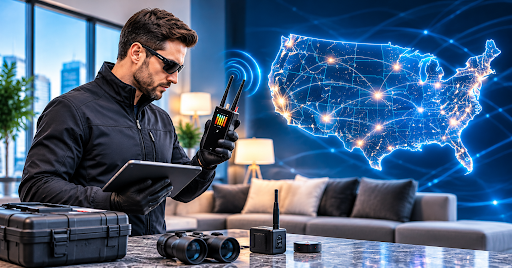
Nationwide bug sweep services send a trained TSCM (Technical Surveillance Countermeasures) team to your home, office, vehicle, hotel room, boat or aircraft anywhere in the US. The team uses RF spectrum analysis, non-linear junction detection, thermal imaging, phone line testing and a hands-on physical search to find hidden microphones, cameras, GPS trackers and wiretaps. You get a confidential report of what was found, and what to do next.
You don’t get to choose where someone decides to spy on you. It might be the house you’ve lived in for fifteen years, a rented office in another state, the car you drive every day, or a hotel suite booked for a two-day negotiation. And the uncomfortable truth is that the best surveillance-detection expert is rarely the one who happens to be closest.
That’s exactly why nationwide bug sweep services exist. Instead of settling for whoever is in your zip code — or worse, a $40 “bug detector” from an online marketplace — you bring in an experienced TSCM team that travels to you, with professional equipment and a proven process.
Here’s how that actually works, what gets checked, and how to tell if you need one.
What “Nationwide Bug Sweep Services” Really Means
A bug sweep (the industry term is TSCM) is a methodical search for electronic eavesdropping devices. Think hidden audio recorders, transmitters, covert cameras, compromised phone lines, rogue Wi-Fi devices and GPS trackers.
Nationwide simply means the team isn’t limited to one city. At HAM Investigations, we’re based in Knoxville, Tennessee, but our specialists travel across the country to wherever the problem is. One week it’s a corporate boardroom in Texas. The next, a family home in Ohio or a yacht docked in Florida.
Why does that matter? Because TSCM is a niche skill. Plenty of private investigators offer “debugging” as a side service, yet very few have the equipment, training and repetition that real sweeps require. Going nationwide lets you hire for expertise instead of geography. You can see where we regularly work on our bug sweep services coverage area page.
How a Professional TSCM Team Protects You — Step by Step
Every job is different, but a professional sweep follows a clear sequence. Here’s roughly what to expect.
1. A discreet first contact
This part matters more than people realize. If someone is listening, calling from the suspect phone — or talking about the sweep inside the suspect room — can tip them off. We’ll ask you to reach out from a phone and a location you trust. Our consultation is free.
2. Scoping the job
We’ll ask a few practical questions. What’s the property? How many rooms, vehicles or phone lines? Why do you suspect surveillance — did someone know something they shouldn’t? That conversation shapes the plan, the equipment we bring and how long the sweep will take.
3. Arrival and a low-profile setup
Our team shows up quietly. No marked vans, no announcements. Where possible, we schedule the visit so it doesn’t break your normal routine (a sudden change in behavior can alert whoever planted a device).
4. The sweep itself
This is the technical core of the job, and it’s layered on purpose. No single tool catches everything, so a real sweep combines several methods:
- RF spectrum analysis to find devices that transmit audio, video or data over radio frequencies, including cellular bugs that call out on their own.
- Non-linear junction detection (NLJD) to locate hidden electronics even when they’re switched off or only record locally.
- Thermal imaging to spot the heat signature of powered devices tucked inside walls, smoke detectors, chargers or furniture.
- Telephone and network analysis for landlines, VoIP systems, PoE devices, fax machines and copiers — all common wiretap points.
- Wi-Fi and Bluetooth inspection to identify unknown devices hiding on your network.
- A thorough physical search. Honestly, this is where a lot of devices turn up — inside outlets, behind vents, under desks, in décor. Experience counts here more than gadgets do.
You can learn more about the tools behind this on our eavesdropping detection equipment page.
5. Findings and next steps
If we find something, we document it carefully — photos, location, device type — and advise you on how to proceed. Sometimes that means leaving a device in place while you talk to an attorney or law enforcement. If the space is clean, you’ll know that too. Either way, you walk away with answers instead of guesswork.
Where We Sweep: Homes, Businesses, Vehicles and Beyond
Surveillance isn’t only a corporate problem. A large share of our calls come from private individuals — people going through divorces, custody disputes, stalking situations or business partnerships gone sour.
Here are the most common settings we handle across the US:
- Homes and apartments – Living rooms, bedrooms, home offices. See our hidden camera sweeps for houses and apartment bug sweeps.
- Offices and boardrooms – Executive suites, conference rooms and meeting spaces where confidential decisions get made. Our business bug sweeps are built for this.
- Vehicles – Both live (real-time) and passive (logging) GPS trackers. Our GPS tracker bug sweep covers cars, trucks and fleet vehicles.
- Hotel rooms and rentals – Especially for traveling executives and high-profile guests. Learn about hotel room bug sweeps.
- Yachts and aircraft – Private spaces that move, and often carry very sensitive conversations. We handle yacht bug sweeps and aircraft bug sweeps.
- Schools, locker rooms and restrooms – Hidden cameras in private spaces are a serious and growing concern for institutions.
Why a Professional Sweep Beats a DIY Bug Detector
We get this question a lot. Can’t you just buy a detector and check for yourself?
You can. But it probably won’t tell you much. Most consumer detectors only pick up active radio transmissions, so they’ll miss devices that record locally, transmit in short bursts or sit idle until triggered. They also go off constantly near ordinary electronics — routers, phones, smart TVs — which leaves you more anxious than when you started.
There’s another risk people don’t think about. If you poke around and find a device, then pull it out, you may destroy evidence or alert the person who installed it. A professional team knows how to handle that moment properly.
So the real value isn’t just the equipment. It’s the process, the judgment and the experience of having done hundreds of these.
Signs You May Need a Bug Sweep
There’s rarely one smoking gun. More often it’s a pattern that just feels wrong. Pay attention if:
- Someone knows details of private conversations they had no way of hearing
- Business competitors seem to anticipate your bids, plans or pricing
- You notice new or unfamiliar objects — chargers, clocks, smoke detectors, USB adapters
- Wall plates, ceiling tiles or vents look disturbed, or there’s fine dust on the floor
- Your phone line has odd clicks, static or volume changes
- An ex-partner, former employee or contractor had unsupervised access to your space
- Someone seems to know where your car has been
One of these alone doesn’t prove anything. Two or three together? That’s worth a call.
What to Do (and Avoid) Before Your Sweep
If you suspect you’re being monitored, a few simple habits protect both you and the investigation:
- Don’t discuss your suspicions in the suspect space. Talk outside, or somewhere you trust.
- Use a different phone to contact a TSCM professional.
- Don’t remove or tamper with anything you think might be a device.
- Keep your routine normal. Sudden changes can alert whoever is listening.
- Limit who knows about the sweep — ideally, almost nobody.
Licensing and Credentials Matter
Not every state regulates TSCM work the same way. North Carolina, for example, requires a specific license to perform electronic countermeasures, and HAM Investigations holds that license. Wherever you are, ask any provider about their licensing, insurance and experience before you let them into your home or business. A legitimate team will answer without hesitation.
You can review our professional affiliations and read what past clients say on our testimonials page.
Frequently Asked Questions
Do you really travel anywhere in the US for bug sweeps?
Yes. HAM Investigations is based in Knoxville, Tennessee, and provides nationwide bug sweep services. Our TSCM team travels to homes, offices, vehicles, hotels, yachts and aircraft across the country.
How long does a professional bug sweep take?
It depends on the size and complexity of the space. A single vehicle or small apartment may take a couple of hours, while a large home or multi-room office can take most of a day. We’ll give you a realistic estimate during your free consultation.
What kinds of devices can a TSCM sweep find?
A professional TSCM sweep can detect hidden audio bugs, covert cameras, GPS trackers, cellular listening devices, telephone wiretaps and unauthorized Wi-Fi or Bluetooth devices. Layered methods mean even devices that are switched off or recording locally can be located.
Can a phone app detect hidden bugs?
Not reliably. Phone apps and cheap detectors miss many devices, especially ones that don’t constantly transmit, and they produce frequent false alarms. A professional sweep uses specialized equipment and a hands-on physical search.
What happens if you find a listening device?
We document the device, its location and type, and advise you on next steps. Often that involves preserving it as evidence for your attorney or law enforcement rather than simply removing it.
Is a bug sweep confidential?
Yes. Discretion is part of the job. We arrive low-profile, keep details private and share findings only with you.
Peace of Mind Shouldn’t Depend on Your Zip Code
Whether you’re in a small town or a major city, you deserve the same level of protection. If something feels off — in your home, your office or your car — trust that instinct and get it checked properly.
Call HAM Investigations toll-free at (888) 386-6482 from a phone you trust, or contact us here for a free, confidential consultation.
