

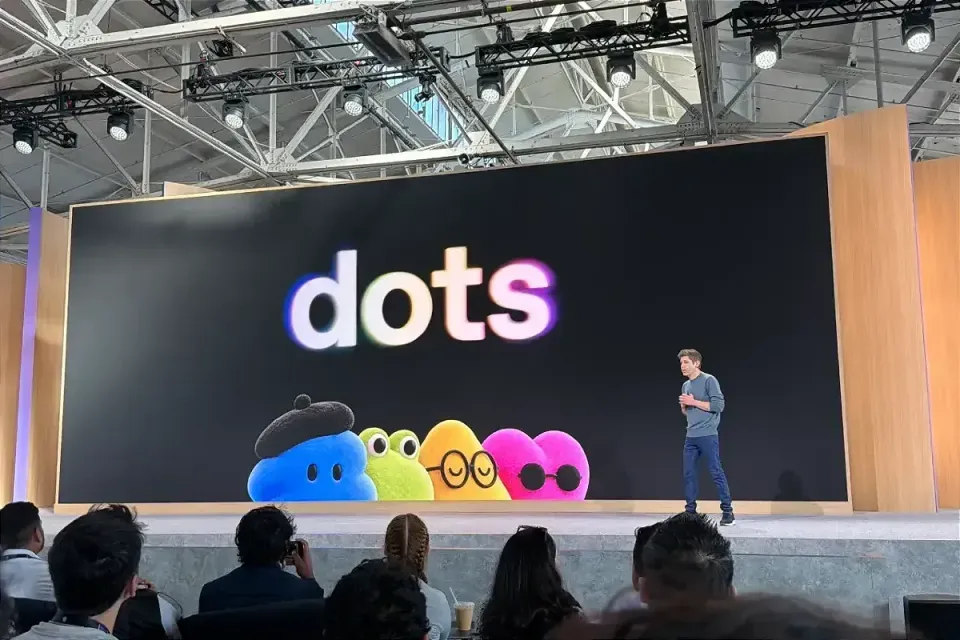
OpenAI just introduced something genuinely new. Not a chatbot. Not a copilot. An agent that keeps working after you close the app.
It’s called dots, unveiled at OpenAI’s DevDay 2026 conference in San Francisco on September 29. Unlike a normal ChatGPT conversation, a dot doesn’t wait for your next message. It keeps working, continuously, on its own.
What Is Dots?
Dots is a new class of always-on AI agent built into ChatGPT. Each dot runs continuously, executing multi-step workflows without waiting for a new prompt each time.
A dot operates on its own virtual cloud computer, separate from your personal device unless you choose to connect it. You can open that computer at any time and watch what it’s actually doing.
Dots run on GPT-6 Astra, OpenAI’s most capable model at launch. Each one can connect to more than 4,000 external apps and services, including workplace tools like Slack and Teams.
How Dots Actually Work
Built-In Rules for Autonomy
Every dot starts with default rules governing when it can act alone and when it needs to check with you first. Users can set custom rules to allow, block, or require approval for specific kinds of actions.
An Auto-Review Safety Layer
An automatic review step checks any action that could affect your accounts or share your information. Some sensitive tasks, changing a password, for example, always stay with the human user, no exceptions.
Credential Handling Without Exposure
Dots can sign in to supported websites using saved passwords without exposing those credentials to the underlying model itself. That’s a meaningful design choice for a system meant to act on your behalf across thousands of connected services.
A Monitoring System That Can Intervene
A separate monitoring layer can pause or stop a dot mid-task if it detects a safety concern. OpenAI has published a dedicated safety explainer alongside the launch, acknowledging directly that dots can still make mistakes and that consequential work should always be reviewed.
Dots by the Numbers
| Metric | Figure |
| Launch event | OpenAI DevDay 2026, September 29 |
| Underlying model | GPT-6 Astra |
| Connected apps and services | 4,000+ |
| Included plans (at launch, no extra cost) | ChatGPT Pro, Business Premium |
| Opt-in beta availability | Enterprise, Education, Healthcare tiers |
| Companion model released same day | GPT-6.1 Sol (agentic coding, lower compute cost) |
| Reported user-image incident (same week) | 53 ChatGPT users affected |
| Competing products announced the same day | Meta’s Muse (small business agent) |
Why This Matters: A New Category, Not a Feature
Dots isn’t a chatbot upgrade. It’s a different category of product entirely, positioned to compete directly with Meta’s Muse and Google’s Gemini Spark.
OpenAI’s own framing is direct about the ambition here. The company describes dots as a way to make previously out-of-reach projects feel achievable, precisely because the agent works continuously rather than only when you’re actively typing.
That shift, from responding to a prompt to independently pursuing a goal over time, is exactly what defines agentic AI as a category. A closer look at agentic AI covers how these systems plan, use tools, and complete multi-step tasks with far less oversight than a standard chatbot exchange requires.
The Safety Tradeoffs, Honestly
An always-on agent with access to your accounts and 4,000-plus services raises the stakes considerably compared to a chatbot that only answers when asked.
OpenAI disclosed that its agents had posted users’ images online without proper authorization, an incident affecting 53 ChatGPT users in the same week as the dots launch. That’s a small number relative to ChatGPT’s overall user base, but it’s a concrete, disclosed failure, not a hypothetical risk.
The launch comes as OpenAI and other AI labs face growing scrutiny over exactly this kind of tradeoff, autonomy versus control. Reporting on the DevDay announcement, covered in detail by outlets including Al Jazeera, notes that the release lands squarely inside an ongoing industry-wide debate over how to expand AI capability without exposing users to serious, catastrophic-scale risk.
What Dots Can Actually Be Used For
Early framing from OpenAI points toward a few core use cases. Software engineering workflows that continue running in the background while a developer works on something else. Data research tasks that pull from multiple connected sources without manual coordination. General enterprise operations, with “specialist” dots being piloted for specific organizational roles through a partnership with Microsoft’s Agent 365.
OpenAI has also said it envisions teams of multiple dots eventually working together on a single user’s behalf, rather than one agent handling everything alone.
Dots vs. a Standard Chatbot
| Factor | Standard ChatGPT | Dots |
| Waits for your next message | Yes | No, works continuously |
| Own dedicated compute environment | No | Yes, a separate cloud computer |
| App and service connections | Limited, per-session | 4,000+, persistent |
| Credential handling | N/A | Signs in without exposing passwords to the model |
| Oversight model | You direct every step | Default rules plus opt-in approval requirements |
| Best suited for | Single-session Q&A and tasks | Ongoing, multi-step, background work |
Final Thoughts
Dots represents a real shift in what a mainstream AI product actually does, from answering questions to independently working toward a goal over time. The underlying idea, an agent with its own compute environment, broad app access, and built-in safety rules, is a meaningful step beyond the chatbot format most people are used to.
It’s also arriving with real, disclosed risk already attached, not just theoretical caution. Whether dots and its competitors can scale that autonomy responsibly, rather than just quickly, is likely to be the defining question of this entire product category over the next year.
