

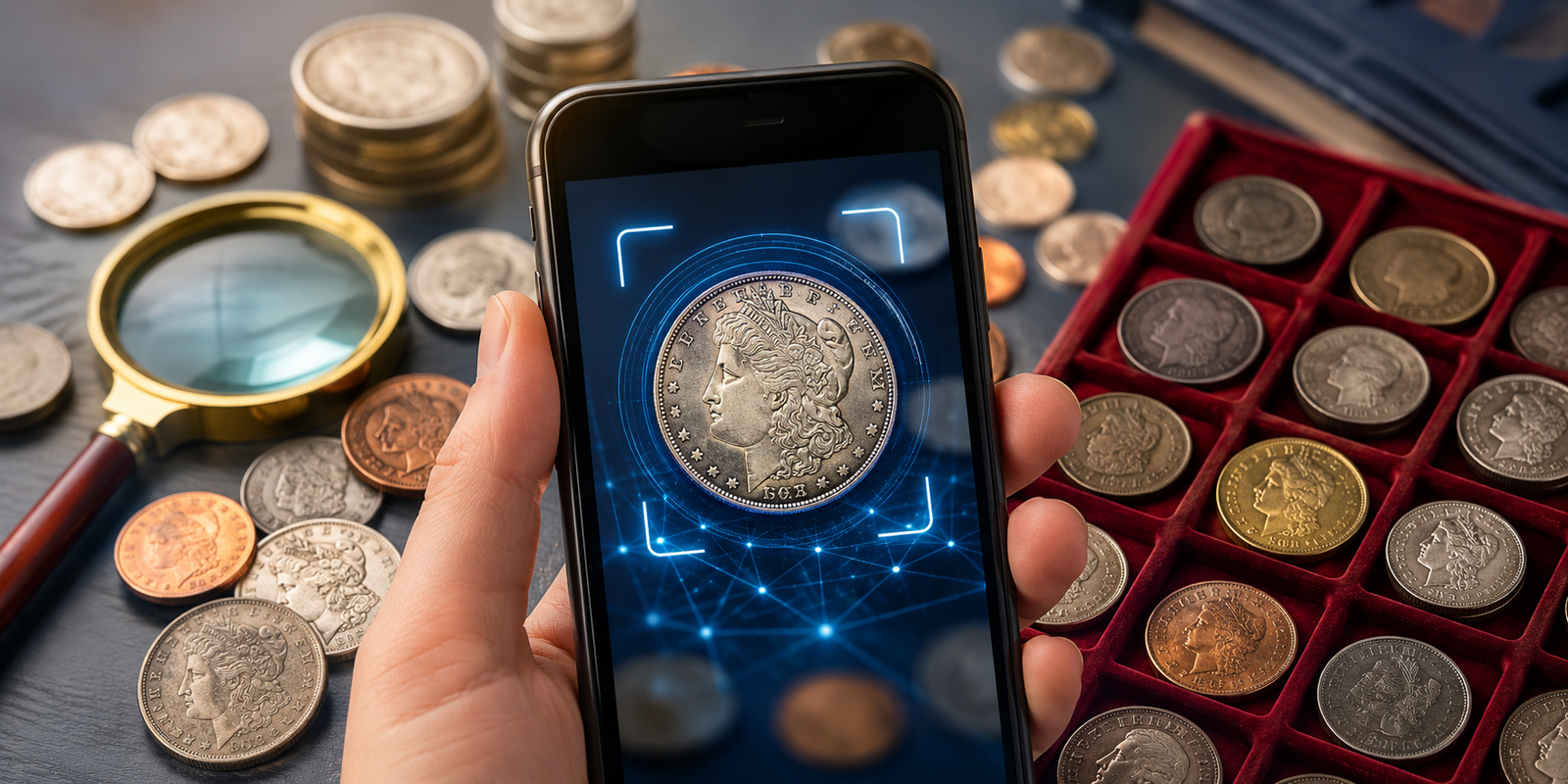
That old coin jar in the back of a closet has never been easier to sort through. Point a smartphone camera at a coin, and AI image recognition. That can now identify what it is, estimate its grade, and pull up. A rough market value in a matter of seconds. No dealer visit, no reference book, no numismatics degree required.
That said, not every “AI coin identifier” app on the market delivers the same accuracy, and some marketing claims in this category are worth taking with a grain of salt.
How AI Coin Identification Actually Works
Most of these apps use computer vision models trained on large image datasets of known coins, comparing a photo you take against that reference database to find the closest match. The better apps also cross-reference details like mint marks, date, metal composition estimates from lighting and color, and visible wear to estimate a grade on the Sheldon Scale, the 1-to-70 system professional graders use.
It’s worth understanding what this technology is, and isn’t. It’s a strong first-pass identification tool. It is not a substitute for professional grading or authentication, especially for coins that might be genuinely rare or valuable. For anything a photo-based app flags as potentially worth real money, a professional grading service like PCGS or NGC is still the right next step before selling.
8 Free AI Coin Identifier Apps
CoinKnow
CoinKnow focuses specifically on identification precision and error detection for U.S. coins, including doubled dies, repunched mint marks, and other varieties that add real value to an otherwise common coin. Its grading estimates are generally reported as tighter than most competitors, landing within a narrow range on the Sheldon Scale rather than a broad guess.
CoinHix (formerly CoinValueChecker)
CoinHix pairs identification with a fuller market intelligence layer: recent auction data, price trend tracking, and alerts when similar coins sell. For collectors who want to actively track a growing collection’s value over time rather than get a one-time identification, this ongoing tracking layer is its main differentiator.
PCGS CoinFacts
PCGS CoinFacts isn’t a photo-identification tool in the same sense as the others; it doesn’t scan a picture and tell you what you’re holding. Instead, it’s a completely free, ad-free reference encyclopedia covering more than 39,000 U.S. coins, with authoritative pricing, population data, and auction records from one of the two major professional grading services. It’s the tool to cross-check a result from an AI scanner app against.
Coinoscope
Coinoscope takes a different, arguably more honest approach than apps that give a single confident answer: it shows a list of visually similar coins for you to compare and choose from yourself, rather than asserting one definitive match. With coverage spanning 300,000-plus coins and 120,000-plus banknotes worldwide, it’s a particularly strong option for international and world coin collectors, a category many U.S.-focused apps handle poorly.
Numii
Numii is primarily built as a collection management app, with photo identification included as a secondary feature rather than the core product. It’s a solid choice if you’re mainly looking to catalog and track a growing collection over time, with identification working reasonably well on common U.S. issues specifically.
Numiis
Numiis leans into the historical and educational side of coin collecting, pairing AI identification with context about the era, political situation, and cultural significance behind a coin’s design. Its database covers close to 30,000 U.S. coins with flexible filtering by year, country, denomination, and mint mark, making it a strong pick for history enthusiasts and educators, not just people chasing resale value.
NGC Coin App
The NGC Coin App works differently from the others on this list: it verifies coins that have already been professionally certified and encapsulated by NGC, rather than identifying an unknown coin from a photo. It’s most useful after you’ve had a coin professionally graded, as a way to confirm and look up certification details, not as a first-pass identification tool.
Coinara
Coinara is a newer entrant that’s tested particularly well on less common categories, including ancient Greek, Roman, and Byzantine coins, where many mainstream apps struggle. Independent testing has shown notably higher accuracy on ancient and world coins compared to competitors more narrowly focused on U.S. issues, though full functionality typically requires a premium subscription rather than staying entirely free.
Coin Identifier Apps Compared
| App | Best For | Fully Free | Notable Strength |
| CoinKnow | U.S. error coin detection | Yes | Tight grading precision |
| CoinHix | Ongoing value tracking | Free tier available | Market trend and auction data |
| PCGS CoinFacts | Reference and cross-checking | Yes, fully free | Authoritative U.S. coin database |
| Coinoscope | International and world coins | Yes | 300,000+ coin database, visual match list |
| Numii | Collection cataloging | Free tier available | Long-term collection tracking |
| Numiis | History and education | Free tier available | Historical context alongside ID |
| NGC Coin App | Verifying certified coins | Yes | Official certification lookup |
| Coinara | Ancient and world coins | Limited free trial | Strong accuracy on non-U.S. coins |
What These Apps Get Right, and Where They Fall Short
AI coin identifier apps genuinely excel at fast, first-pass identification of common coins, U.S. wheat pennies, silver dimes, Morgan dollars, and typical modern circulation coins tend to get identified quickly and accurately across most of these tools. Where they consistently struggle is with obscure varieties, ancient and non-U.S. coins on apps not specifically built for that coverage, and precise value estimates, which are best treated as rough starting points rather than firm numbers.
Independent testing across these apps has shown accuracy rates that vary meaningfully depending on the coin type. Apps built specifically for U.S. coins tend to perform very well on U.S. coins and noticeably worse on international or ancient ones, and vice versa for apps built with broader world coverage. Matching the app to your actual collection matters more than picking whichever one ranks first in a search result.
A Word on “Best App” Rankings
Worth knowing before you dig further: a lot of the “best coin identifier app” content online comes from sites connected to the apps themselves, or from marketing-driven roundups that all crown the same one or two apps as “#1” using nearly identical language. That doesn’t necessarily mean those apps are bad; several genuinely have strong feature sets, but it’s worth treating any single “best overall” claim with some healthy skepticism and picking based on your own collection’s needs rather than a superlative in a headline.
Tips for Getting Accurate Results
A few habits noticeably improve how well these apps perform. Use natural, even lighting rather than direct flash, which can wash out fine details like mint marks and date wear that the AI relies on. Photograph both sides of the coin when the app allows it, since obverse and reverse details both factor into accurate identification. Clean coins only with extreme caution, and generally not at all, since improper cleaning can actually reduce a coin’s value and confuse an app’s wear-based grading estimate. And treat any value estimate as a starting point for research, not a guaranteed sale price, since actual market value depends heavily on real buyer demand and true condition that a photo can’t fully capture.
Final Thoughts
Free AI coin identifier apps have genuinely changed what’s possible for casual collectors and people sorting through an inherited coin jar, turning a process that once required a dealer visit or a reference book into a 10-second smartphone scan. The right app for you depends heavily on what you’re actually working with. In U.S.-focused error detection, international coverage, historical context, or simple long-term collection tracking. All point toward different tools on this list.
Whichever app you pick, treat its output the way you’d treat any AI-generated first draft. A genuinely useful starting point, not the final word, especially in the moment. That scan suggests you might be holding something actually valuable.
