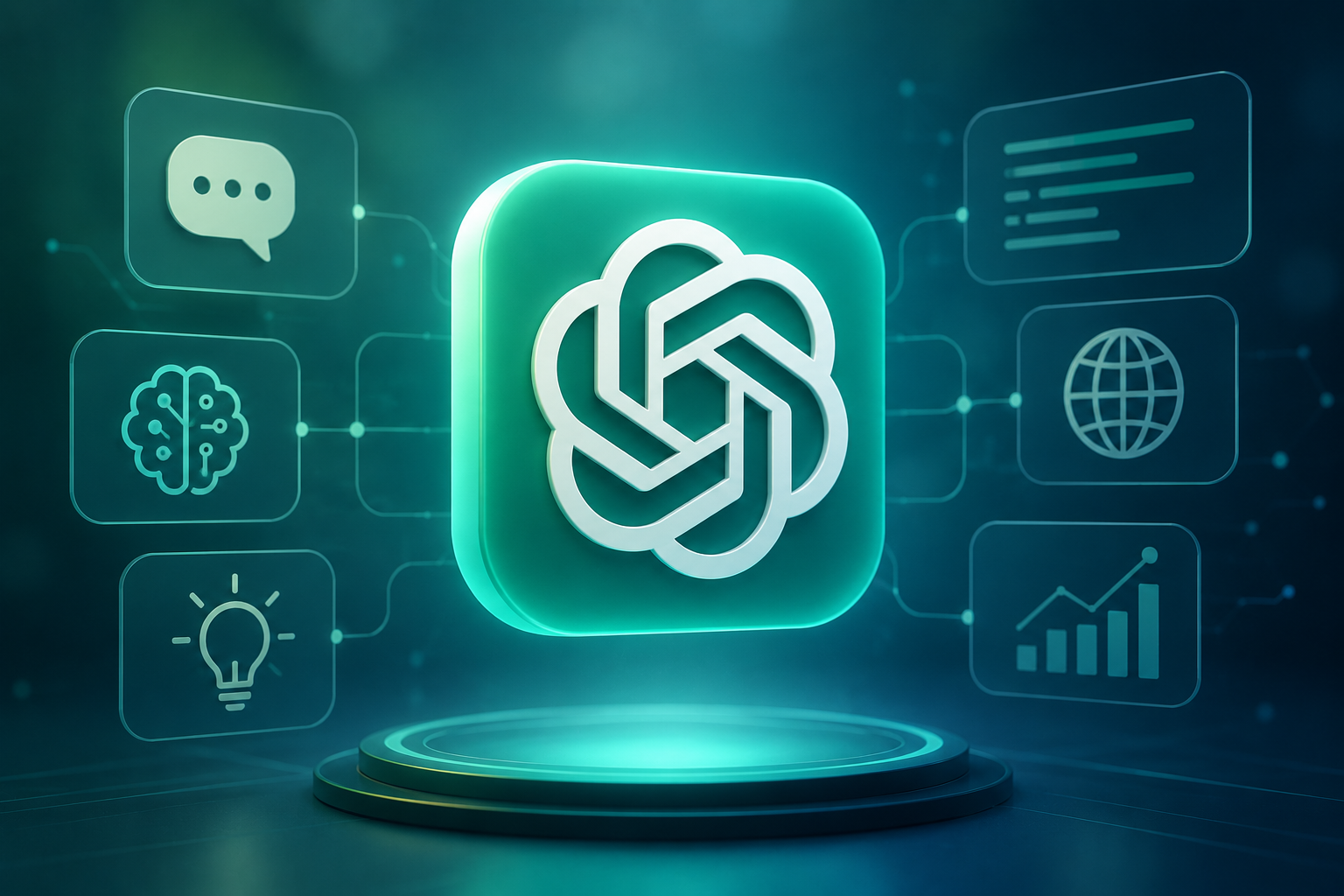
ChatGPT is the tool most people mean when they say “AI chatbot.” It’s a generative AI system built by OpenAI that can hold a conversation, write and summarise text, answer questions, and increasingly handle multi-step tasks, and it’s now embedded in the daily workflow of millions of businesses worldwide, including a growing number in the UK.
What Is ChatGPT?
ChatGPT is a generative AI chatbot develop by OpenAI, built on the company’s GPT family of large language models. It uses natural language processing to hold humanlike conversations and generate content such as articles, summaries, emails, code, and more based on a text prompt you give it.
Since its public launch in late 2022, ChatGPT has become one of the most widely used consumer AI products in the world, and its success helped kick off the broader AI boom, prompting rival products such as Google’s Gemini and Anthropic’s Claude. OpenAI itself was found by Sam Altman, Greg Brockman, and a group of co-founders that originally included Elon Musk, and the company has taken on billions of dollars in investment from Microsoft since 2019, largely in the form of Azure cloud computing credits.
How Does ChatGPT Work?
ChatGPT runs on generative pretrained transformers (GPTs), a type of large language model built on transformer architecture, which is particularly good at tracking context across long pieces of text using a mechanism called self-attention.
In simple terms, ChatGPT generates a response in two stages:
- Understanding the input: Your prompt is converted into a numerical representation (an “embedding”) that captures its meaning and structure.
- Generating a response: The model combines that input with the context of the conversation and predicts the most likely, relevant response, based on patterns it learned during training.
The model was trained on enormous volumes of text pulled from internet articles, forum posts, books, and websites using a mix of unsupervised learning and reinforcement learning from human feedback (RLHF), where human reviewers rank responses to help fine-tune the model’s behaviour. That training is also why user feedback (the thumbs-up and thumbs-down buttons, and custom instructions you give it) can shape how ChatGPT responds to you over time.
Since 2022, the underlying models have moved through several generations. As of 2026, OpenAI’s newest models power the paid tiers, with free and entry-level plans typically running a lighter, faster model and higher tiers unlocking more advanced reasoning, larger context windows, and features like image generation, voice mode, and live web search.
What Can ChatGPT Do for a Business?
This is where it matters most for UK business owners and managers. Common business use cases include:
- Content creation: drafting emails, blog posts, product descriptions, social posts, and marketing copy
- Summarisation: condensing long reports, contracts, or meeting notes into a quick, usable summary
- Research support: with web search enabled, ChatGPT can pull in current information rather than relying solely on its training data
- Business planning: acting as a first-pass business analyst for market research, SWOT analysis, or drafting a business plan
- SEO and content marketing: generating keyword ideas and outlining or drafting supporting content
- E-commerce: writing product descriptions at scale for online stores
- Customer communication: drafting responses, FAQs, and support scripts
- Translation: ChatGPT supports dozens of languages, useful for businesses trading internationally
- Coding support: reviewing code, debugging, and filling in code snippets for technical teams
- Repurposing content: turning one long-form piece (a report, a webinar transcript) into several shorter formats for different channels
Custom GPTs
Since 2023, ChatGPT has support custom GPTs versions of ChatGPT that can be configuer for a specific role, with their own instructions and uploaded reference material. For a business, this means you can build a GPT trained on your own tone of voice, product catalogue, or internal FAQ, rather than re-explaining context in every conversation. Creating custom GPTs is generally reserve for paid subscribers, though free users can typically use ones that have already been shared publicly.
ChatGPT Pricing in the UK
ChatGPT’s pricing has expanded considerably since launch. OpenAI now runs several tiers, priced in USD as a base rate, with UK customers typically billed in GBP with 20% VAT added at checkout. Below is a general guide; always confirm current pricing at checkout, since rates and VAT treatment can shift.
| Plan | Typical UK Price | Best For |
| Free | £0 | Casual or occasional use, testing the tool |
| Go | ~£6–8/month | Light regular use on a budget; may include ads |
| Plus | ~£16–20/month | Individual professionals using it daily |
| Pro (lower tier) | ~£80–100/month | Heavy individual users hitting Plus limits |
| Pro (higher tier) | ~£160–200/month | Power users running intensive research or coding work |
| Business | ~£16–25/user/month | Teams needing a shared workspace and admin controls |
| Enterprise | Custom quote | Larger organisations needing SSO, compliance, and data residency controls |
A few things worth knowing before you budget for it:
- VAT-registered UK businesses can typically reclaim the VAT charged on a subscription, so it’s worth keeping the invoice from your billing portal.
- Business plans require a minimum of two users and include a shared workspace, admin console, and, importantly for many companies, a guarantee that your organisation’s data isn’t used to train OpenAI’s models by default.
- Enterprise pricing is negotiated directly with OpenAI’s sales team and is generally aimed at larger organisations, so smaller UK businesses will usually land on Plus or Business.
Is ChatGPT Free to Use?
Yes there’s a genuinely usable free tier, which is a sensible place to start if you’re evaluating whether ChatGPT fits your workflow before committing to a paid plan. The free tier gives you a lighter model with usage limits, basic image generation, and limited voice mode and file uploads. Paid tiers unlock more advanced reasoning models, higher usage limits, and business-specific features like admin controls and data-training exclusions.
The Limitations of ChatGPT
For all its usefulness, ChatGPT has real limitations that matter in a business context:
- Accuracy isn’t guaranteed: ChatGPT doesn’t automatically cite sources, and even when prompted to, those sources aren’t independently verified. Any factual claim, statistic, or figure it produces should be checked before it goes into a client-facing document or a business decision.
- Hallucinations happen: Like all generative AI tools, ChatGPT can produce confident-sounding answers that simply aren’t true, because it’s predicting plausible text rather than retrieving verified facts.
- It isn’t a substitute for professional advice: For legal, financial, medical, or other high-stakes matters, ChatGPT’s output should be treated as a starting point, not a final answer.
- Reliability can vary: Some users have reported inconsistent performance over time, and OpenAI’s usage limits and model access change fairly frequently across tiers — so it’s worth periodically checking that your plan still matches your needs.
- It reflects the biases in its training data: Because it’s trained on human-generated content, ChatGPT can reproduce the same kinds of reasoning errors and biases people do, particularly on subjective or judgement-based tasks.
Data Privacy and Business Use
For any UK business considering ChatGPT beyond casual, individual use, data handling is worth understanding upfront. On the free and consumer plans, input data can, with some exceptions, be use to help train OpenAI’s models, so sensitive business or client information shouldn’t be enter into those tiers. ChatGPT Business and Enterprise plans, by contrast, exclude your organisation’s data from model training by default and add admin-level controls, which is generally the more appropriate route once ChatGPT moves from personal experimentation into an actual business workflow involving client or company data.
If your business operates under specific data protection or compliance obligations, it’s worth reviewing OpenAI’s current data processing terms directly before rolling ChatGPT out to a team.
Getting Start: A Simple Approach for Businesses
- Start on the free tier to test whether ChatGPT fits how your team actually works.
- Identify one or two repetitive tasks: drafting emails, summarising reports, first-pass content rather than trying to overhaul every process at once.
- Upgrade to Plus or Business: once you have a clear, recurring use case that justifies the cost.
- Set basic ground rules for staff: what information shouldn’t be enter into prompts, and how outputs should be check before use.
- Review usage periodically: since OpenAI updates pricing, models, and features fairly often.
Conclusion
ChatGPT has moved well beyond novelty status and into genuine daily use across UK businesses for drafting, summarising, researching, and speeding up the kind of repetitive writing and thinking tasks that eat into a working day. It isn’t a replacement for expert judgement, and its answers need checking rather than blind trust, but used deliberately with a clear use case and sensible data-handling rules, it’s one of the more practical AI tools a business can adopt today.
If you’re weighing it up, the free tier costs nothing to try. Test it on a real task this week, and let that decide whether a paid plan is worth it for your business.
