

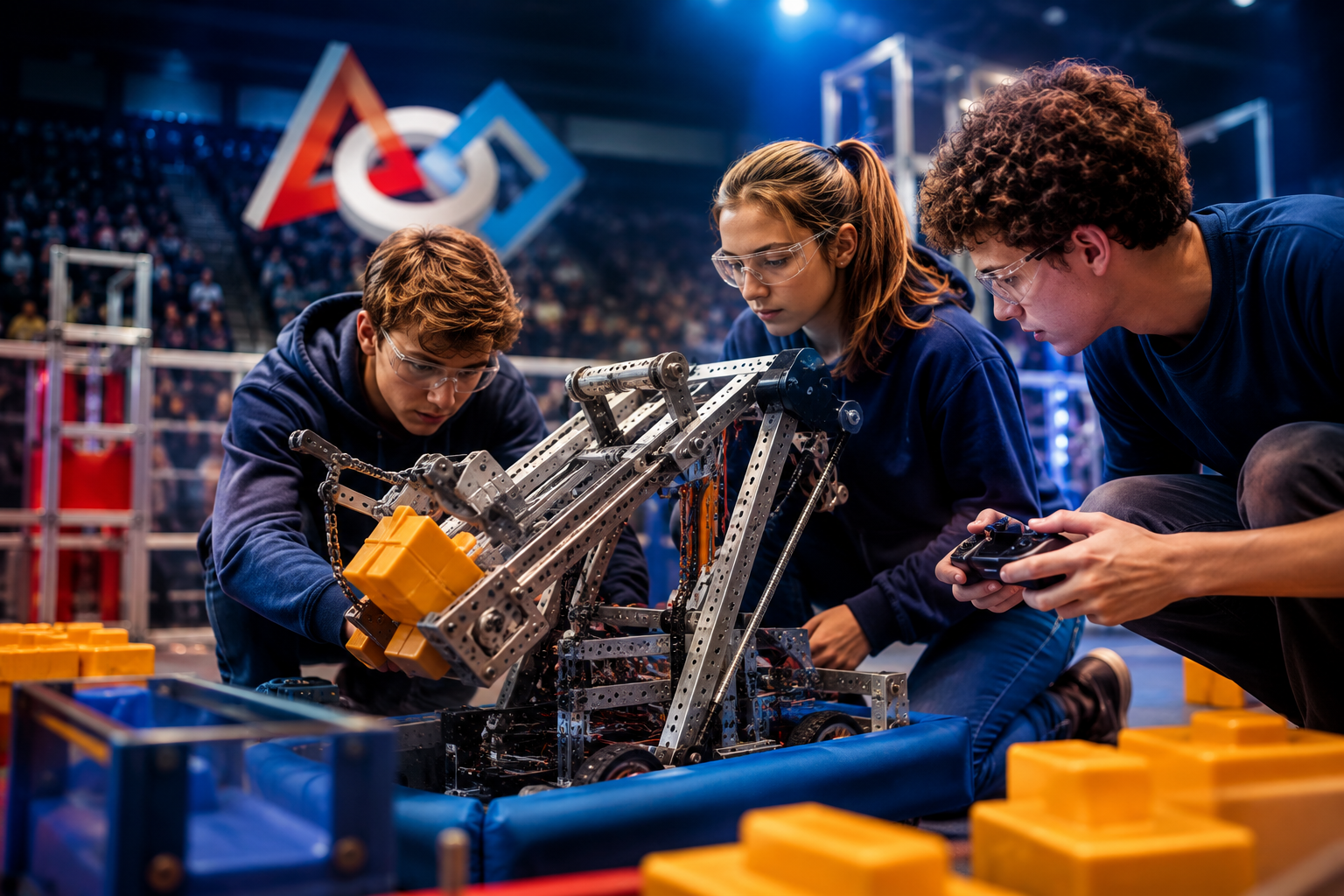
Picture a hockey arena packed with teenagers, but instead of skates and sticks. They are wheeling out industrial-sized robots they designed, built, and programmed themselves in just six weeks. That’s the scene every spring at the Maverik Center in West Valley City. Where Utah’s FIRST Robotics Regional brings together dozens of high school teams from across the state. They compete for one of the most intense, rewarding STEM competitions a teenager can take part in.
FIRST Robotics Competition, or FRC, is the flagship program of FIRST. An international nonprofit that’s grown into one of the largest youth STEM movements in the world. In 2026 alone, 3,724 teams from 30 countries and regions took part, and Utah’s own regional competition. That has become a genuine hub for the state’s most driven young engineers, coders, and builders.
What Is FIRST Robotics Competition?
FIRST Robotics Competition is an international high school robotics competition. Where teams of students, working alongside coaches and adult mentors, design and build a full-sized robot to compete in a new, specially designed game each year. Every January, teams receive a Kit of Parts and a game reveal at Kickoff. Then have roughly six weeks to design, build, program, and test a robot before competition season begins.
The program was founded by inventor Dean Kamen and engineering professor Woodie Flowers, and it runs on two core values baked into every event: Gracious Professionalism, meaning empathy, help, and respect toward other teams, and Coopertition, the idea that teams can compete hard on the field while still genuinely helping each other succeed. It’s a deliberately different culture from most competitive sports, one built around the belief that collaboration and competition aren’t opposites.
FIRST Robotics by the Numbers (2026 Season)
| Metric | Figure |
| Total FRC teams worldwide (2026) | 3,724 |
| Countries and regions represented | 30 |
| Total regional competitions | 56 |
| Total district events | 144 |
| Season game | REBUILT, presented by Haas |
| Championship location | George R. Brown Convention Center, Houston |
| Utah Regional 2026 dates | April 16–18, 2026 |
| Utah Regional 2026 venue | Maverik Center, West Valley City |
| Teams competing at Utah Regional 2026 | 42 |
Inside the Utah Regional
The Utah Regional is one of the state’s marquee FIRST Robotics events, drawing teams from across Utah and neighboring states to compete over three intense days. The 2026 event, held April 16 through 18 at the Maverik Center, brought together 42 teams for a full slate of qualification matches, alliance selection, and playoff rounds, all built around that year’s game, REBUILT, a challenge themed around archaeology as part of FIRST’s broader “FIRST Age” season.
Teams competing at the Utah Regional in 2026 came from a genuinely wide geographic spread, including Utah-based squads like Red Pebble Rebels and Red Rock Robotics from Salt Lake City, Rooks and Ravens from Sandy, and Amperes from Salt Lake City, alongside out-of-state teams from Idaho, Colorado, Hawaii, and Pennsylvania. That regional draw is fairly typical of FRC events, since teams often travel to whichever regional fits their season schedule, not strictly the one closest to home.
What Utah Students Actually Build and Learn
Real Engineering, Under Real Time Pressure
Teams start each season with a Kit of Parts and roughly six weeks to design, build, and test a competition-ready robot, a build cycle that closely mirrors the time and resource pressure of a real engineering project, just compressed into a school semester.
A Genuinely Cross-Disciplinary Challenge
Building a competitive FRC robot touches mechanical design, electrical systems, and software all at once. Students end up learning CAD design, fabrication, wiring, sensor integration, and robot programming, the same blend of skills covered in more depth in a broader breakdown of what robotics engineering as a career path actually requires, and a useful early preview of that career for any Utah student considering it.
Business Skills, Not Just Engineering
FRC teams don’t just build robots; they run something closer to a small organization. Teams raise funds, manage budgets, handle outreach and sponsorships, and often run their own marketing and social media, giving students exposure to skills well outside a typical engineering classroom.
Mentorship From Real Engineers
Utah’s FRC teams are frequently supported by mentors working in the state’s genuinely strong tech and aerospace sector, professional engineers who volunteer their time to guide students through real-world design and problem-solving challenges, a mentorship model that gives students a rare, direct look into engineering careers before they’ve even finished high school.
Why FIRST Robotics Matters for Utah’s STEM Pipeline
Utah has built a genuinely strong technology and aerospace industry presence, and FIRST Robotics functions as one of the clearest on-ramps connecting local students to that pipeline early. The skills built through FRC- hands-on robotics programming, mechanical design, and iterative engineering under real deadline pressure- map directly onto the fast-growing robotics and automation job market described in a broader look at how robotics is changing the world, where demand for exactly this kind of cross-disciplinary technical skill continues to climb.
FIRST’s own research consistently shows that participation drives measurable outcomes. Students involved in FRC report higher interest in pursuing STEM degrees and careers. And many go on to study engineering, computer science, or related fields in college. Some crediting their FRC experience directly with that decision.
How to Get Involved With FIRST Robotics in Utah
- For students: interested in joining a team, the most direct path is checking whether your high school already sponsors an FRC team, and if not, reaching out to a nearby team directly, since many welcome students from schools without their own program.
- For parents and mentors: most Utah teams are actively looking for adult volunteers, particularly those with engineering. These include machining, programming, or business backgrounds, to help guide students through the build season.
- For schools without an existing program: starting a new FRC team typically involves securing a faculty sponsor, finding initial funding through local sponsorships or grants. That includes connecting with FIRST’s regional network for startup guidance and mentorship.
- For anyone wanting to simply watch: Utah Regional events are open to the public and offer a genuinely exciting. These high-energy events look at what competitive youth robotics actually looks like in person.
Final Thoughts
FIRST Robotics in Utah has grown into a genuine engine for the state’s next generation of engineers. That gives high schoolers a hands-on, deadline-driven crash course in exactly. The kind of cross-disciplinary Technical work that defines modern robotics careers. The Utah Regional’s mix of local and out-of-state teams, strong industry mentorship. A culture built around Gracious Professionalism and Coopertition makes it one of the more distinctive. And rewarding STEM programs a Utah student can take part in.
Whether you’re a student looking to build your first robot. A parent wondering how to get a team started at your school, or simply someone curious enough. To watch a regional in person, FIRST Robotics in Utah offers a rare, front-row seat to the future of engineering. That is built entirely by teenagers with six weeks and a kit of parts.
