

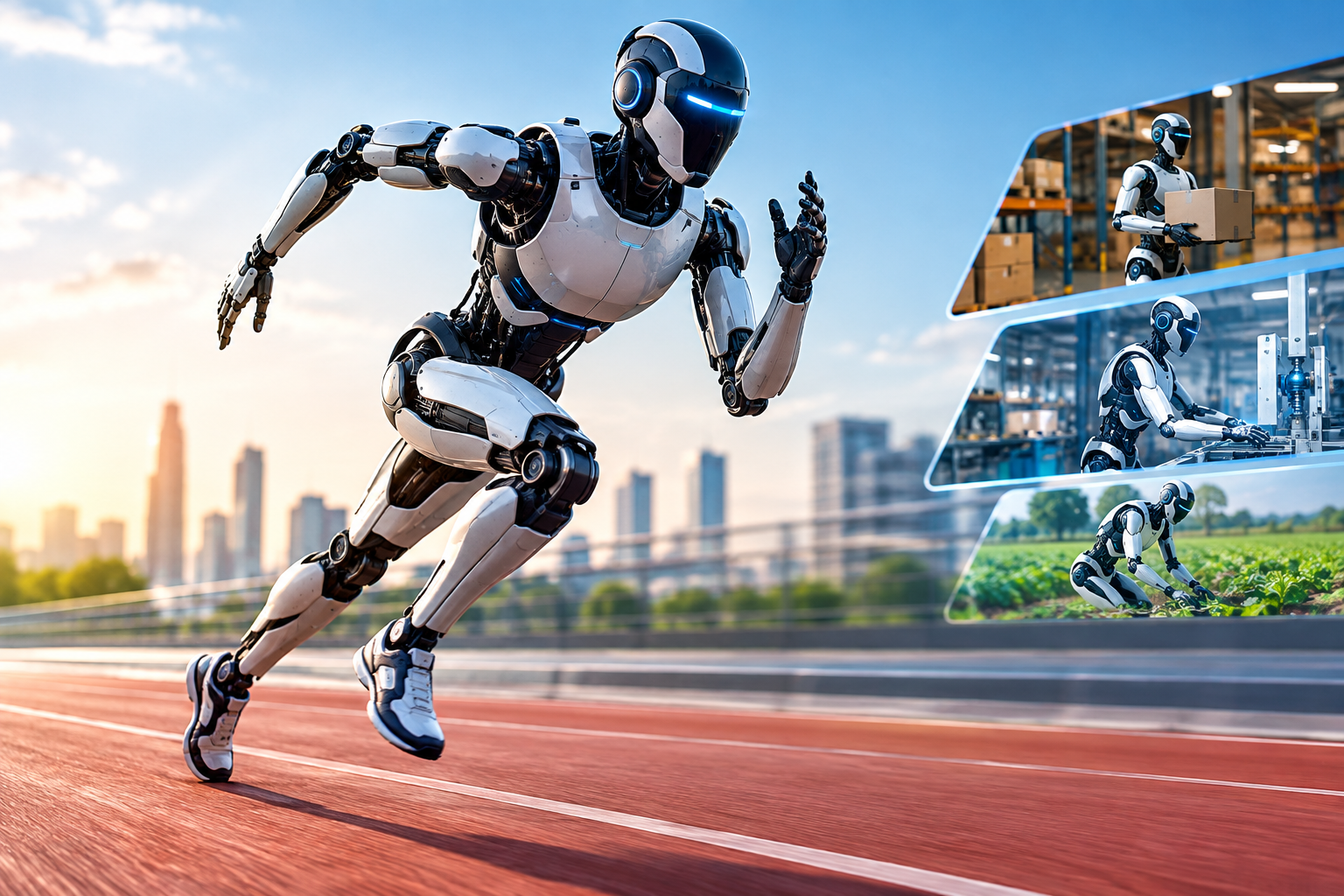
A humanoid robot just ran 100 metres in 8.64 seconds. That’s almost a second faster than Usain Bolt’s human world record of 9.58 seconds.
Twelve months earlier, the same model needed 21.5 seconds. That’s a 60% improvement in about a year.
It’s a remarkable result. It’s also a misleading one, if you use it to judge how close robots are to doing real work.
What Happened in Beijing
Tiangong Ultra, built by the Beijing Humanoid Robot Innovation Centre, set the record at the World Humanoid Robot Games. The run made for perfect viral footage.
One detail at the finish line got far less attention. Some robots accelerated brilliantly but stopped badly. A few hit padded barriers. Others fell after crossing the line and had to be carried away.
That doesn’t diminish the engineering. It does show a gap between what’s easy to demonstrate and what’s actually hard.
Why Speed Is the Easy Benchmark
Running has a start line, a finish line, and a stopwatch. Everyone understands that nine seconds beats twenty.
Investors, researchers, and governments all need simple ways to judge progress. Simple, comparable benchmarks win that competition every time.
The problem is that what we measure shapes what we build. Speed makes a great headline. It says very little about whether a robot can be useful.
The Real Challenge: Interacting With the World
Moving through space is one problem. Working on the physical world is a much harder one.
Take sanding. The robot has to do far more than drag a tool across a surface.
It needs to apply the right pressure. That needs to sense how the material responds. It needs to adjust as the abrasive wears down. And it can’t damage the part while doing all of that.
The same challenge shows up in grinding, polishing, drilling, and assembly. Once a robot pushes against or cuts into a real material, the world gets unpredictable fast.
Why Locomotion Advanced So Quickly
Walking and running have improved fast for a simple reason. They’re easy to practise in simulation.
Robots can rehearse a movement millions of times in a virtual environment. Engineers then transfer that skill to a physical machine. We’ve become very good at modelling rigid bodies moving through free space.
Contact is different. Simulation struggles to capture what happens when a tool meets a real surface.
Why Contact Is So Hard to Learn
A few examples show the problem clearly.
Two aluminium parts that look identical can behave differently. Geometry and surface condition change the result. Aluminium reacts differently than carbon fibre. Tools wear down as they work. Surfaces heat up. Vibration shifts mid-task.
A robot doing this work well needs more than vision. It needs to understand what happens when it applies force.
That understanding requires real physical data. The robot needs experience with different materials, tools, and forces. It also needs feedback on whether each result was good or bad.
The Data Problem
Here’s where the case for general-purpose humanoids gets interesting. Deploy large numbers of capable robots in the real world, and they could collect huge amounts of data. Scale has already transformed other areas of AI.
But the type of data matters as much as the amount. A million hours spent learning to walk and balance makes a robot excellent at locomotion. It teaches nothing about how an abrasive behaves on aluminium versus a composite.
Those lessons only come from doing the actual work.
Speed vs. Useful Work: A Quick Comparison
| Factor | Speed Benchmark | Real-Work Benchmark |
| Example | 100-metre sprint | Sanding, grinding, assembly |
| Easy to measure? | Yes, one stopwatch | No, many variables |
| Can simulation train it? | Largely yes | Only partly |
| Data needed | Movement and balance | Contact, force, material response |
| Makes a viral video? | Yes | Rarely |
| Predicts real usefulness? | Weakly | Strongly |
By the Numbers
| Metric | Figure |
| Tiangong Ultra’s 100-metre time | 8.64 seconds |
| Same model’s time the year before | 21.5 seconds |
| Improvement in about one year | ~60% |
| Human world record (Usain Bolt) | 9.58 seconds |
| Gap between the robot and the record | ~0.94 seconds |
What Better Benchmarks Would Look Like
A stopwatch can’t measure the abilities that matter most. A few better questions would help.
Can the robot notice that a material behaves differently today, and adjust? Is it detect a worn tool before quality drops? Can it meet a part it has never seen and work out how to approach it?
These aren’t world-record abilities. They’re also among the hardest problems in robotics.
Some companies already report progress on this kind of measure. Dyna Robotics, for example, reports a success rate above 99% over 24 hours of continuous operation. It also cites throughput of about 60% of human workers at a strict quality bar.
Agility Robotics tracks something similar in a different way. Its Digit robot has logged more than 65,000 hours inside real customer facilities. Those numbers say far more about usefulness than any sprint time.
Why This Matters for the Industry
The gap between speed and skill shapes where money and research flow. Investors reward what they can compare easily.
That’s why the broader picture in how robotics is changing the world matters. Real adoption follows real work, in warehouses, factories, and hospitals. It doesn’t follow race times.
The same shift is reshaping the skills behind these machines. Force control, sensing, and adaptive learning now sit at the centre of robotics programming. Those are also the skills employers increasingly look for in robotics engineering careers.
The companies competing in this space are covered in more depth in a roundup of top robotics companies. Many now judge themselves on task performance, not spectacle.
Final Thoughts
The Beijing result deserves real celebration. Cutting a 100-metre time from 21.5 to 8.64 seconds in about a year is extraordinary engineering.
But the hardest robotics problems have no stopwatch and no viral clip. They involve force, friction, and materials that behave differently every day.
Robots have become very good at moving through the physical world. What matters next is how well they can work with it.
