

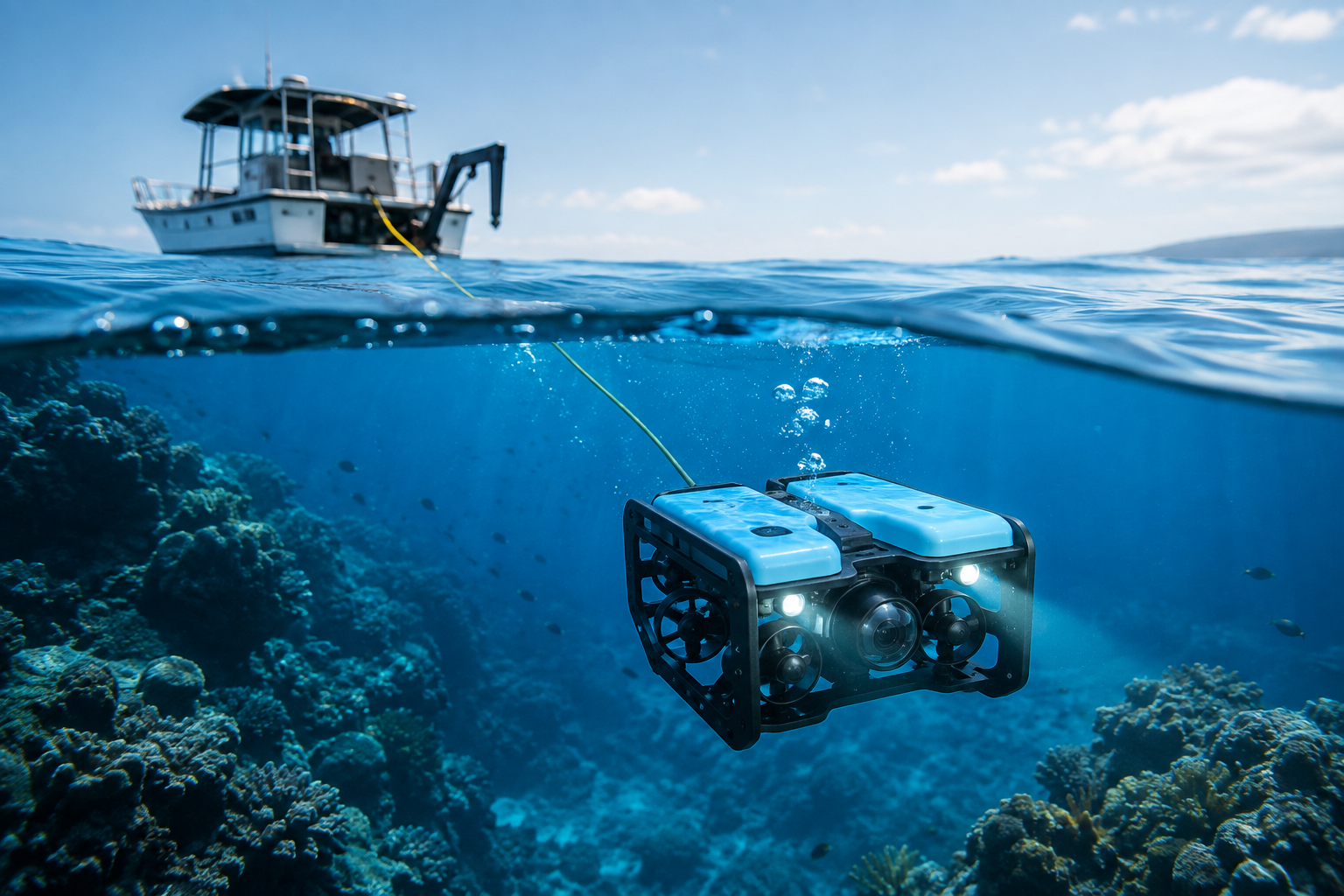
A traditional inspection-class underwater ROV can cost well into six figures. Blue Robotics sells one starting around $4,500. That price gap is the whole story of how this company grew from a garage in Torrance, California, into one of the most widely used names in marine robotics, and it started with an idea that had nothing to do with ROVs at all: a solar-powered surfboard meant to cross from California to Hawaii.
Founder Rustom “Rusty” Jehangir couldn’t find affordable underwater components for that project, so he built his own. That gap became a business. Twelve years later, Blue Robotics ships more than 300 products, generates $5.6 million in annual revenue, and is relocating to a 46,000-square-foot research campus at the Port of Los Angeles.
What Is Blue Robotics?
Blue Robotics is a marine robotics company based in Torrance, California, founded in 2014 by Rustom Jehangir. It designs and manufactures low-cost, high-performance hardware for underwater exploration, including thrusters, sensors, cameras, sonars, and complete remotely operated vehicles, alongside open-source control software.
The company’s mission has stayed consistent since day one: make ocean exploration accessible to people who couldn’t previously afford it. Universities, research institutions, government agencies, commercial inspection companies, hobbyists, and first responders all show up on Blue Robotics’ customer list, a genuinely wide range for a company that started as a single Kickstarter campaign.
From a Garage Kickstarter to a Global Supplier
The T100 Thruster Started It All
Blue Robotics’ first product wasn’t an ROV. It was the T100 Thruster, a low-cost underwater propulsion motor launched through a Kickstarter campaign that raised more than $100,000, well beyond what Jehangir needed to get started. That early customer demand confirmed something important: a real market existed for underwater hardware that didn’t cost a research institution’s entire budget.
Building the Product Line
Since that first thruster, Blue Robotics has steadily expanded into watertight enclosures, cameras, grippers, speed controllers, and sonar systems, each one following the same underlying philosophy of the original thruster: professional-grade capability at a fraction of traditional marine industry pricing.
A New Home at the Port of Los Angeles
In late 2025, Blue Robotics signed a ten-year lease for 46,000 square feet at AltaSea, a research campus built inside the historic docklands at the Port of Los Angeles. The move, with renovations starting in early 2026, will relocate the company’s headquarters and production facility from inland Torrance to direct waterfront access, giving Blue Robotics 2,000 linear feet of water for testing and pilot projects right outside its own door.
The BlueROV2: Blue Robotics’ Flagship Product
Built for Real Underwater Work
The BlueROV2 is a remotely operated underwater vehicle designed for inspection, research, and exploration, rated to depths of 100 meters in its standard acrylic configuration and up to 300 meters with an aluminum enclosure upgrade. It’s controlled through a tether connected to a surface computer or tablet, with the pilot managing everything from camera angle to precise, six-degree-of-freedom movement.
Open-Source by Design
Unlike most commercial ROVs, the BlueROV2 runs on fully open-source software and hardware. It uses ArduSub, part of the broader ArduPilot project, running on a Navigator flight controller paired with an onboard Raspberry Pi 4. That open approach means owners can inspect, extend, and integrate new capabilities without waiting on a vendor’s roadmap, a meaningful difference from the closed, proprietary systems that dominate traditional marine robotics.
Built to Be Assembled, Not Just Bought
The BlueROV2 ships as a partially assembled kit, requiring roughly 6 to 12 hours of assembly. That’s a deliberate design choice, not a shortcoming. Building the vehicle yourself teaches you exactly how every component fits together, knowledge that pays off later when you’re troubleshooting or adding new accessories in the field.
A Genuinely Modular Platform
The BlueROV2’s open frame supports easy integration of grippers, scanning sonar, additional battery enclosures, and scientific instruments. A payload skid extends the frame further for larger equipment, letting research teams customize the same base platform for wildly different missions, from aquaculture inspection to underwater archaeology.
Blue Robotics by the Numbers
| Metric | Detail |
| Founded | 2014, Torrance, California |
| Founder | Rustom “Rusty” Jehangir |
| Initial Kickstarter raised | $100,000+ |
| Annual revenue (2026) | ~$5.6 million |
| Employee count | ~65 |
| Products manufactured | 300+ |
| BlueROV2 starting price | ~$4,500 |
| BlueROV2 standard depth rating | 100 meters (330 ft) |
| BlueROV2 extended depth rating | 300 meters (980 ft) |
| BlueROV2 thruster configuration | Six or eight T200 thrusters |
| BlueROV2 units deployed globally | Several thousand |
| New headquarters | AltaSea, Port of Los Angeles (46,000 sq ft, 10-year lease) |
Who Actually Uses Blue Robotics Equipment
Blue Robotics’ customer base spans a genuinely wide range of underwater work. Research institutions and universities use its ROVs and sensors for marine science and academic robotics research. Commercial inspection companies rely on the BlueROV2 for underwater infrastructure checks that would otherwise require sending a diver into hazardous conditions. Government agencies, including law enforcement like the Los Angeles Police Department, have used Blue Robotics products for underwater search and recovery work. Aquaculture operators use the vehicles for underwater farm inspection, and hobbyists and educators use them as an accessible entry point into real, professional-grade marine robotics.
That range reflects the core problem Blue Robotics set out to solve: currents, confined spaces, contaminated water, and depth all put human divers at genuine risk, and a capable, affordable ROV lets people stay out of the water entirely while the robot does the work.
Why Open-Source Marine Robotics Matters
Blue Robotics’ commitment to open-source hardware and software sets it apart from most of the underwater robotics industry, where closed, proprietary systems have traditionally locked customers into a single vendor’s ecosystem. This same shift toward accessible, community-driven robotics platforms mirrors a broader trend reshaping robotics programming more generally, where open frameworks increasingly let a wider range of engineers and researchers build on shared, proven foundations rather than starting from scratch.
That openness has helped BlueROV2 become what one industry review calls the platform an entire underwater robotics industry now builds on, a meaningful claim in a field historically defined by expensive, closed commercial systems.
Blue Robotics vs Traditional Commercial ROVs
| Factor | Blue Robotics (BlueROV2) | Traditional Commercial ROV |
| Starting price | ~$4,500 | Well into six figures |
| Software | Fully open-source (ArduSub, BlueOS) | Typically closed, proprietary |
| Customization | Modular frame, open payload bus | Often vendor-locked |
| Assembly | User-assembled kit (6–12 hours) | Fully pre-assembled |
| Depth rating | Up to 300 meters (aluminum config) | Varies, often deeper for specialized units |
| Target users | Researchers, hobbyists, agencies, SMBs | Large commercial and government operators |
Final Thoughts
Blue Robotics turn a personal frustration, the high cost of underwater hardware for a solar-power surfboard project, into a company that’s genuinely reshap who gets to explore the ocean. Its combination of low-cost hardware, open-source software, and a modular, build-it-yourself design philosophy has made professional-grade marine robotics accessible to universities, small businesses, and hobbyists who could never have afforded traditional commercial ROVs.
With its move to a dedicated waterfront research campus at the Port of Los Angeles and a product catalog that’s grown to more than 300 items, Blue Robotics looks positioned to keep pushing the same mission that started in Rusty Jehangir’s garage: making ocean exploration accessible to anyone curious enough to build it themselves.
