

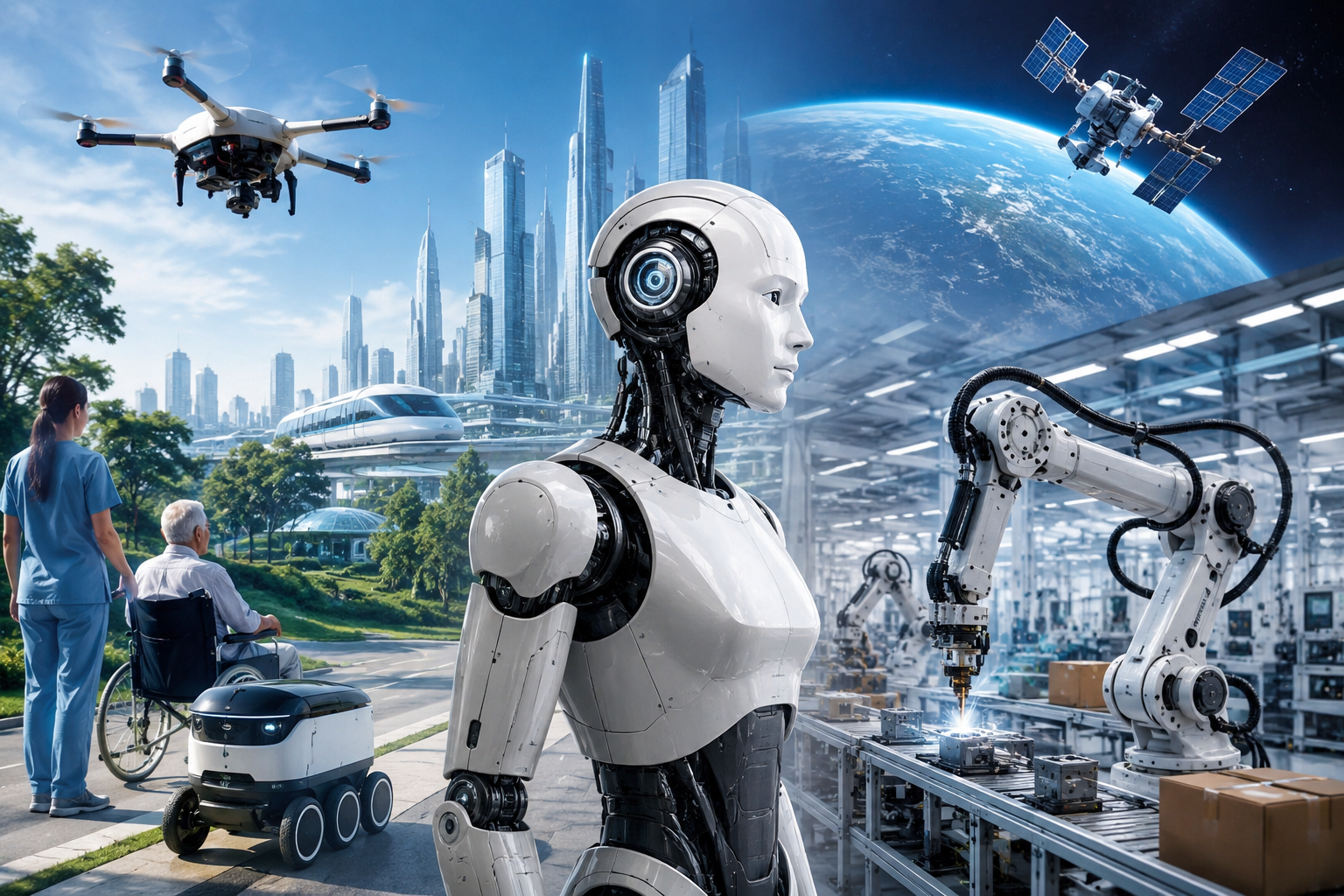
More than 3.4 million industrial robots are working somewhere on the planet right now, and that number sits inside a much bigger picture: robotics as an industry now supports roughly 9.3 million jobs worldwide, a market worth $88.3 billion in 2026, on track to more than double to $218 billion by 2031. This isn’t a slow, background shift happening somewhere out of view. It’s already reshaping how goods get made, how patients get treated, and how millions of people get through their workday.
Robotics has quietly moved from a manufacturing-floor niche into something touching nearly every corner of modern life.
Manufacturing: Where the Robotics Revolution Started, and Never Stopped
A Rapidly Rising Robot-to-Human Ratio
The global manufacturing industry now runs at a robot-to-human ratio of roughly 1 robot for every 71 workers, a figure that keeps climbing as automation costs fall and capabilities improve. In 2024 alone, 542,000 new industrial robots were installed worldwide, with Asia accounting for 74% of those installations, followed by Europe at 16% and the Americas at 9%.
Automation Density Varies Sharply by Country
Some countries have embraced industrial automation far faster than others. South Korea leads the world with 1,012 robots per 10,000 manufacturing employees, followed by Singapore at 770 and China at 470. Germany and Japan round out the leading group, each maintaining robot densities well above 400 per 10,000 workers, cementing their positions as some of the most automated manufacturing economies on Earth.
Capital Spending Keeps Climbing
Industrial businesses now plan to direct roughly 25% of their capital spending toward automation over the next five years. A clear signal that robotics has shifted from an experimental upgrade to a core, ongoing investment priority across global manufacturing.
Healthcare: Robots in the Operating Room and Beyond
A Growing Share of the Global Robotics Market
The medical sector is projected to account for around 27% of the entire global robotics market, driven by everything. That ranges from precision surgical systems to hospital logistics robots that move supplies and medication through busy facilities.
Responding to an Aging Population
Healthcare robotics adoption is closely tied to demographic pressure. By 2050, roughly one in four people in the United Kingdom will be over the age of 65, and Japan already has the world’s most rapidly aging population, with 30 million people, a quarter of its population, over 65. Robotic systems in nursing and elder care are increasingly framed not as a replacement for human caregivers, but as a way to support an overstretched workforce facing a genuine staffing shortage.
European Healthcare Systems Leading Adoption
More than half of European healthcare organizations, 53%, planned to use medical robotics by the end of 2024, with Europe currently leading regional adoption of healthcare robotics compared to other parts of the world.
Logistics and Delivery: Getting Goods Where They Need to Go
Warehouses Are Being Rebuilt Around Robots
Autonomous mobile robots have become a defining feature of modern warehouse operations, helping fulfillment centers keep pace with surging e-commerce demand. The broader shift toward AI-driven, adaptive robots rather than simple, fixed-instruction machines is exactly the trend covered in a deeper look a thow robotics programming has evolved, where software and real-time decision-making increasingly matter as much as the physical hardware itself.
Last-Mile Delivery Is Going Autonomous
Autonomous delivery robots are expected to handle more than 25% of all last-mile deliveries in urban areas by 2030, a shift that could meaningfully reshape how online orders reach doorsteps in dense cities over the next several years.
The Cost-Saving Case Is Massive
Robotics and automation are estimated to save businesses as much as $8 trillion in labor costs by 2030, a figure that helps explain why logistics investment in robotics has accelerated so sharply, even amid broader economic uncertainty elsewhere.
The Numbers Behind the Robotics Boom
| Metric | Figure |
| Global robotics market size (2026) | $88.3 billion |
| Projected market size by 2031 | $218 billion |
| Industrial robots currently operating worldwide | 3.4 million+ |
| Jobs supported by the robotics industry globally | ~9.3 million |
| New industrial robots installed in 2024 | 542,000 |
| Share of medical robotics in the global market | ~27% |
| Projected labor cost savings from automation by 2030 | $8 trillion |
| Last-mile deliveries handled by autonomous robots by 2030 | 25%+ |
| Estimated new robotics-related jobs by 2035 | ~2 million |
Robotics Adoption by Region
| Region | Share of New Industrial Robot Installations (2024) | Notable Strength |
| Asia | 74% | Largest manufacturing base, led by China, South Korea, Japan |
| Europe | 16% | Strong healthcare and automotive robotics adoption |
| Americas | 9% | Growing logistics and warehouse automation investment |
The Honest Tradeoff: Jobs Lost, and Jobs Created
No conversation about robotics changing the world is complete without addressing its most debated impact: employment. Estimates suggest robots could displace up to 20 million manufacturing jobs by 2030, and separate research indicates roughly 14% of workers globally have already lost a job to automation in some form.
At the same time, the picture isn’t purely one of loss. The robotics industry itself is projected to create around 2 million new jobs by 2035, spanning robotics engineers, robot programmers, maintenance technicians, and design specialists, career paths that didn’t meaningfully exist a generation ago. For anyone considering how that shift plays out on an individual level, a detailed breakdown of robotics engineering as a career path shows just how quickly salaries and demand have grown in this specific corner of the job market.
Critics of the automation boom point out that this isn’t the first time technology has eliminated entire job categories; elevator operators and highway toll collectors are frequently cited historical examples, but caution that robotics is now moving into higher-skilled roles in a way earlier waves of automation didn’t. The honest reality is that robotics is simultaneously destroying certain categories of work and creating entirely new ones, and the net effect looks different depending on someone’s industry, location, and skill set.
Beyond Factories: Robots in Daily Life
Service Robots Are Becoming Ordinary
The global service robot market, covering everything from robot vacuum cleaners to hospitality and elder-care robots, is projected to reach $24.64 billion, growing at a rate of more than 21% a year. In 2020 alone, sales of domestic service robots like vacuum cleaners and lawnmowers reached 5.44 million units worldwide, and that category has only expanded since.
Robots as Waiters, Receptionists, and Companions
In countries like Japan and Singapore, robot waiters and receptionists have become a visible, everyday part of the hospitality industry. These are part of a broader push to offset labor shortages in service sectors. They have historically relied heavily on human staffing.
Autonomous Vehicles Reshaping Transportation
The autonomous vehicle market, closely tied to advances in robotics and AI, is estimated to be worth well over $500 billion. That is driven by rapid progress in self-driving technology across passenger vehicles, delivery, and long-haul trucking.
Robots Supporting Sustainability
Robotics is also playing a growing role in precision farming, waste reduction, and energy-efficient production, applications that connect the technology directly to broader environmental and sustainability goals rather than pure cost-cutting alone. The same companies driving this shift, spanning industrial giants and fast-growing humanoid startups alike, are covered in more depth in a broader roundup of the world’s leading robotics companies.
What This Means Going Forward
The throughline across every industry robotics touches is the same. The Robots are shifting from fixed, single-purpose machines into adaptive. AI-driven systems capable of learning, adjusting, and working safely alongside people. That shift is what’s allowing robotics to move beyond the factory floor and into hospitals. And warehouses, restaurants, and homes at a pace that would have seemed unrealistic even five years ago.
With deployments now stabilizing above 540,000 new industrial units a year. Human-robot interaction research is growing at more than 14% annually; the direction of travel is clear. Robotics isn’t a future technology anymore. It’s a current one, already embedded in how a growing share of the world eats, shops, heals, and works.
Final Thoughts
Robotics has stopped being a niche, factory-only technology and become something closer to infrastructure, quietly running in the background of healthcare systems, delivery networks, warehouses, and increasingly, everyday homes. The scale of that shift- a market headed toward $218 billion by 2031, millions of jobs both displaced and created, and robots now working safely alongside people in ways that felt experimental just a few years ago- makes it one of the defining technology stories of this decade.
Whatever industry you work in, robotics is very likely already touching it in some way, whether that’s a robot in a nearby warehouse, a surgical system in a local hospital, or a delivery robot navigating a city sidewalk. The world isn’t just adopting robotics anymore. It’s already being rebuilt around it.

4 Comments
Pingback: Agentic AI Explained: What It Is and Why It's Growing 40x Faster Than Expected
Pingback: What Is Artificial Intelligence?
Pingback: The Future of Artificial Intelligence: What the Data Actually Shows
Pingback: Humanoid Robots Can Sprint Now. Can They Actually Do the Job?