

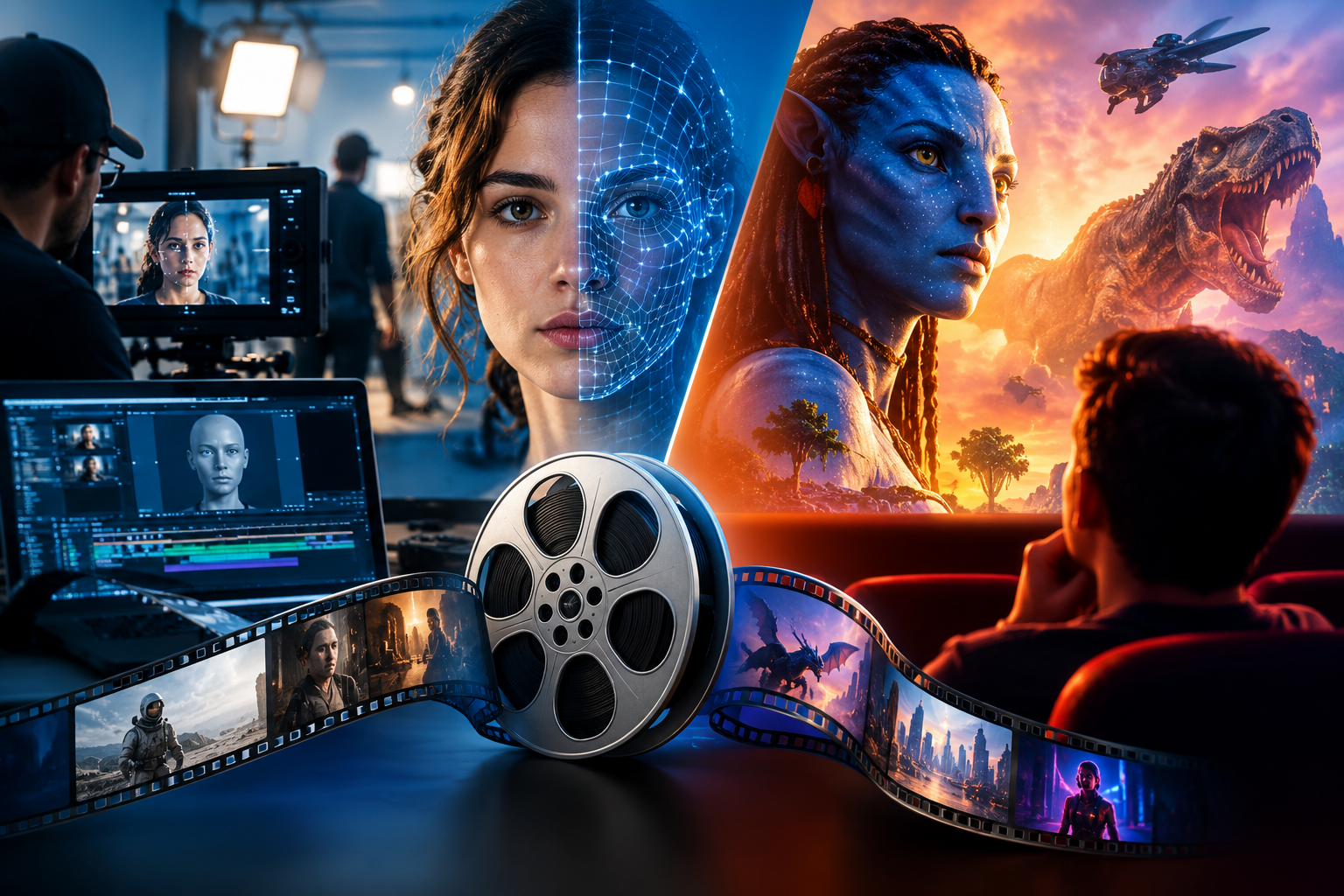
A fully AI-generated 90-minute feature film, no cameras, no actors, no film crew, hasn’t premiered yet. But the gap between “impossible” and “inevitable” has closed dramatically fast. Grok’s video tool went from generating zero video to producing over 1.2 billion unique clips in a single month, and xAI has publicly committed to releasing a full-length AI-generated film by the end of 2026.
At the same time, most of what gets called an “AI movie” right now is something narrower and more useful: AI tools woven into traditional filmmaking, not replacing it.
What AI Can Actually Do in Filmmaking Today
Short-form AI video, clips under roughly 60 seconds, has reached genuinely professional quality. Tools like Veo, Sora, Runway, and Kling can now produce polished, cinematic footage with synchronized audio and camera work that holds up well against traditionally shot material for a single scene or short sequence.
Where the technology still struggles is consistency across a full-length runtime. Feature films need the same character to look, move, and sound the same across dozens of scenes and 90-plus minutes, and that’s a fundamentally harder problem than generating one striking clip. Character drift, subtle changes in a face, voice, or proportions between shots, remains one of the field’s most persistent unsolved issues heading into 2026.
Where AI Is Already Embedded in Real Film Production
This is the part of the story that gets far less attention than flashy “AI made a whole movie” headlines, but it’s where the actual, measurable transformation is happening right now.
- Pre-visualization and concept work are widely considered the strongest current application, letting directors and cinematographers rapidly test shot compositions, lighting, and scene ideas before committing to an expensive physical shoot.
- Visual effects and post-production have seen real, practical AI integration, including noise reduction, dialogue isolation, and automated rotoscoping tasks that used to require large manual VFX teams. Script breakdowns and character analysis are increasingly AI-assisted, helping production teams plan logistics and continuity faster than manual review allows.
- Localization has sped up dramatically, with AI-powered dubbing cutting a global release’s translation turnaround from months down to weeks in some reported cases.
Industry surveys suggest a large majority of studios now run multiple AI video platforms simultaneously, rather than betting on one, because no single tool currently handles every part of the pipeline well. Runway tends to lead on character consistency, while newer versions of Veo lead on native audio integration, a split that reflects the broader “no single best tool” pattern showing up across the entire AI video category.
The Push Toward Fully AI-Generated Feature Films
The most ambitious frontier is a complete, feature-length film generated primarily or entirely by AI, and 2026 has brought that goal closer than ever, without quite crossing the finish line.
Elon Musk has publicly committed to xAI releasing a “watchable” full-length AI-generated film by the end of 2026, with genuinely strong movies following in 2027, according to his own stated roadmap. Separately, NVIDIA’s CEO has suggested AI-generated full-length films could reach theaters as early as 2026. Independent film forecasters and industry commentators have floated similar predictions, some specifically betting that the first commercially visible, largely AI-generated feature is more likely to be animated or a hybrid production than a live-action blockbuster, given how much harder live-action consistency remains to solve.
It’s worth treating all of these as forecasts, not settled fact. Prediction markets tracking this exact question have historically assigned single-digit to low-teens percentage odds on a true “Hollywood-level” AI-generated feature arriving by specific target dates, a useful reminder that confident public statements from tech leaders don’t always match independent, incentive-aligned forecasting.
The Industry’s Real Concerns
A full-length AI film isn’t just a technical challenge. It’s running into genuine resistance from the people who make movies for a living.
Actors’ unions have pushed hard on digital likeness protections following the 2023 SAG-AFTRA strikes. A large majority of Americans believe actors should be compensated whenever their digital likeness is used. A principle that now shapes how studios can legally deploy AI-generated performances. Intellectual property rights remain one of the most commonly cited barriers to broader studio AI adoption. Training data provenance and likeness rights are still being actively litigated and negotiated across the industry. The Academy has updated its Oscar eligibility rules to explicitly allow AI-assisted films to compete. But meaningful human creative involvement remains part of how a submission gets evaluated, a deliberate hedge against a fully synthetic film claiming a major award.
Audience Sentiment: The Part the Hype Often Skips
Technology readiness is only half the equation. How audiences actually feel about AI-made films matters just as much, and the signals here are decidedly mixed.
A meaningful share of surveyed audiences say they’d be less likely to watch a movie specifically knowing it was written entirely by AI, and a similarly large share of consumers report concern about AI-generated deepfake content in entertainment more broadly. At the same time, interest in AI-enabled formats that couldn’t exist otherwise is real: a notable share of viewers say they’re open to interactive films where AI adjusts the plot based on their choices, a genuinely new format rather than a cheaper replacement for a traditional one.
That split, skepticism toward AI replacing traditional filmmaking, openness toward AI enabling something new, is probably the most useful way to read where audience sentiment actually sits heading into any first major AI-generated theatrical release.
The Economics Behind the Push
Cost is the clearest, least debatable driver behind the entire AI filmmaking push. Generative AI tools are estimated to be capable of saving a major studio. Tens of millions of dollars per film in post-production work alone, and AI-assisted production. More broadly has been linked to cost reductions reaching into the double digits as a percentage of total budget. Independent and lower-budget productions stand to benefit even more proportionally. AI tools can meaningfully close the gap in a self-funded creator’s toolkit. What previously required a full studio-backed production budget.
That economic pressure is exactly why so many studios are experimenting even. While the underlying technology’s creative and legal questions remain unresolved. The financial incentive to figure this out doesn’t wait for every open question to get answered first.
AI Movies: Reality Check
| Claim | Current Reality |
| “AI can generate a full, consistent feature film today” | Not yet; short clips are strong, but full-length character consistency remains unsolved |
| “Studios are already using AI extensively” | True, but mainly for pre-visualization, VFX, and post-production, not full films |
| “A fully AI-generated film will hit theaters in 2026” | Predicted by some industry figures; independent forecasts remain far more cautious |
| “Audiences are excited for AI-made movies” | Mixed; many say they’d watch less if a film is known to be fully AI-written |
| “AI filmmaking raises no legal questions” | False; IP rights and digital likeness remain major, actively contested barriers |
| “AI is replacing human filmmakers” | Not currently; the dominant pattern is AI as a tool within traditional workflows |
For a closer look at the specific tools driving this shift, a comparison of the best AI video generators breaks down. How platforms like Veo, Sora, Runway, and Kling actually differ in the capabilities feeding into this entire trend.
Final Thoughts
AI movies sit at a genuinely interesting inflection point in 2026. The short-form quality that would have seemed impossible two years ago, real and growing integration. That’s across pre-visualization, VFX, and post-production, and a handful of confident public predictions. That a full, watchable AI-generated feature is coming before the year ends.
What hasn’t arrived yet is the thing the biggest headlines promise. A fully AI-generated film with no human crew or cast that plays like a real movie start to finish. The honest read is that AI is transforming how movies get made well before it replaces. Who makes them, and that gap between “powerful new tool” and “full replacement” is likely to stay. The more accurate story for a while longer, whatever premieres by December.
