

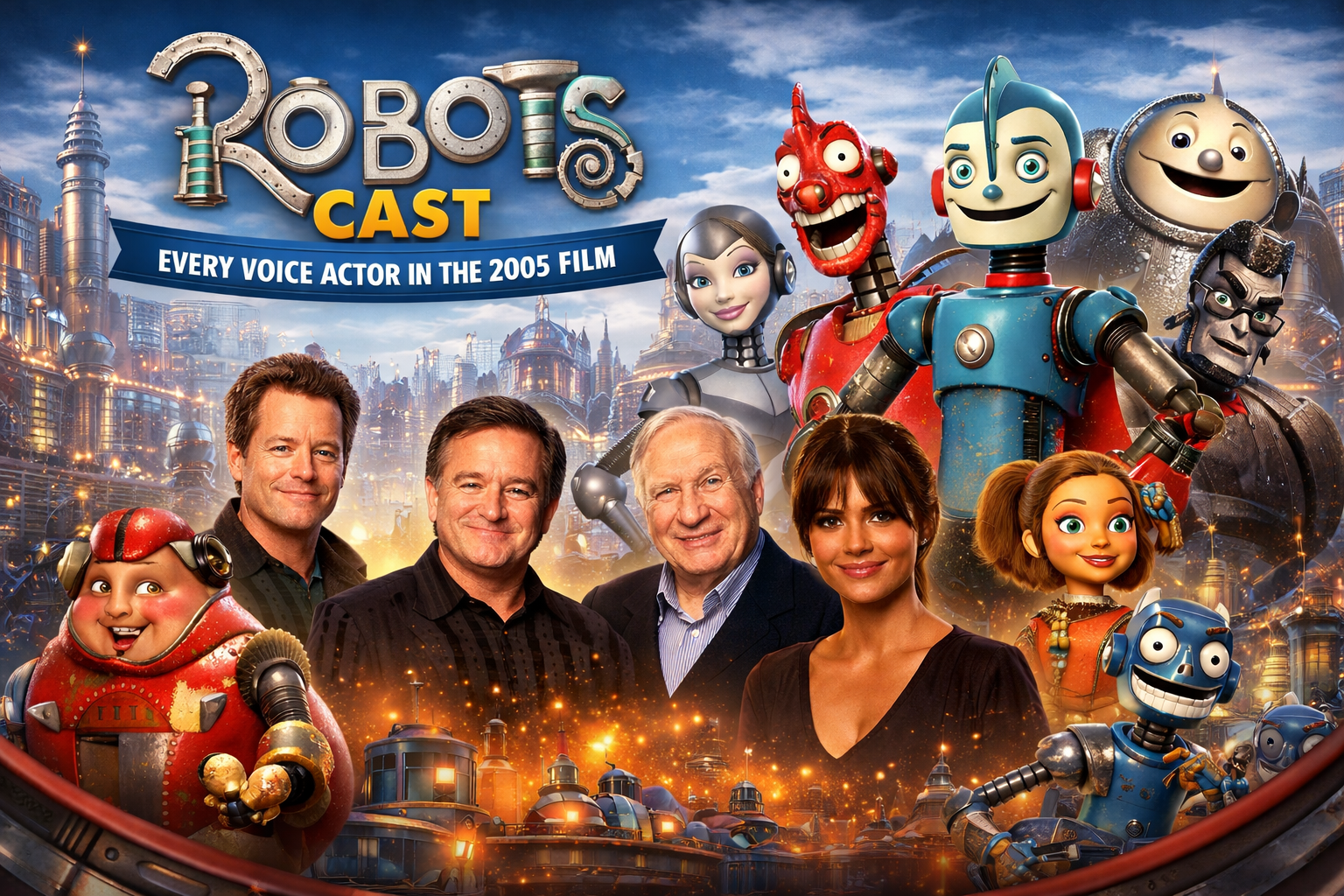
Few animated films have assembled a voice cast as impressive or as perfectly matched to their characters as Robots (2005). Directed by Chris Wedge and produced by Blue Sky Studios and 20th Century Fox Animation, the Robots cast includes five Oscar winners. That alongside Emmy and Tony honorees, a level of prestige rarely seen in animated features of that era. Released on March 11, 2005, the film grossed $262.5 million worldwide. Became a beloved classic for audiences of all ages. From the earnest idealism of Ewan McGregor’s Rodney Copperbottom to the anarchic energy of Robin Williams’ Fender. Every member of the Robots cast brought something genuinely irreplaceable to the production.
This comprehensive guide covers every major member of the Robots cast, exploring the characters. They voiced the real actors behind them, and what made each performance so memorable. For readers interested in how modern AI tools are now reshaping animation. The voice-acting pipelines, the technology landscape around these creative fields is evolving rapidly. Still, in 2005, Robots was a landmark purely of human craft and imagination.
Full Voice Cast at a Glance
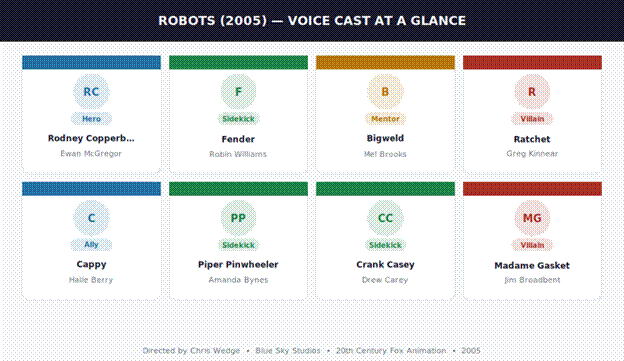
Fig. 1 — Principal voice cast of Robots (2005), color-coded by character role type
Film Overview: Setting the Stage
Robots is set in a fully imagined world populated entirely by mechanical beings. The story follows Rodney Copperbottom, a young inventor robot from the small town of Rivet Town. Who travels to gleaming Robot City to pursue his dream of working for legendary inventor Bigweld. What he finds instead is a corporation under new, villainous management targeting struggling robots for forced upgrades they cannot afford. The film’s production designer was William Joyce, whose visual imagination transformed industrial imagery into a rich, vibrant mechanical universe.
The screenplay was written by David Lindsay-Abaire, Lowell Ganz, and Babaloo Mandel. Chris Wedge, who had previously directed the Academy Award-winning. That short Bunny and the hugely successful Ice Age, brought his signature warmth and humor to the project. Development on Robots began as early as 2000 and was placed on hold. While Wedge directed Ice Age, a decision that ultimately served the film well. The success of Ice Age gave Blue Sky Studios the resources to realize the robot world at full scale.
Production Fact: William Joyce researched design ideas at junkyards, factories, and secondhand stores even his own kitchen, where a waffle iron and meat grinder served as inspiration. The goal was to make every element of Robot City feel like it had been assembled from scavenged parts.
Infographic: Character Screen-Time Prominence
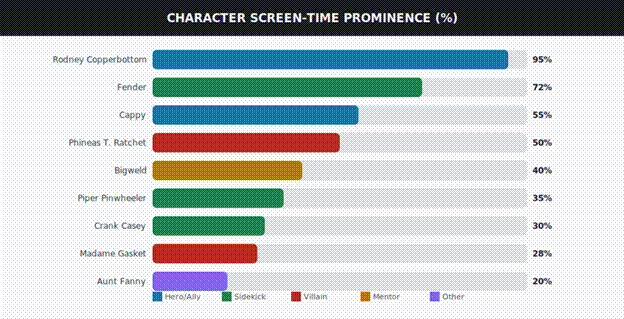
Fig. 2 — Estimated screen-time prominence by character, color-coded by role type
The Robots Cast: Character Deep Dives
Ewan McGregor as Rodney Copperbottom
Rodney Copperbottom is the moral and emotional heart of Robots, a young, idealistic inventor. Who refuses to give up on his belief that anyone can shine, regardless of what they are made of. Ewan McGregor, then widely known globally as Obi-Wan Kenobi in the Star Wars prequel trilogy. That brought natural sincerity and warmth to the role that grounds the film emotionally. His voice conveys Rodney’s enthusiasm without ever tipping into naivety. Notably, Robots was released simultaneously with Star Wars. In Episode III, many fans reportedly saw the film just to hear McGregor’s voice in a different context.
Robin Williams as Fender
Robin Williams’ return to feature animation following his iconic performance. As the Genie in Aladdin (1992) was one of the most anticipated elements of the Robot’s cast. As Fender, a loose-limbed, perpetually falling-apart misfit who becomes Rodney’s best friend. Williams brought his trademark improvisational energy and rapid-fire wit to a character that could easily have been one-dimensional. Fender’s physical comedy (his body parts routinely detach at inopportune moments) gave the animation team extraordinary material to work with. His performance remains widely considered the comedic highlight of the entire film. Just as AI is reshaping creative industries today, Williams’ performance in Robots showed. How a singular human talent can elevate the entire creative output of a production.
Mel Brooks as Bigweld
Bigweld is the larger-than-life inventor-philanthropist whose motto, ‘See a need, fill a need, ‘ drives the film’s moral engine. Mel Brooks, comedy legend and creator of Blazing Saddles and Young Frankenstein, was a natural fit for the role. His voice carries an irresistible mix of bluster and warmth that makes Bigweld simultaneously ridiculous and genuinely heroic. Brooks has noted in interviews that the character’s optimism resonated deeply with him. That quality comes through unmistakably in the performance.
Greg Kinnear as Phineas T. Ratchet
The film’s principal antagonist, Phineas T. Ratchet, is the slick corporate villain who has seized control of Bigweld Industries. That replaced its mission of helping robots with a ruthless forced-upgrade scheme. Greg Kinnear brought a smooth, entitled charm to the role that makes Ratchet genuinely menacing. While remaining appropriate for a family film. Kinnear’s delivery perfectly captures the character’s self-satisfaction. Contempt for those he considers beneath him, a portrayal of corporate villainy that feels remarkably relevant even today.
Halle Berry as Cappy
Cappy is a high-ranking executive at Bigweld Industries who secretly sympathizes with Rodney. Halle Berry voiced the character with warmth and intelligence that distinguishes Cappy from a passive love-interest role. Berry’s performance gives Cappy genuine agency. She is resourceful, principled, and willing to risk her position for what is right. The character represents the film’s optimistic belief that even those embedded within corrupt systems can choose the right path.
Jim Broadbent as Madame Gasket
One of the most memorable casting choices in the Robots cast is Jim Broadbent, a British actor. Actor known for dramatic roles, voicing the theatrical villain Madame Gasket. Ratchet’s mother is the true architect of the film’s plot. Broadbent’s gender-bending casting lends Gasket a theatrical menace that is both funny and faintly sinister. She runs the Chop Shop, where outdated robots are melted down for parts. Broadbent gives her the perfect blend of camp villainy and genuine threat.
Amanda Bynes as Piper Pinwheeler
Piper is Fender’s younger sister, a tomboy with more determination and common sense than almost anyone else in the Rusties gang. Amanda Bynes, then at the height of her Nickelodeon popularity. This voiced the character with an energetic authenticity that made Piper a fan favorite. Her arc from skeptic to genuine hero provides one of the film’s most satisfying supporting storylines.
Jennifer Coolidge as Aunt Fanny
Jennifer Coolidge made her animated film debut as Aunt Fanny. The well-meaning but catastrophically oblivious landlady of the Rusties’ makeshift lodgings. Coolidge, who later rose to wider fame through White Lotus, brought her signature unself-consciousness. Delivery to a character whose physical comedy required bold, confident performance. Director Chris Wedge has said Coolidge simply inhabited the character immediately upon arrival, making the animators’ job significantly easier.
Drew Carey as Crank Casey
Crank Casey is the gruff, lovable pessimist of the Rusties. That always convinced the worst was about to happen, but loyal to the end. Drew Carey’s naturally deadpan delivery is perfectly suite to the character. His comedic timing adds texture to ensemble scenes that might otherwise be dominated by Williams’ improvisational energy.
Infographic: Production Timeline
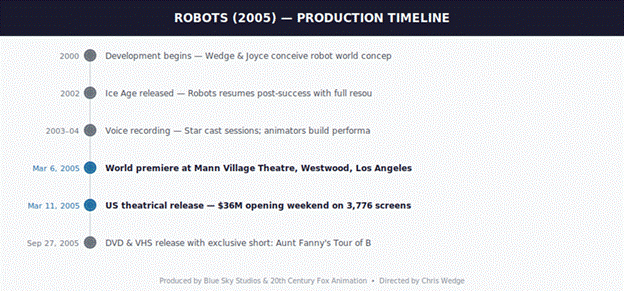
Fig. 3 — Key milestones in the development and release of Robots (2005)
Supporting Cast and Celebrity Cameos
Beyond the main ensemble, the Robots cast includes an impressive array of supporting voices. Stanley Tucci voices Herb Copperbottom, Rodney’s sweet-natured father. Dianne Wiest brings warmth to Lydia Copperbottom. Natasha Lyonne, Paul Giamatti, and Harland Williams appear in supporting roles. Celebrity cameos include Al Roker, Terry Bradshaw, Jay Leno, and Paula Abdul. Even James Earl Jones contributes an uncredited voice role, adding gravitas to the ensemble. The breadth of the Robots cast reflects the era’s appetite for star-studded animated features. A tradition that continues today, as seen in how AI in entertainment is now beginning. To explore synthetic voice generation alongside traditional casting.
The Robots cast featured five Oscar winners at the time of release an unusually high concentration for a single animated feature. The animators studied each voice actor’s physical mannerisms during recording sessions to inform their characters’ movement and facial expression, creating a tight feedback loop between performance and animation.
Infographic: Box Office & Key Statistics
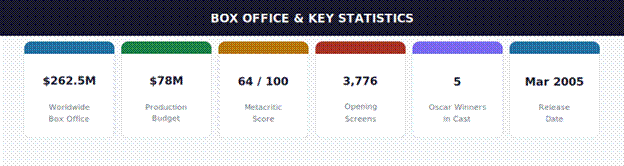
Fig. 4 — Production budget, worldwide gross, critical score, and key production facts
Animation, Music, and Production
Blue Sky Studios brought remarkable technical ambition to Robots. The film presented an entirely imagined world; every character, prop, and environment was mechanical, with no human characters whatsoever. The computer-generated animation was groundbreaking for its time, with the studio developing rich visual vocabularies. For emotional expression through robot faces and physical comedy through detachable parts. The score was compose by John Powell, whose propulsive orchestral music matched the film’s visual energy. Just as machine learning today enables new creative tools for animators. The manual craft of the Robots’ animation team represented the absolute frontier of what human artistry could produce in 2005.
Awards, Reception, and Legacy
- ASCAP Award: Won (Top Box-Office Films, 2005)
- Annie Award: Nominated (Outstanding Character Design in an Animated Feature)
- Annie Award: Nominated (Outstanding Production Design, William Joyce & Steve Martino)
- Kids’ Choice Award: Nominated (Favorite Animated Movie)
- Kids’ Choice Award: Nominated (Favorite Voice Robin Williams as Fender)
- Teen Choice Award: Nominated (Choice Movie: Animated/Computer Generated)
- Visual Effects Society Award: Nominated (Outstanding Visual Effects in Animated Film)
Critics praised the Robots cast, the humor, and the animation, earning the film a Metacritic score of 64. Commercially, it was a clear success, $262.5 million worldwide against a $75–80 million production budget. A sequel was discussed but abandoned as the studio shifted focus to the Ice Age franchise. In retrospect, Robots is frequently cited as a missed opportunity, a film that deserved the sequel it never received. AI in education is inspiring a new generation to think differently about technology. Robots planted seeds of curiosity about invention and creativity. That standing up to corporate power in millions of children who grew up with the film.
Conclusion
The Robots cast remains one of the most remarkable voice ensembles ever assembled for an animated feature. Five Oscar winners, comedy legends, and rising stars united in service of a visually inventive and emotionally sincere film. From Ewan McGregor‘s grounded hero to Robin Williams’ anarchic sidekick. Mel Brooks’ lovably grandiose mentor, every performer brought something irreplaceable to the production. Nearly two decades on, the Robots cast endures as a testament to. What perfectly matched voice talent can do for animated storytelling. For those who want to explore how artificial intelligence is transforming entertainment and creative industries. The contrast with Robots’ entirely human-crafted performances offers a thought-provoking baseline. The film’s message is that anyone can shine, no matter what. What they are made of remains as resonant today as it is in 2005.
FAQS
1. Who are the main voice actors in Robots (2005)?
The main voice cast includes Ewan McGregor (Rodney Copperbottom) and Robin Williams (Fender). The Mel Brooks (Bigweld), Halle Berry (Cappy), and Greg Kinnear (Ratchet) also participated.
2. Who voices Rodney Copperbottom in Robots?
Rodney Copperbottom, the film’s main character, is voice by Ewan McGregor. That known for his role as Obi-Wan Kenobi in Star Wars.
3. Which actor played Fender in Robots?
Fender is voic by Robin Williams, whose energetic and improvisational style. That made the character one of the most memorable in the film.
4. Who is the villain in Robots (2005)?
The main antagonist, Phineas T. Ratchet, is voic by Greg Kinnear, with additional villainous influence from Madame Gasket, voiced by Jim Broadbent.
5. Who voiced Bigweld in Robots?
Bigweld, the legendary inventor, is voiced by Mel Brooks, bringing humor and warmth to the character.
6. Is Robots (2005) a star-studd cast film?
Yes, Robots features a highly acclaimed ensemble, including multiple Oscar-winning actors and well-known comedians.
7. Who voices Cappy in Robots?
Cappy is voiced by Halle Berry, who adds depth and intelligence to the character.
8. Are there any celebrity cameos in Robots (2005)?
Yes, the film includes cameo appearances by celebrities such as Jay Leno, Al Roker, and Paula Abdul.
9. Who voiced Aunt Fanny in Robots?
Aunt Fanny is voiced by Jennifer Coolidge, known for her distinctive comedic style.
10. How successful was Robots (2005) at the box office?
Robots was a commercial success, earning over $260 million worldwide against a production budget of around $75–80 million.
11. Who produced and directed Robots (2005)?
The film was directed by Chris Wedge and produced by Blue Sky Studios along with 20th Century Fox Animation.
12. Why is the Robots cast considered special?
The cast is notable for combining Oscar winners and comedy legends. The rising stars are making it one of the most diverse and talented voice ensembles in animated film history.
