

The debate around data analytics vs data science is one of the most common sources of confusion for anyone entering the data industry. Both fields deal with data, both produce insight, and both are among the most in-demand and best-compensated careers according to the World Economic Forum Future of Jobs Report 2025. Yet despite their overlap, data analytics and data science are fundamentally different disciplines with different purposes, different tools, different educational requirements, and different career trajectories. Understanding the distinction is essential whether you are choosing a career, hiring for your team, or deciding which type of tool or approach best serves your organization’s data needs.
This comprehensive guide breaks down data analytics vs data science across every key dimension, scope, methodology, skills, tools, salary, and career paths. It also explores how AI tools are transforming both fields, and closes with a practical FAQ section answering the most common questions people have when comparing the two.
Data Analytics vs Data Science Side-by-Side Overview
What Is Data Analytics?
Data analytics is the process of examining datasets to extract value and find answers to specific, predefined questions. Data analytics focuses on interpreting data as it currently exists, understanding what happened in the past, why it happened, and what patterns or trends can be identified to inform better decisions going forward. It is practical, business-oriented, and primarily concerned with delivering actionable insight to stakeholders in a clear, understandable format.
Data analysts typically work with structured data, the kind stored in spreadsheets, relational databases, and business intelligence platforms. Their outputs are dashboards, reports, visualizations, and written summaries that communicate findings to non-technical audiences. The questions data analysts answer tend to be specific and tangible: Which product categories saw the highest return rates last quarter? Which customer segments are most at risk of churning? How did this campaign perform relative to the previous one?
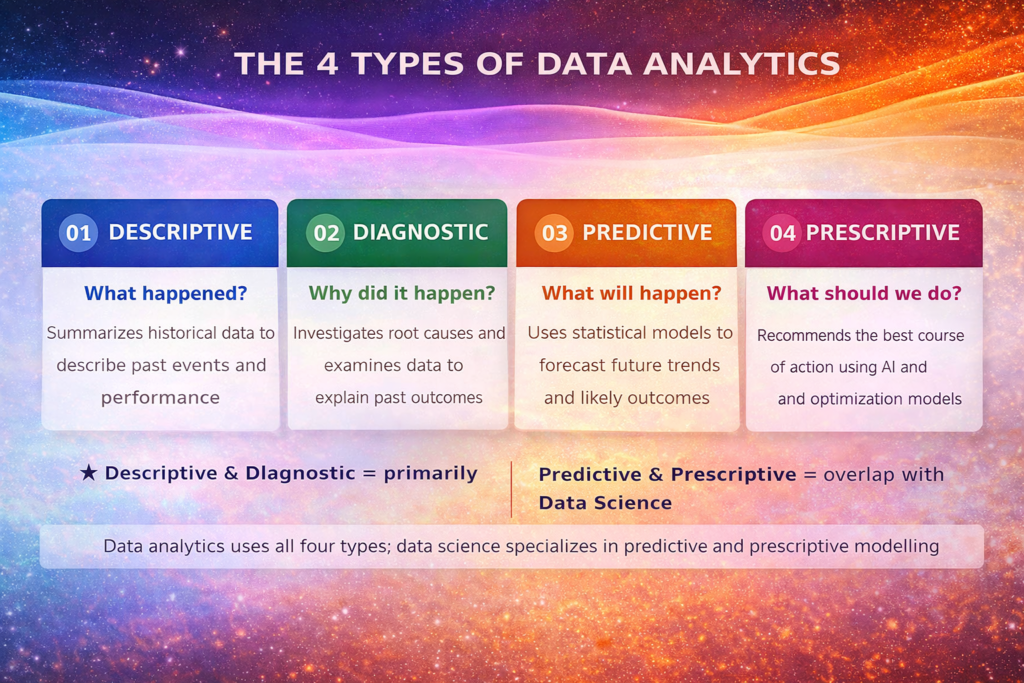
Data analytics is organized around four core types of analysis, each answering a different kind of question: descriptive analytics (what happened?), diagnostic analytics (why did it happen?), predictive analytics (what will happen?), and prescriptive analytics (what should we do?). The first two are the primary domain of data analysts; the latter two begin to overlap with data science.
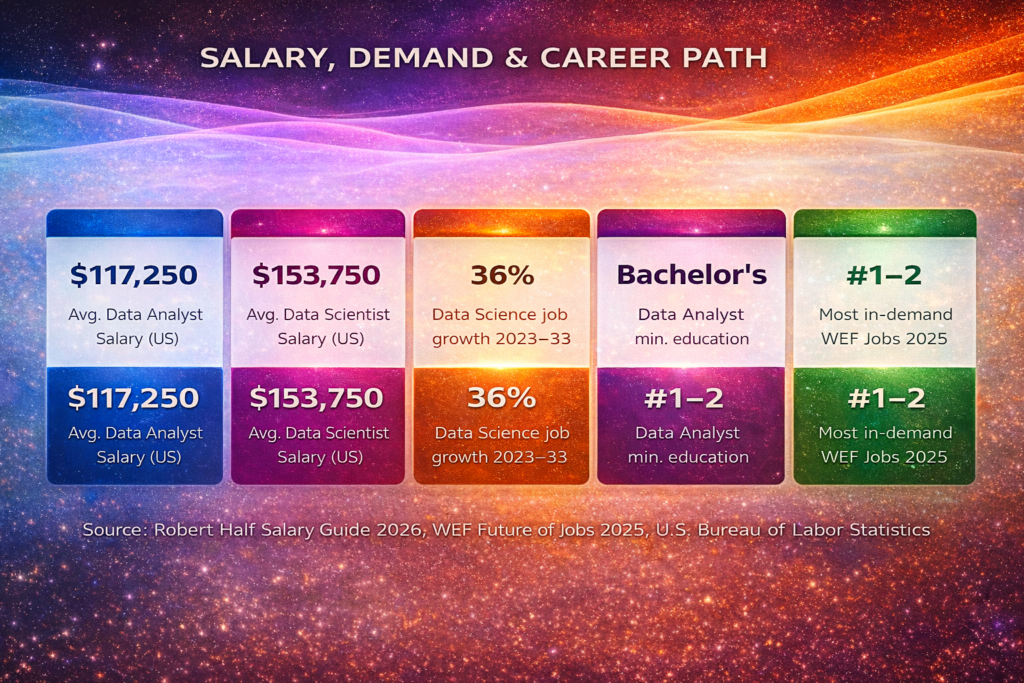
Key Insight: According to the Robert Half Salary Guide 2026, the average salary for a data analyst in the United States is $117,250. Entry-level roles are accessible with a bachelor’s degree, making data analytics one of the most approachable high-paying career paths in the technology sector.
What Is Data Science?
Data science is the broader, more technically advanced field that encompasses data analytics and extends far beyond it. Where data analytics asks specific questions about existing data, data science asks open-ended questions, often questions the organization does not yet know to ask, and builds systems capable of answering them autonomously. CS scientists design and build the algorithms, models, and AI systems that organizations use to automate decisions, forecast outcomes at scale, and extract insight from massive, complex, or unstructured datasets.
Data science is an interdisciplinary field that combines computer science, mathematics, statistics, and domain expertise. Data scientists work with both structured and unstructured data, including text, images, audio, and video, and apply advanced techniques, including machine learning, deep learning, and natural language processing, to transform raw inputs into predictive or prescriptive outputs. The results of data science work are often themselves systems: recommendation engines, fraud detection models, demand forecasting algorithms, and computer vision pipelines.
The data science workflow is iterative. Scientists form hypotheses, design experiments, build and test models, evaluate results, and refine their approach across multiple cycles, a process sometimes called the data science lifecycle. This research-oriented mindset distinguishes data science from the more operational, reporting-focused orientation of data analytics. As AI in healthcare demonstrates, data science is enabling breakthroughs that go far beyond what traditional analytics could produce, from early disease detection to personalized treatment recommendations.
Key Insight: The U.S. Bureau of Labor Statistics projects a 36% increase in data scientist positions between 2023 and 2033, far outpacing the national average job growth of 4%. Average salary according to the Robert Half Salary Guide 2026: $153,750 per year in the United States.
The Four Types of Data Analytics
Data Analytics vs Data Science: Key Differences
While the two fields overlap significantly, several dimensions clearly separate data analytics from data science. Understanding these differences helps organizations build the right teams and helps individuals choose the right career path.
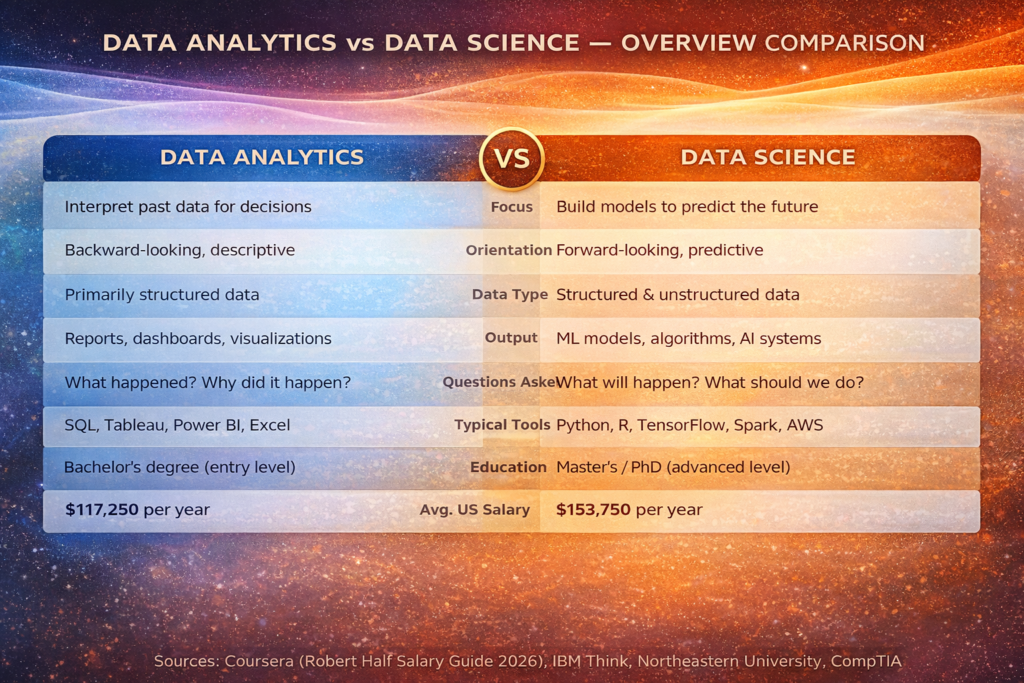
| Dimension | Data Analytics | Data Science |
| Primary Focus | Interpret past data for decisions | Build models to predict & automate |
| Time Orientation | Backward-looking | Forward-looking |
| Data Types | Structured (tables, spreadsheets) | Structured + unstructured |
| Key Question | What happened? Why? | What will happen? What should we do? |
| Core Output | Reports, dashboards, visualizations | ML models, algorithms, AI pipelines |
| Typical Tools | SQL, Tableau, Power BI, Excel | Python, R, TensorFlow, Spark |
| Coding Required | Basic (SQL, some Python) | Advanced (Python, R, Scala) |
| Education | Bachelor’s degree | A master’s or PhD is typical |
| Avg. US Salary | $117,250/year | $153,750/year |
| Overlap Area | A master’s or a PhD is typical | |
| Team Focus | Business intelligence, reporting | Research, ML engineering |
Skills Comparison: Data Analyst vs Data Scientist
Tools and Technologies: What Each Role Uses
Data Analytics Tools:
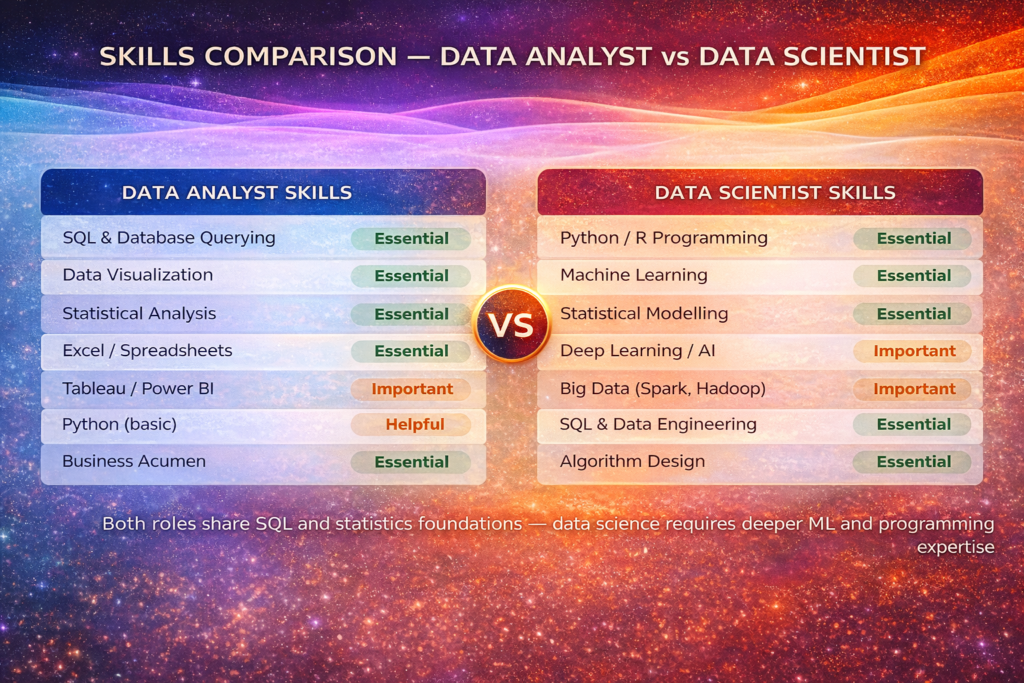
Data analysts rely on a set of tools optimized for querying, visualizing, and reporting on structured data. SQL is the foundational language used to extract and manipulate data from relational databases. Tableau and Microsoft Power BI are the leading visualization platforms, enabling analysts to build interactive dashboards and reports. Excel remains widely used for ad hoc analysis and financial modeling. Python (particularly pandas and matplotlib) is increasingly common among analysts who want to automate repetitive tasks or perform more advanced statistical analysis. As covered in our data analytics tools guide, the landscape has expanded significantly with AI-powered tools like Julius AI and Zoho Analytics that allow non-technical users to query data conversationally.
Data Science Tools:
Data scientists work with a more extensive and technically demanding toolkit. Python is the dominant language, with libraries like scikit-learn, TensorFlow, PyTorch, and Keras enabling machine learning and deep learning model development. R is widely used in academic and statistical research contexts. Apache Spark and Hadoop handle large-scale distributed data processing. Cloud platforms AWS SageMaker, Google Vertex AI, and Azure ML provide the infrastructure for training and deploying models at scale. Jupyter notebooks serve as the standard development environment for experimental, iterative model building. Version control (Git) and MLOps tools (MLflow, DVC) are essential for managing model development in production environments. The growth of machine learning platforms has made many of these capabilities more accessible, but deep proficiency remains a prerequisite for serious data science work.
Salary, Demand & Career Path
Similarities Between Data Analytics and Data Science
Despite their differences, data analytics and data science share a meaningful common foundation that moves from the two fields to make them possible and increasingly common.
- Both involve working with data to generate insight and support decision-making.
- Both require proficiency in SQL for data extraction and manipulation.
- Both use statistical concepts, averages, distributions, correlations, and regression as foundational tools.
- Both benefit from strong data visualization skills for communicating findings to stakeholders.
- Both are increasingly influenced by AI and automation, with tools like Power BI Copilot and Julius AI serving analysts, and AutoML and AI-powered IDEs serving data scientists.
- Both are in high demand across virtually every industry, including finance, healthcare, retail, technology, government, and beyond.
The overlap is most pronounced in the area of predictive analytics, a discipline that sits at the boundary between the two fields. A senior data analyst may build statistical predictive models using Python or R, while a junior data scientist may spend much of their time performing exploratory data analysis that closely resembles traditional analytics work. As AI in education continues to expand data literacy, the lines between these roles will continue to blur.
Which Career Path Should You Choose?
The choice between data analytics and data science ultimately comes down to three factors: your interests, your technical background, and your career goals.
Choose Data Analytics If:
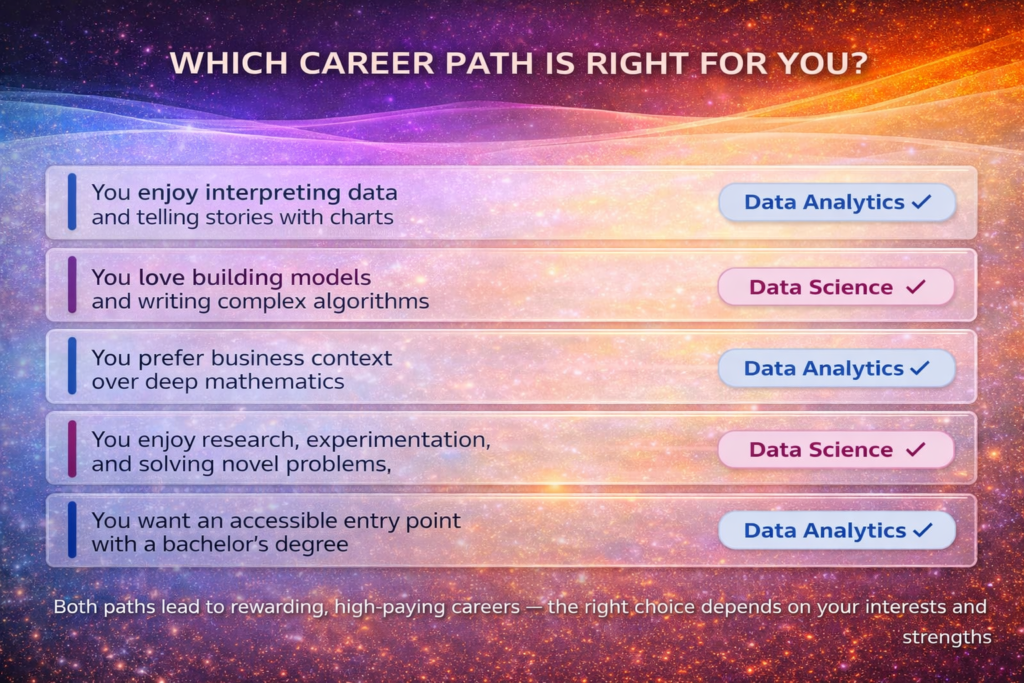
- You enjoy translating data into business stories and communicating findings to non-technical stakeholders.
- You prefer working within a defined problem space with specific, answerable questions.
- You want an accessible entry point with a bachelor’s degree and strong job market prospects.
- You are more drawn to business strategy and operational improvement than to building predictive systems.
- You are comfortable with SQL and visualization tools, but less drawn to deep programming or mathematics.
Choose Data Science If:
- You are passionate about mathematics, statistics, and algorithmic thinking.
- You enjoy research, experimentation, and solving problems that have never been solved before.
- You want to build the systems, the recommendation engines, fraud detectors, and forecasting models that organizations depend on.
- You are willing to invest in advanced education (master’s or PhD) in exchange for higher earning potential and technical leadership roles.
- You want to work at the frontier of artificial intelligence and machine learning.
Career Transition: Many successful data scientists began as data analysts. Building analytical skills, gaining business domain expertise, and progressively learning machine learning and programming is a well-established path. The reverse is also possible: data scientists who develop strong communication skills and business acumen often move into analytical leadership roles.
Which Path Is Right for You?
Frequently Asked Questions (FAQs)
Below are the most commonly asked questions about data analytics vs data science, answered clearly and concisely.
Q: Is data science harder than data analytics?
Generally, yes, data science is considered more technically demanding than data analytics. Data science requires deeper expertise in mathematics, statistics, programming, and machine learning algorithms. Data analytics is more accessible, with many entry-level roles available to those with a bachelor’s degree and proficiency in SQL and visualization tools. That said, ‘harder’ does not mean ‘better’; both fields are rewarding and well-compensated, and the right choice depends on your interests and strengths.
Q: Can a data analyst become a data scientist?
Yes, and this is one of the most common career transitions in the data industry. Many data scientists began as analysts and gradually developed their programming, machine learning, and statistical modeling skills over time. The analytical thinking, business acumen, and data handling experience gained as an analyst provide a strong foundation for data science work. Transitioning typically requires investment in learning Python or R, statistics, and machine learning through university programs, online courses, or professional certification.
Q: Which pays more for data analytics or data science?
Data science typically pays more. According to the Robert Half Salary Guide 2026, the average salary for a data scientist in the United States is $153,750 per year, compared to $117,250 for a data analyst. The higher compensation reflects the additional technical expertise required and the typically more complex, strategic nature of data science work. Senior data scientists with expertise in AI and machine learning can earn significantly more, particularly in technology and finance sectors.
Do I need a degree in data science or data analytics?
A: A formal degree is beneficial but not always required, particularly for entry-level data analytics roles. Many employers accept strong portfolios, relevant certifications (such as Google Data Analytics Professional Certificate or IBM Data Science Professional Certificate), and demonstrated skills alongside or instead of formal degrees. For data science roles at established organizations, a master’s degree or PhD is frequently expected, though bootcamps and self-directed learning combined with strong project portfolios can open doors, especially at startups.
Q: What is the difference between a data analyst and a business analyst?
While both roles work with data to inform business decisions, a data analyst focuses specifically on quantitative data extraction, cleaning, analyzing, and visualizing datasets to answer specific questions. A business analyst has a broader remit that includes process analysis, requirements gathering, stakeholder management, and strategic recommendations, often using data as one input among many rather than as the primary focus. Some organizations use the terms interchangeably, but in most contexts, a data analyst role is more technically specialized in data manipulation and statistical analysis.
Q: Is Python necessary for data analytics?
Python is not strictly required for data analytics, but it is increasingly valuable. Many data analysts work effectively with SQL, Excel, and BI tools like Tableau or Power BI without writing Python code. However, Python proficiency, particularly libraries like pandas for data manipulation and matplotlib or seaborn for visualization, significantly expands what an analyst can do, enabling automation of repetitive tasks, more sophisticated statistical analysis, and a smoother transition toward data science if desired.
Q: What industries hire data analysts and data scientists the most?
Both roles are in demand across virtually every sector. Technology companies are the largest employers, followed by finance and banking (for fraud detection, risk modeling, and algorithmic trading), healthcare (for clinical analytics, patient outcomes modeling, and drug discovery), retail and e-commerce (for demand forecasting, recommendation engines, and customer segmentation), and government (for policy analytics and public services optimization). The WEF Future of Jobs Report 2025 ranks data-related roles among the most in-demand positions globally across all industries.
Q: What is the role of AI in data analytics and data science?
A: Artificial intelligence is transforming both fields. In data analytics, AI is being integrated into tools like Power BI Copilot, Tableau AI, and Julius AI, enabling non-technical users to query data in natural language, generate dashboards automatically, and surface anomalies without manual analysis. In data science, AI and machine learning are the core methodologies that data scientists use to build the AI systems that power these tools and many others. As AI capabilities advance, certain repetitive analytical tasks are being automated, freeing both analysts and scientists to focus on higher-value strategic and creative work.
Conclusion
The data analytics vs data science debate ultimately reflects the breadth. What is possible with data, from the precise, business-oriented insight of a well-crafted. This analytics dashboard takes the frontier-pushing capability of a machine learning model that predicts outcomes no human analyst could anticipate. Both fields are essential, both are growing rapidly, and both offer rewarding career paths. For people with the right mix of curiosity, analytical thinking, and technical skill. Understanding where they differ and where they overlap allows organizations. To build more effective data teams and individuals to make smarter career choices. For continued reading on the tools, technologies, and trends shaping both fields, AI Journal. That provides regularly updated expert analysis across the full spectrum of artificial intelligence and data-driven innovation.
