


Data is everywhere. But raw data means nothing on its own. Analytics turns data into decisions. It helps businesses understand the past, explain the present, and prepare for the future.
There are five key types of data analytics. Each answers a different question. Each serves a different purpose. Together, they form a complete analytical strategy. According to Harvard Business School, data-driven companies are 5% more productive and 6% more profitable. Understanding these types is the first step toward becoming one.
This guide covers all five types in detail. It includes real examples, tools, and use cases. It also explores how AI tools are transforming analytics across every type and industry.
The Analytics Pyramid: All Types of Data Analytics
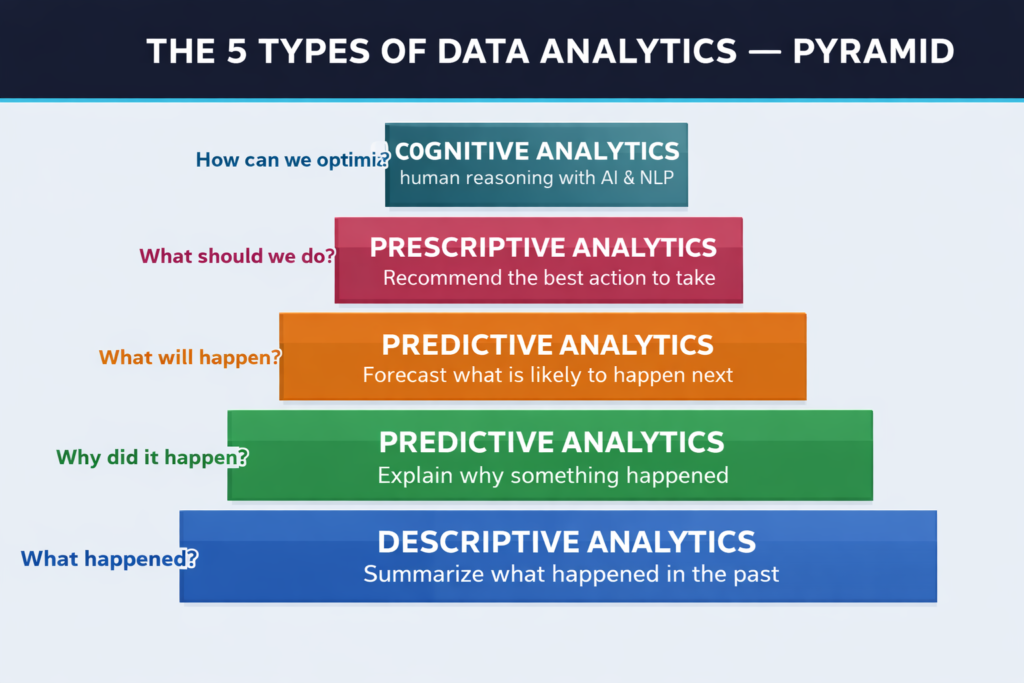
Overview: The 5 Types of Data Analytics
Think of analytics as a pyramid. Each level builds on the one below it.
- At the base: descriptive analytics. Simple. Foundational. Easy to start.
- At the top: cognitive analytics. Complex. Powerful. AI-driven.
Most organizations start at the bottom. They grow upward as their data maturity improves. Here is what each level means.
| Type | Key Question | Looks At | Example Output |
| Descriptive | What happened? | Past data | Sales dashboard |
| Diagnostic | Why did it happen? | Past causes | Root cause report |
| Predictive | What will happen? | Future trends | Churn forecast |
| Prescriptive | What should we do? | Best actions | AI recommendation |
| Cognitive | How can we automate? | Human reasoning | Autonomous AI decision |
Type 1: Descriptive Analytics
Descriptive analytics answers one question: what happened?
It summarizes historical data. It identifies trends, patterns, and performance metrics. This is the most common type of analytics. Every business uses it. Dashboards, reports, and KPI summaries are all descriptive analytics at work.
How It Works:
- Collect historical data from databases or spreadsheets.
- Clean and organize the data into a structured format.
- Visualize results using charts, graphs, and tables.
- Share findings with stakeholders in clear reports.
Real Examples:
- A retailer tracks monthly sales by region.
- A hospital monitors average patient wait times.
- A marketing team reviews last week’s email open rates.
- A finance team generates quarterly revenue reports.
Key strength: Descriptive analytics is easy to implement. It requires no advanced modeling. It provides an immediate, clear picture of business performance.
Type 2: Diagnostic Analytics
Diagnostic analytics answers: why did it happen?
It goes deeper than description. It investigates the causes behind outcomes. Something went wrong with your numbers? Diagnostic analytics finds out why.
How It Works:
- Start with a known outcome, a spike, drop, or anomaly.
- Drill down into segmented data to identify contributing factors.
- Look for correlations between variables.
- Determine root causes using statistical analysis.
Real Examples:
- An e-commerce site sees a drop in conversions. Diagnostic analysis reveals a slow page load after a recent update.
- A manufacturer sees rising defect rates. Analysis links it to a specific supplier’s materials.
- A SaaS company sees higher churn. Investigation shows users who skip onboarding leave faster.
Key strength: Diagnostic analytics prevents recurring problems. It bridges the gap between understanding the past and planning for the future.
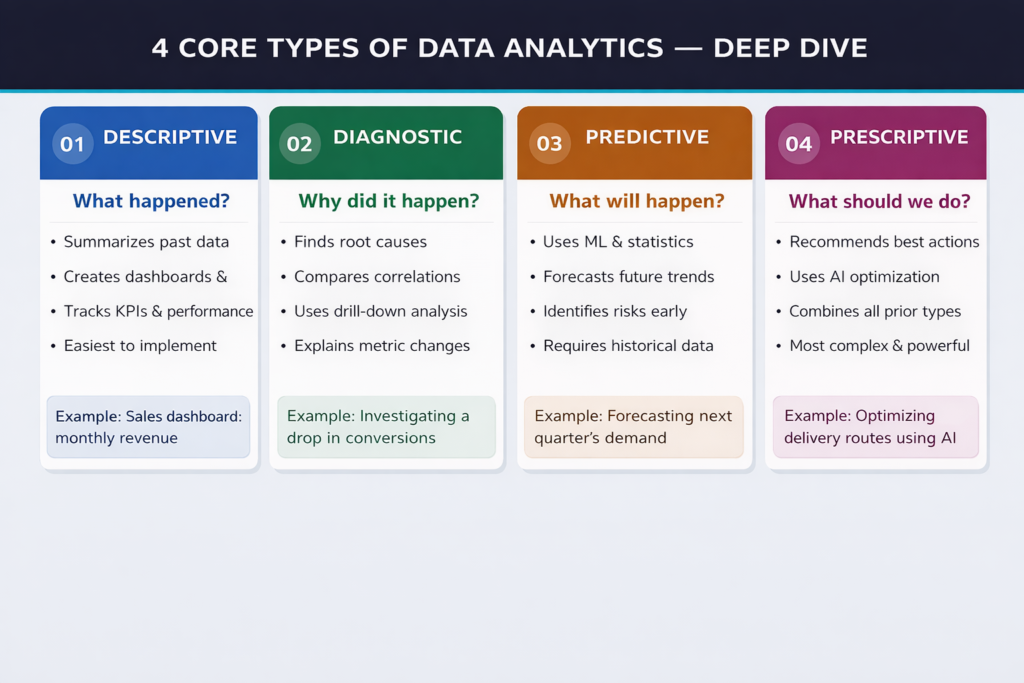
The 4 Core Types Deep Dive
Type 3: Predictive Analytics
Predictive analytics answers: what will happen? It uses machine learning and statistics to forecast future outcomes. It looks at historical patterns. Then it projects them forward.
This type requires more data and more skill. But the payoff is significant. Organizations that use predictive analytics move from reactive to proactive.
How It Works:
- Gather large volumes of clean historical data.
- Choose an appropriate model: regression, decision trees, or neural networks.
- Train the model on past data.
- Generate predictions with associated confidence levels.
- Monitor and retrain the model as new data arrives.
Real Examples:
- A bank predicts which customers are likely to default on loans.
- A retailer forecasts product demand before the holiday season.
- A healthcare provider scores patients by risk of hospital readmission.
- A streaming service predicts which subscribers will cancel next month.
Predictive analytics is where AI and machine learning begin to transform analytics from reporting into intelligence. It is used across finance, retail, healthcare, and logistics.
Key strength: Predictive analytics enables proactive decision-making. Businesses anticipate problems before they occur saving time, money, and resources.
Type 4: Prescriptive Analytics
Prescriptive analytics answers: what should we do?
- It is the most advanced practical form of analytics.
- It does not just predict outcomes.
- It recommends the best action to achieve a desired result.
Prescriptive analytics combines predictive insights with optimization algorithms, AI simulations, and decision trees. It evaluates multiple possible futures. Then it tells you which path to take.
How It Works:
- Build on predictive models already in place.
- Define constraints: resources, costs, and time limits.
- Apply optimization algorithms to evaluate all action paths.
- Output the recommended course of action with expected impact.
Real Examples:
- A logistics company optimizes delivery routes based on traffic, weather, and package priority.
- A hospital recommends personalized treatment plans based on patient history and outcomes data.
- A retailer dynamically adjusts pricing based on demand forecasts and inventory levels.
- An airline optimizes seat pricing per flight to maximize revenue.
Key strength: Prescriptive analytics converts insight into action. It is the closest analytics type to automated, AI-driven decision-making.
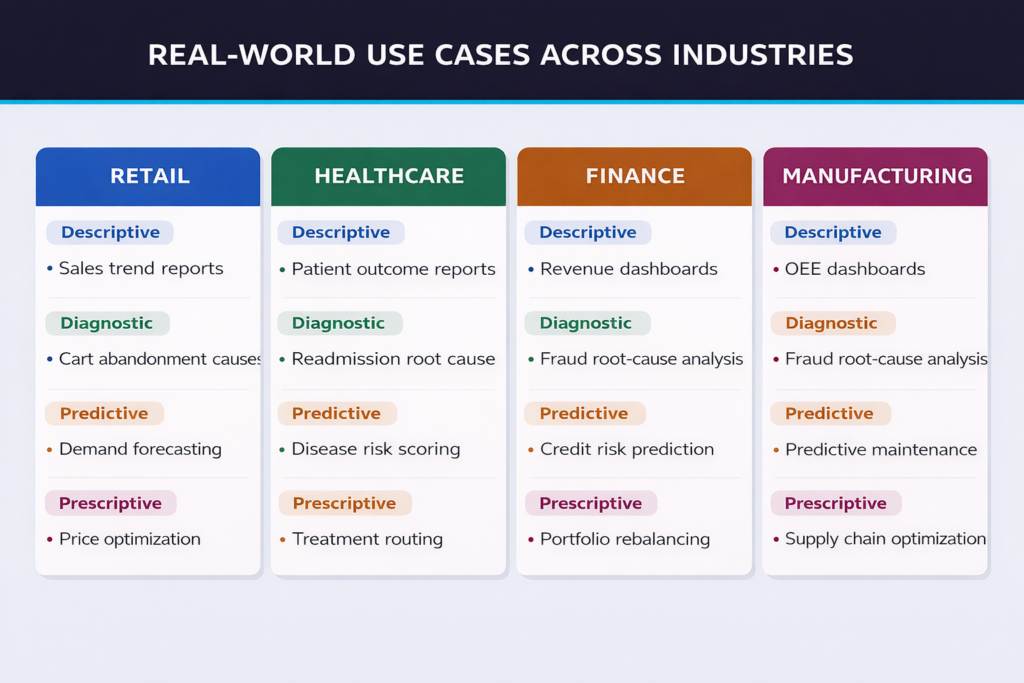
Real-World Use Cases by Industry
Type 5: Cognitive Analytics
Cognitive analytics represents the next frontier. It combines artificial intelligence, natural language processing, machine learning, and deep learning to mimic human reasoning.
- It does not just answer questions.
- It understands context. It learns from new information.
- It adapts its reasoning over time.
This is the analytics type closest to what humans do naturally, but at machine speed and scale.
Real Examples:
- AI assistants that answer complex customer questions by reasoning through context.
- Medical diagnostic tools that synthesize patient history, symptoms, and research literature.
- Fraud detection systems that adapt to new fraud patterns without retraining.
- Autonomous supply chain systems that re-route orders based on real-time disruptions.
As AI in healthcare demonstrates, cognitive analytics is already saving lives. It moves beyond analytics into autonomous intelligence.
Key strength: Cognitive analytics scales human-like decision-making across entire organizations. It handles complexity, ambiguity, and real-time data simultaneously.
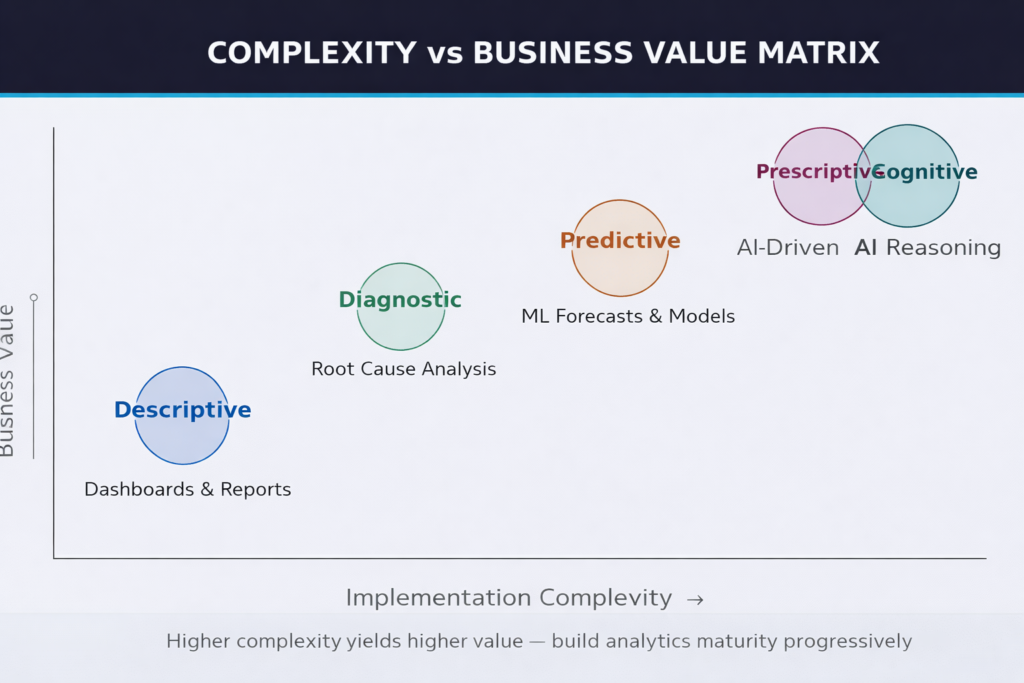
Complexity vs Business Value Matrix
How the 5 Types Work Together
The five types are not alternatives. They are layers. Each builds on the one before it. Together, they form a complete analytics strategy.
Here is how they connect in practice:
- Start with descriptive analytics. Understand what is happening right now.
- Apply diagnostic analytics. Find out why it is happening.
- Add predictive analytics. Anticipate what will happen next.
- Use prescriptive analytics. Decide what action to take.
- Deploy cognitive analytics. Let AI handle ongoing reasoning automatically.
Most organizations begin at level one. They progress as their data infrastructure, team skills, and technology investment grow.
Organizations that implement all four core types see 73% faster decision-making, according to research. They also report 15% higher revenue growth. Investing in AI tools for digital transformation accelerates this progression significantly.
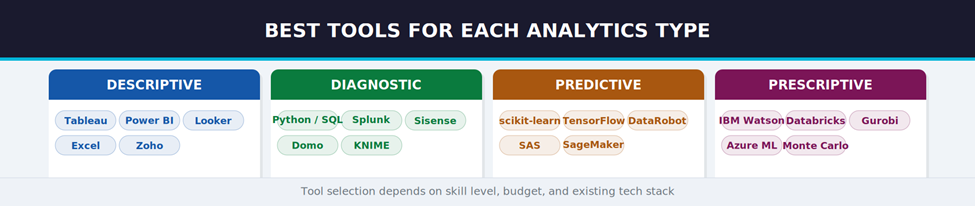
Best Tools for Each Analytics Type
How to Choose the Right Type of Analytics
- Not every business needs all five types at once. Start with the right question.
- Need to understand current performance? Use descriptive analytics.
- Need to investigate a problem or anomaly? Use diagnostic analytics.
- Need to plan for the future? Use predictive analytics.
- Need to choose between strategic options? Use prescriptive analytics.
- Need to automate complex reasoning at scale? Use cognitive analytics.
The right starting point depends on your data maturity, team skills, and budget. Most small businesses start with descriptive. Most enterprise organizations aim for predictive and prescriptive. As explored in our guide to AI in education, even schools and nonprofits are now moving into predictive analytics to improve outcomes.
Frequently Asked Questions (FAQs)
Here are the most common questions about types of data analytics.
Q: What are the 4 main types of data analytics?
A: The four main types are descriptive, diagnostic, predictive, and prescriptive analytics. Descriptive tells you what happened. The diagnostic explains why. Predictive forecasts what will happen. Prescriptive recommends what to do. A fifth type of cognitive analytics uses AI to mimic human reasoning and is increasingly recognized as part of the modern analytics spectrum.
Q: Which type of data analytics is most commonly used?
A: Descriptive analytics is the most commonly used type. It is the foundation of all analytics work. Every business that tracks sales figures, monitors website traffic, or reviews performance dashboards is using descriptive analytics. It is the easiest to implement and requires no advanced modeling.
Q: What is the difference between predictive and prescriptive analytics?
A: Predictive analytics forecasts what is likely to happen based on historical data and statistical models. Prescriptive analytics goes further; it recommends the specific action you should take to achieve the best outcome. Think of predictive as ‘it will probably rain tomorrow’ and prescriptive as ‘bring an umbrella and leave 20 minutes early to avoid traffic.’
Q: Do I need all 5 types of analytics in my business?
A: No not immediately. Most businesses start with descriptive analytics and progress from there as their data infrastructure and team capabilities grow. Small businesses can derive significant value from descriptive and diagnostic analytics alone. Predictive and prescriptive analytics require more investment in data quality, tools, and technical expertise.
Q: What tools are used for each type of analytics?
A: Descriptive analytics uses tools like Tableau, Power BI, and Google Looker. Diagnostic analytics relies on SQL, Python, and platforms like Splunk or Domo. Predictive analytics uses scikit-learn, TensorFlow, DataRobot, and AWS SageMaker. Prescriptive analytics uses IBM Watson, Databricks, and optimization platforms like Gurobi. Cognitive analytics is powered by large language models, NLP frameworks, and platforms like Azure AI.
Q: Is data science the same as data analytics?
A: No, they are related but different. Data analytics focuses on interpreting existing data to answer specific business questions. Data science is a broader field that includes building new algorithms, training machine learning models, and creating AI systems. Predictive and prescriptive analytics overlap with data science. Descriptive and diagnostic analytics are primarily within the analytics domain.
Q: How does AI fit into data analytics?
A: AI is transforming every type of analytics. In descriptive analytics, AI tools like Power BI Copilot and Julius AI automatically generate insights and answer questions in plain language. These predictive analytics and machine learning models power forecast engines. In prescriptive analytics, AI optimization algorithms evaluate thousands of action paths simultaneously. In cognitive analytics, AI is the core engine for reasoning, adapting, and making decisions autonomously.
Q: What is cognitive analytics?
A: Cognitive analytics is the most advanced form of data analytics. It uses artificial intelligence, natural language processing, and machine learning to simulate human reasoning. Unlike other analytics types that answer specific questions, cognitive analytics understands context, learns from new information, and adapts over time. It is used in areas like medical diagnosis, fraud detection, customer service automation, and autonomous supply chain management.
Conclusion
Data analytics is not one thing. It is five distinct capabilities. Each type answers a different question. Each serves a different purpose. Descriptive tells you what happened. Diagnostic tells you why. Predictive shows what is coming. Prescriptive guides your action. Cognitive automates the reasoning.
The organizations that invest across all five levels make better decisions, faster. They stay ahead of problems instead of reacting to them. For those looking to go further, AI Journal covers the latest developments in artificial intelligence and data analytics across every industry. The right analytics strategy does not just report the past. It shapes the future.
