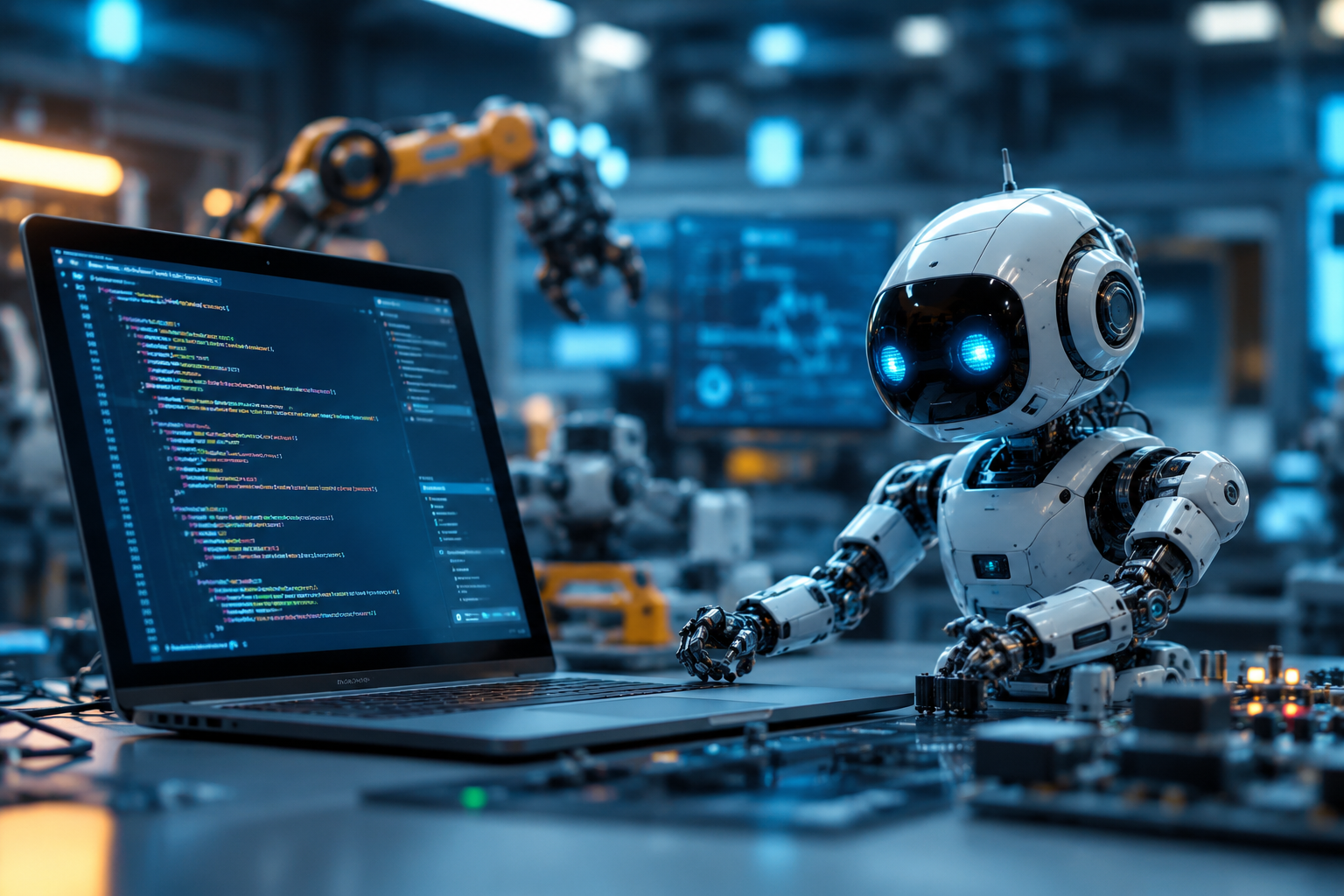
Right now, somewhere in the world, a robot is being deployed roughly every few seconds. That pace is accelerating faster than at any point in the last ten years. Global robot deployments grew 34% year over year in 2026 alone. The fastest growth rate the industry has recorded in a decade. While the robotics market itself is on track to roughly triple in size by 2031. Behind every one of those machines is code, thousands of lines of it. That written by programmers who taught a pile of motors and sensors. How to sense, decide, and move like it actually understands the world around it.
The numbers behind this shift are hard to ignore. The global robotics market is expected to hit approximately $88.27 billion in 2026, up from $73.64 billion just a year earlier, and is projected to climb to $218.56 billion by 2031. Vision-Language-Action models, the systems letting robots interpret spoken instructions and visual input, are now built into roughly 40% of all new robot deployments, up from a small fraction just two years ago. And the cost of training data for robots has dropped nearly 60% since 2024, making robotics development faster and more accessible than it’s ever been.
What Is Robotics Programming?
Robotics programming is the practice of writing the software that controls a robot’s sensing, decision-making, and movement. It sits at the intersection of several disciplines: embedded systems programming for hardware control, algorithms for perception and planning, and increasingly, machine learning for tasks like object recognition and autonomous navigation.
Unlike typical software development, robotics code has to deal with the physical world in real time. A web app can tolerate a half-second delay. A robotic arm moving near a human worker cannot. This real-time constraint shapes almost every decision a robotics programmer makes, from which language to use to how code gets tested before it ever touches hardware.
Robotics code generally lives in layers. At the bottom sits firmware that talks directly to motors, sensors, and microcontrollers. In the middle is the logic layer handling state estimation, kinematics, and path planning. At the top is often a broader software stack managing perception, decision-making, and increasingly, AI models that let robots interpret their environment rather than just follow pre-programmed instructions.
The Core Languages Behind Robotics
No single language runs the entire robotics world. Instead, most professional robotics teams work across several, each suited to a different layer of the stack.
Python:
Python has become the default entry point into robotics programming, and for good reason. Its simple syntax makes it approachable for beginners, while its massive ecosystem of libraries, including TensorFlow and PyTorch, makes it the dominant language for the AI and machine learning components increasingly built into modern robots. Python is commonly used for prototyping, computer vision, and high-level decision-making logic, though it’s rarely used where split-second timing is critical.
C and C++:
When a robot needs to respond in microseconds, C and C++ take over. C offers direct, low-level control over hardware components like motors and sensors, making it a natural fit for embedded systems. C++ builds on that foundation with better performance and structure for larger, more complex systems, which is why it powers most industrial robots and forms the backbone of ROS, the software framework most professional robotics teams build on.
ROS and ROS 2:
ROS, short for Robot Operating System, isn’t actually an operating system. It’s a middleware framework that lets different parts of a robot’s software, sensors, motors, and planning algorithms talk to each other in a standardized way. In 2026, most professional robotics work runs on ROS 2, which added real-time performance improvements and better support for the distributed, multi-robot systems increasingly common in warehouses and factories.
MATLAB and Simulink:
MATLAB remains a favorite in research and academic settings, particularly for control systems design, simulation, and testing algorithms before they ever touch physical hardware. Simulink, its companion tool, is widely used for modeling and simulating dynamic systems, which makes it valuable for testing robot behavior safely before deployment.
C# and .NET:
C# is a less obvious choice, but it plays a real role, particularly in industrial and lab settings where Windows-based systems are common. Operator dashboards, calibration tools, and Unity-based simulation environments frequently rely on C#, and it’s often the language used to bridge a .NET-based enterprise system with a ROS 2 robotics network.
Java:
Java shows up less often in real-time robot control but remains relevant for higher-level applications, particularly in enterprise robotics systems, Android-based robotics platforms, and academic contexts where its structure and portability are valued.
Robotics Programming by the Numbers
| Metric | Figure |
| Global robotics market size (2026) | ~$88.27 billion |
| Projected market size by 2031 | ~$218.56 billion |
| Robotics market CAGR (2026–2031) | ~19.9% |
| Global robotics deployment growth (2026, YoY) | 34% |
| Vision-Language-Action model adoption in new deployments | ~40% |
| Data collection cost drop per hour (vs. 2024) | ~60% |
| Commercial humanoid platforms available | Up from 3 in 2024 to multiple in 2026 |
| Programming language market size (2026) | ~$220.81 billion |
Which Language Should You Learn First?
For most beginners, the honest answer is Python. It has the gentlest learning curve, an enormous base of tutorials and community support, and direct relevance to the AI-driven direction robotics is heading. Starting with Python also means you can build real, working projects, like a line-following robot or a basic computer vision pipeline, without getting bogged down in memory management and low-level syntax first.
That said, Python alone won’t get you far in professional robotics. Once the fundamentals click, most learning paths move toward C++ for performance-critical control code, and ROS 2 for understanding how real robotic systems are actually architected. Younger students or complete beginners sometimes start even earlier, with block-based tools like Scratch, before transitioning into text-based languages.
A realistic learning path looks something like this: start with Python and basic electronics to understand sensors and actuators, move into C/C++ once you need real-time control, then layer in ROS 2 to learn how professional systems integrate multiple components. MATLAB and Simulink are worth adding if your path leans toward research, control theory, or simulation-heavy work.
Comparison: Robotics Programming Languages
| Language | Best For | Learning Curve | Real-Time Performance | Common Use Case |
| Python | AI, prototyping, computer vision | Easy | Low | Perception, high-level logic, ML models |
| C++ | High-speed, industrial systems | Steep | Excellent | Motor control, ROS-based systems |
| C | Direct hardware control | Steep | Excellent | Embedded firmware, sensors, actuators |
| ROS 2 | System integration | Moderate to steep | Good | Connecting sensors, planning, and control |
| MATLAB/Simulink | Simulation and research | Moderate | N/A (simulation) | Control system design, algorithm testing |
| C# | Tooling and industrial integration | Moderate | Moderate | Dashboards, Unity simulation, enterprise bridges |
Skills Beyond the Code
Writing code is only part of what makes someone effective at robotics programming. A few adjacent skills consistently separate strong robotics engineers from people who simply know a programming language.
Understanding of electronics and hardware:
Robotics code doesn’t run in a vacuum. Knowing how sensors, motors, and microcontrollers actually behave helps programmers write code that accounts for real-world noise, latency, and mechanical limitations.
Linear algebra and control theory:
Concepts like transformation matrices, PID control, and kinematics show up constantly in robotics, particularly for anything involving movement or manipulation.
Simulation-first thinking
With teleoperation and simulation tooling now driving down data collection costs significantly, testing algorithms in simulation before deploying to physical hardware has become standard practice rather than an optional step.
Debugging distributed systems
Since most modern robots run on middleware like ROS 2 with multiple components communicating simultaneously, understanding how to debug a distributed, real-time system is a distinct skill from debugging a single application.
Where Robotics Programming Is Headed
A few clear trends are reshaping what “robotics programming” even means going into the back half of the decade.
AI is merging with traditional robotics code:
Vision Language Action models, systems that let robots interpret natural language instructions and visual input to plan actions, are now present in roughly 40% of new robot deployments, a sharp jump from just a couple of years ago. This is shifting robotics programming away from purely rule-based logic and toward hybrid systems that combine traditional control code with learned models.
Simulation is doing more of the heavy lifting:
As teleoperation tooling and commodity hardware have driven data collection costs down by around 60% compared to 2024, teams are increasingly training and testing robots in simulation before touching physical hardware, changing what a typical robotics development workflow looks like.
Imitation learning is overtaking reinforcement learning:
For manipulation tasks specifically, teaching robots by demonstration has surpassed traditional reinforcement learning as the primary training method, which changes the kind of programming and data pipeline skills that matter most.
Humanoid platforms are becoming commercially available:
Where only a handful of commercial humanoid robots existed in 2024, multiple platforms are now available for purchase or lease, opening up an entirely new category of robotics programming work focused on bipedal locomotion and general-purpose manipulation.
Getting Started: Practical First Steps
If you’re new to robotics programming and not sure where to begin, a few starting points tend to work well regardless of background.
Start with a low-cost hardware platform, like a Raspberry Pi or an Arduino-based kit, paired with basic sensors and a motor. Build something simple first: a robot that follows a line, avoids obstacles, or responds to basic voice commands. From there, install ROS 2 and work through its official tutorials to understand how professional robotics software is structured. Once the basics feel comfortable, contributing to an open-source robotics project on GitHub is one of the fastest ways to see how experienced engineers structure real, working code.
Final Thoughts
Robotics programming isn’t a single skill; it’s a layered discipline that blends embedded systems, real-time control, and increasingly, AI. Python remains the most approachable entry point, but real proficiency comes from layering in C++, ROS 2, and a solid grounding in the hardware and math that make robots actually work in the physical world.
With the global robotics market accelerating and AI-driven systems reshaping how robots are trained and deployed, the programming skills behind the field are shifting fast too. For anyone starting now, the good news is that the fundamentals- Python first, C++ and ROS 2 next- still hold, even as the systems built on top of them get more capable every year.
