

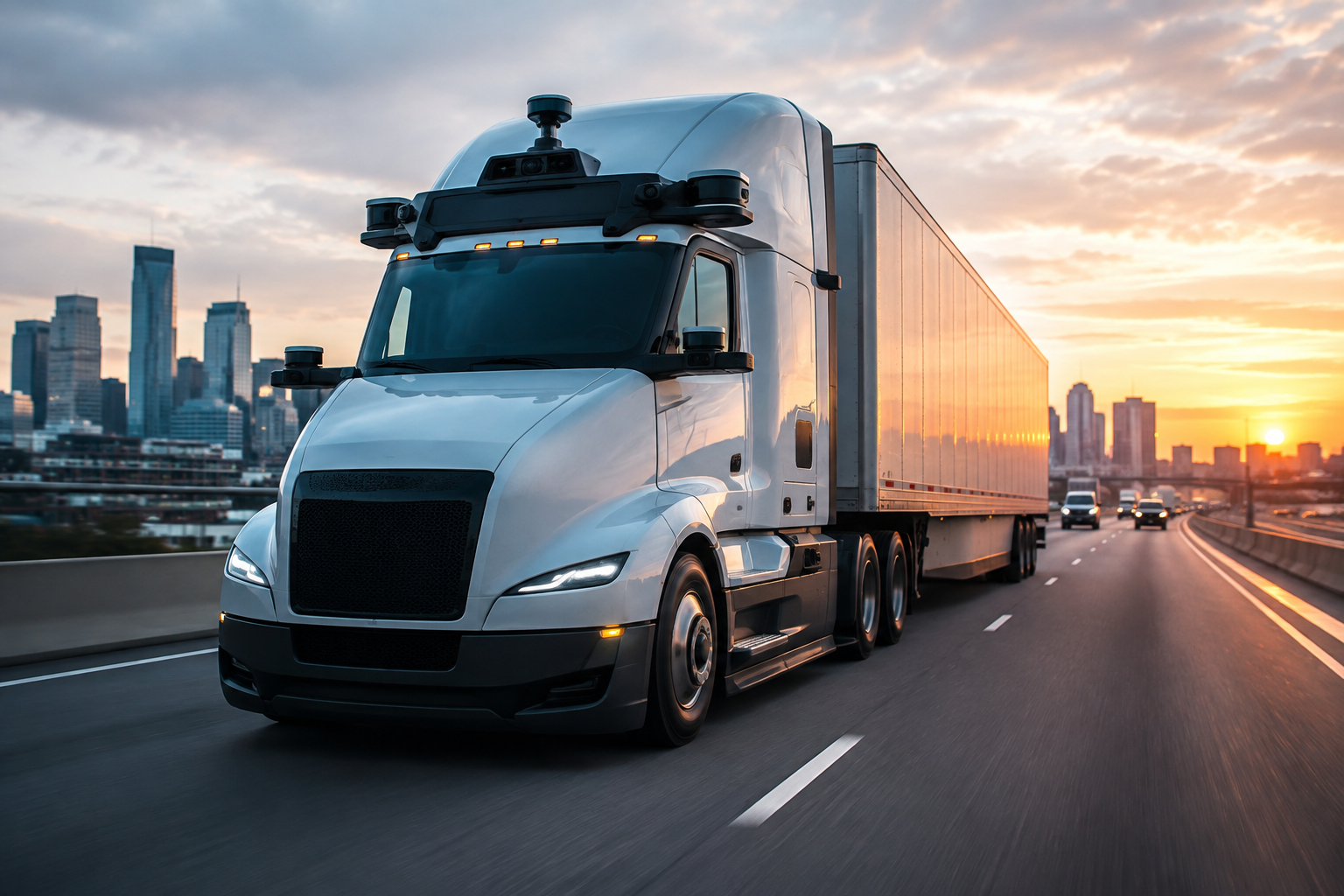
Trucks with no one behind the wheel are already hauling freight across West Texas, right now. Every day, without a safety driver sitting in the cab. That’s not a demo. That’s Kodiak Robotics’ actual, ongoing commercial operation, and it’s one of the clearest signs. Yet that autonomous trucking has moved past the testing phase and into real, revenue-generating work.
Kodiak, now trading publicly as Kodiak AI under the ticker KDK, has spent years building toward this moment.
What Is Kodiak Robotics?
Kodiak Robotics, founded in 2018 and headquartered in Mountain View, California, builds AI-powered autonomous driving technology for long-haul trucking, industrial hauling, and defense applications. Its core product, the Kodiak Driver, is a retrofit autonomy system, meaning it’s installed onto existing trucks rather than requiring a purpose-built vehicle from a truck manufacturer, an approach that sets it apart from some of its biggest competitors.
The company went public in September 2025 through a merger with Ares Acquisition Corporation II, a SPAC affiliated with Ares Management, a firm managing more than $572 billion in assets. The deal valued Kodiak at roughly $2.5 billion and brought in over $212.5 million from institutional investors, giving the company real capital to fund its push toward scaled, driverless operations.
How the Kodiak Driver Actually Works
A Retrofit, Not a Rebuild
Unlike autonomy providers such as Aurora Innovation or Torc Robotics, which work directly with truck manufacturers to build autonomy into new vehicles at the factory, Kodiak’s system is upfitted onto existing trucks. This retrofit work is handled by Roush Industries in Livonia, Michigan, an approach that lets Kodiak scale faster across an existing fleet rather than waiting on new vehicle production lines.
Dual-Use Technology
Kodiak describes itself as a dual-use autonomous technology company, meaning the same core Kodiak Driver platform serves both commercial trucking customers and defense applications. Its collaboration with General Dynamics Land Systems extends this technology into military vehicle applications, a diversification strategy that spreads the company’s revenue base beyond commercial freight alone.
The Autonomy Readiness Measure
To build public trust around its safety validation process, Kodiak introduced what it calls an Autonomy Readiness Measure, a zero-to-100 internal score tracking how much of its safety validation work is complete before removing a human safety operator entirely. As of April 2026, the company reported this score at 86%, a level of transparency that’s relatively uncommon in the broader autonomous vehicle industry.
Kodiak’s Commercial Operations Today
The Atlas Energy Solutions Partnership
Kodiak’s most significant commercial milestone so far has come through its partnership with Atlas Energy Solutions, a bulk carrier operating on private roads in the Permian Basin of West Texas and New Mexico. Kodiak-powered trucks have surpassed 750 hours of commercial driverless operations for Atlas, marking the first publicly announced deployment of customer-owned autonomous semi-trucks in real-world commercial use. Atlas has committed to an initial order of 100 trucks, with Kodiak and Roush aiming to scale production into the hundreds by the end of 2026.
Expansion Into Public Highways
Kodiak has also signed a commercial contract with Roehl Transport, under which Kodiak-equipped trucks autonomously haul freight on public roads between Dallas and Houston, four round trips a week. Unlike the fully driverless Permian Basin operations, these public-highway runs currently still keep a human safety operator behind the wheel as a precaution, reflecting the more cautious rollout required for public road operations compared to private industrial routes.
Fleet Growth and Milestones
By the first quarter of 2026, Kodiak’s driverless fleet had grown to 28 trucks, having added eight new fully driverless vehicles during the quarter alone. The company has accumulated more than 23,500 cumulative hours of paid driverless operations, a 120% increase from the end of 2025, and delivered more than 15,600 cumulative loads.
Kodiak Robotics by the Numbers
| Metric | Detail |
| Founded | 2018, Mountain View, California |
| Went public | September 2025, via SPAC merger with Ares Acquisition Corporation II |
| Nasdaq ticker | KDK |
| Post-merger valuation | ~$2.5 billion |
| Q1 2026 revenue | $1.8 million (up 74% quarter-over-quarter) |
| Driverless fleet size (Q1 2026) | 28 trucks |
| Cumulative driverless operating hours | 23,500+ |
| Cumulative loads delivered | 15,600+ |
| Autonomy Readiness Measure (April 2026) | 86% |
| Cash and marketable securities (Q1 2026) | $90.2 million, excluding a later $100M raise |
Kodiak vs Other Autonomous Trucking Companies
| Company | Deployment Model | Key Differentiator |
| Kodiak Robotics | Retrofit onto existing trucks | Dual-use commercial and defense platform |
| Aurora Innovation | Built with OEM truck partners | Focused primarily on public highway freight |
| Torc Robotics | Built with OEM truck partners | Backed by Daimler Truck’s manufacturing scale |
| Plus | Retrofit and OEM partnerships | International expansion focus |
| Waymo Via | Purpose-built autonomous systems | Backed by Alphabet’s broader autonomy research |
A Fair Look at the Financial Picture
No growth story is complete without the numbers that matter to investors, and Kodiak’s are worth covering honestly.
The company remains firmly pre-profit. Its first-quarter 2026 operating loss came in at $37.9 million, roughly twice what it reported in the same period the year before, and free cash flow for the quarter showed a loss of $35 million. To extend its financial runway, Kodiak raised $100 million in May 2026 through a private placement, but that raise came at a steep discount to its trading price, and the announcement sent Kodiak’s stock tumbling 37% in after-hours trading as investors reacted to what the discount implied about near-term capital needs.
At the same time, the revenue trajectory is genuinely encouraging for a company at this stage: 74% quarter-over-quarter growth, a fast-expanding driverless fleet, and a steadily climbing safety validation score all point toward real operational progress, not just a story built on press releases. As with any pre-profit, capital-intensive technology company, this is a case where the growth story and the balance sheet risk both deserve equal attention, similar to the volatility patterns worth understanding in our breakdown of Richtech Robotics stock, another young, publicly traded robotics name navigating the same kind of high-growth, high-burn tradeoffs.
This section is for informational purposes only and isn’t financial advice. Stock prices and analyst ratings change frequently, so check current data before making any investment decision.
Why Autonomous Trucking Matters Right Now
The broader case for autonomous trucking rests on a few well-documented industry pressures. The trucking industry faces a persistent driver shortage, rising operating costs, and consistent safety concerns tied to long-haul, fatigue-heavy routes, exactly the challenges Kodiak’s leadership has pointed to as the core motivation behind its technology.
Autonomous trucks, in theory, can operate on a Driver-as-a-Service model, generating recurring revenue through a per-truck or per-mile licensing fee rather than a traditional one-time equipment sale. This same shift toward AI systems making real-time decisions rather than following fixed instructions is playing out across the broader robotics world too, echoing the same underlying transition covered in our guide to robotics programming, where AI increasingly sits alongside traditional control code rather than replacing it outright. For readers curious how the people actually building these systems break into the field, an overview of robotics engineering walks through the skills, degrees, and career paths behind companies like Kodiak. And for a broader view of who else is shaping this moment, a roundup of top robotics companies covers the wider industry landscape Kodiak is competing and partnering within.
Final Thoughts
Kodiak Robotics has done something a lot of autonomous vehicle companies still haven’t: put trucks on the road with no human behind the wheel, generating real, growing revenue while doing it. Its retrofit approach, dual-use commercial and defense strategy, and transparent safety scoring system all set it apart in a crowded, capital-hungry field.
The financial picture still carries real risk, heavy losses, and a recent discounted capital raise. The broader challenge of scaling a driverless fleet responsibly. But with a fast-growing operating footprint and a validated commercial partner in Atlas Energy Solutions. With a clear roadmap toward late-2026 driverless highway launches, Kodiak Robotics remains one of the most closely watched names in the race to make autonomous trucking a genuine, everyday reality.
