

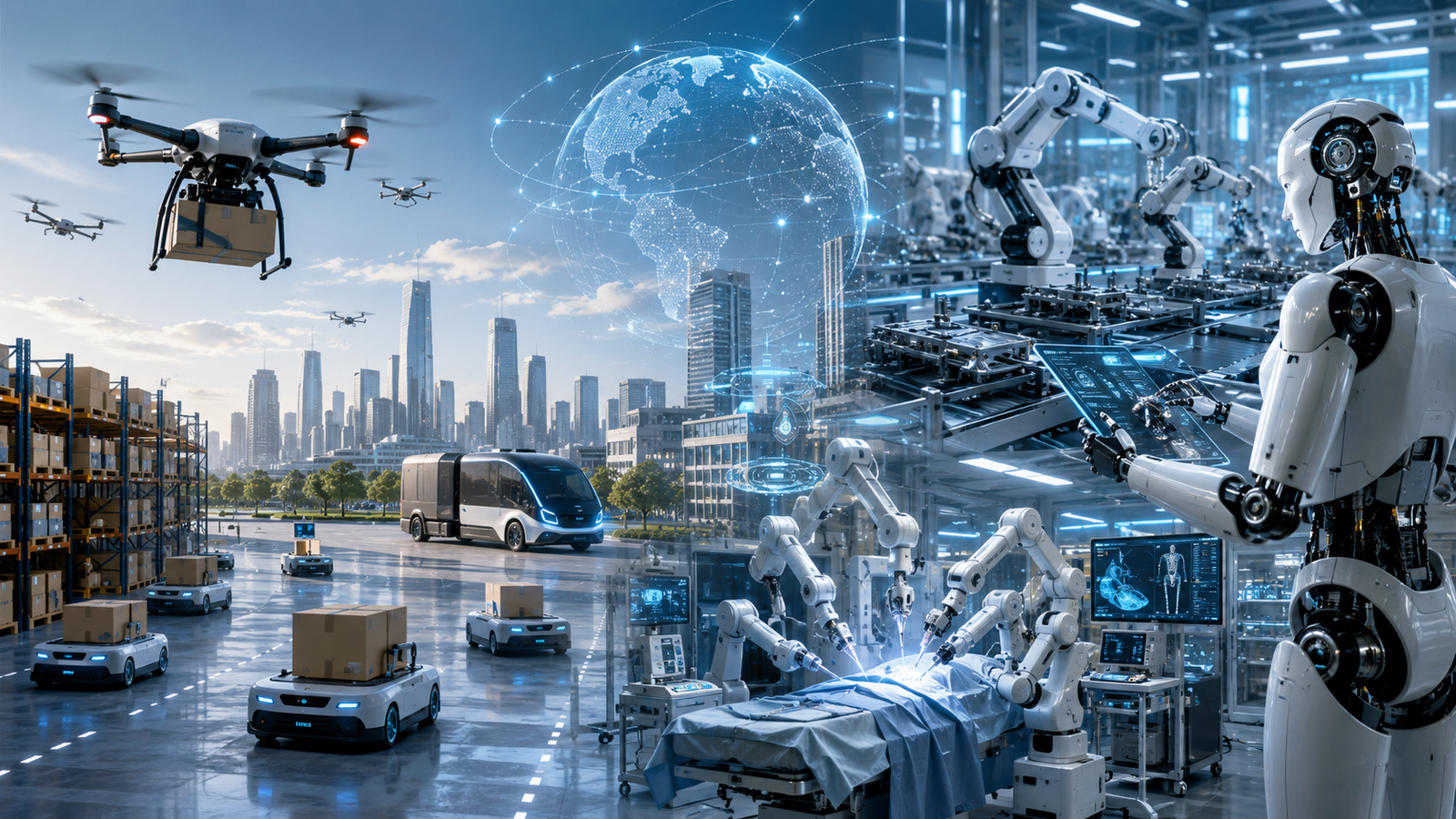
Right now, as you read this sentence, more than 4 million robots are working inside factories around the world. Not in ten years. Not “someday.” Today. And the companies behind them are sitting on a market worth $73.64 billion in 2026, one that’s expected to more than double to $185.37 billion by 2030.
That kind of growth doesn’t happen by accident. A small group of companies is quietly building the machines that pack your online orders, assemble your car, and are now starting to walk, balance, and work in spaces built for humans. Some of these names you already know. Others are racing to become the next big thing in robotics before most people have even heard of them.
From industrial giants that have automated factories for decades to agile startups leading the humanoid robot boom, the robotics industry is evolving at an unprecedented pace. Much of what separates these companies today comes down to the code and AI running underneath the hardware, not just the machines themselves.
Why Robotics Companies Matter Right Now
Robotics isn’t a side story in tech anymore; it’s becoming one of the main ones. Manufacturing, warehousing, healthcare, agriculture, and defense are the industries adopting robots the fastest, and e-commerce growth in particular keeps pushing warehouse automation forward at a rapid pace.
What’s changed most in the past couple of years is simple to explain. Old industrial robots followed fixed, pre-set instructions, like a recipe they never deviated from. Newer robots increasingly use AI to see, adapt, and make their own decisions in real time. That’s why today’s robotics leaders are judged as much on their software and AI smarts as their mechanical engineering, the same shift that’s already reshaping how entire creative and production workflows get built outside the factory floor too.
The Traditional Industrial Giants
Four companies have dominated industrial robotics for decades, and together they still control roughly 55% of the global industrial robot market.
ABB Robotics
ABB remains one of the clearest leaders in the global robotics sector. The Switzerland-based company is best known for precise, reliable industrial robots used heavily in automotive, electronics, logistics, and energy production. In the past year, ABB has expanded into next-generation cobots, autonomous mobile robots, and smart production systems that lean on machine learning, while also pushing energy-efficient manufacturing solutions. ABB holds roughly 13% of the total global robotics market.
FANUC
FANUC, based in Japan, is one of the largest industrial robot manufacturers on the planet, with more than 240,000 robots installed worldwide. It also holds a striking 65% market share in CNC controls, the systems that guide precision manufacturing equipment. FANUC has layered AI into its lineup through machine vision, force control, and predictive maintenance, letting robots catch mechanical problems before they cause downtime.
Yaskawa Electric
Yaskawa is a major force in industrial robotics and motion control, particularly strong in Asian manufacturing markets. Alongside ABB, FANUC, and KUKA, Yaskawa is one of the four companies that built the backbone of the modern factory floor.
KUKA
KUKA, based in Germany, is widely regarded as a leader in intelligent automation. Known for robotic arms used across automotive and general manufacturing, KUKA has continued investing in smarter, more adaptable robotic systems as manufacturers push for more flexible production lines.
The Rise of Humanoid and AI-First Robotics Companies
While the industrial giants still dominate factory floors, a newer wave of companies is chasing something more ambitious: robots that can walk, balance, and work in spaces originally built for humans.
Boston Dynamics
Boston Dynamics is often describe as the technical leader of the humanoid and advanced mobility space. Its four-leg robot, Spot, is already deploy commercially for inspection work in demanding environments like oil, gas, and public safety. Boston Dynamics remains privately held as of 2026, and its engineering reputation continues to set a benchmark other robotics companies are measure against.
Figure AI
Figure AI is one of the most closely watch humanoid robotics startups, focused on building general-purpose humanoid robots aimed at logistics and manufacturing work. Like Boston Dynamics, Figure remains privately held, and it has attracted major investor attention as the humanoid robotics category has heated up.
Tesla (Optimus)
Tesla’s robotics push centers on Optimus, a bipedal humanoid robot first revealed as a concept in 2021, with an early prototype shown the following year. Optimus is designe to take on repetitive physical tasks, in factories or eventually in homes, freeing people for less repetitive work. Tesla CEO Elon Musk has publicly described it as a potentially massive product category for the company going forward.
Neura Robotics, Apptronik, and Agility Robotics
These three humanoid-focused companies have quickly climbed into the top tier of robotics startups. Combined, they carry a valuation of roughly $14.8 billion, a clear sign of how much capital is flowing into humanoid robotics specifically, separate from the broader industrial robotics market. Smaller public companies are chasing the same wave, though not always with the same stability. Richtech Robotics stock has swung wildly over the past year as investors try to price in that same humanoid and service-robotics excitement on a much smaller scale.
Robotics Leaders in Specialized Industries
Not every major robotics company is chasing humanoids. Several have built dominant positions in more specific, high-value niches.
Intuitive Surgical
Intuitive Surgical is the clear leader in surgical robotics, best known for its da Vinci surgical systems used in hospitals worldwide. It’s one of the few publicly trade, pure-play robotics companies with a long track record of consistent revenue growth tied to a single, highly specialized application.
Symbotic and Zebra Technologies
Warehouse automation has become one of the fastest-growing robotics niches, driven directly by e-commerce growth. Symbotic and Zebra Technologies are widely consider the top leaders in this space, building the automated systems that move products through massive fulfillment centers. Amazon Robotics, while not a standalone public company, also operates one of the largest warehouse robotics deployments in the world.
Top Robotics Companies by Revenue and Market Share
| Company | Headquarters | Known For | Market Position |
| ABB Robotics | Switzerland | Industrial automation, cobots | ~13% global market share |
| FANUC | Japan | Industrial robots, CNC controls | 240,000+ robots installed; 65% CNC market share |
| Yaskawa Electric | Japan | Motion control, industrial robots | Top 4 industrial robotics leader |
| KUKA | Germany | Intelligent automation | Top 4 industrial robotics leader |
| Boston Dynamics | USA | Advanced mobility, Spot robot | Private; industry technical benchmark |
| Figure AI | USA | General-purpose humanoids | Private; major startup investment |
| Tesla (Optimus) | USA | Humanoid robotics | Public; rapidly scaling program |
| Intuitive Surgical | USA | Surgical robotics | Public; category leader |
| Symbotic | USA | Warehouse automation | Public; top warehouse robotics leader |
Robotics Industry by the Numbers
| Metric | Figure |
| Robots currently operating in factories worldwide | Over 4 million |
| Global robotics market size (2026) | $73.64 billion |
| Projected market size by 2030 | $185.37 billion |
| Combined market share of top 4 industrial players | ~55% |
| FANUC robots installed worldwide | 240,000+ |
| FANUC CNC controls market share | 65% |
| Combined valuation of Neura, Apptronik, Agility | ~$14.8 billion |
| China’s robotics industry size | ~$35 billion |
Industrial Robots vs Humanoid Robots: Key Differences
| Factor | Industrial Robots (ABB, FANUC, KUKA) | Humanoid Robots (Figure, Tesla, Boston Dynamics) |
| Primary use case | Fixed manufacturing tasks | Flexible, human-adjacent tasks |
| Market maturity | Decades old, highly proven | Early-stage, rapidly evolving |
| Typical deployment | Factory floors, assembly lines | Warehouses, labs, pilot programs |
| Company status | Mostly public, established revenue | Mix of public (Tesla) and private startups |
| AI integration | Increasingly added to existing hardware | Built around AI from the ground up |
| Investment trend | Steady, incremental | Explosive, high-valuation growth |
What to Consider When Evaluating a Robotics Company
If you’re researching robotics companies for a business decision, a few factors matter more than flashy demos or headlines.
Financial stability matters because robots typically need support for seven to ten years, so a financially shaky vendor is a real long-term risk. Installed base is worth checking too, since companies with a larger existing footprint tend to have better spare parts availability and more experienced integrators who know how to work with their systems. Growth trajectory signals whether a company is reinvesting in research and improving its products over time, or coasting on past success. And for companies operating on a robots-as-a-service model, it’s worth evaluating their financial runway, since that pricing approach depends on sustained growth to remain viable long-term.
The broader trend across the industry is clear: companies successfully combining strong AI capability with solid hardware are commanding higher valuations and growing faster than hardware-only competitors. The next wave of market leaders is increasingly likely to be define by AI capability rather than mechanical engineering alone.
Final Thoughts
The robotics industry in 2026 is really two stories running at once. On one side, decades-old industrial giants like ABB, FANUC, Yaskawa, and KUKA continue to dominate factory floors with proven, reliable systems. On the other, a new generation of AI-first companies- Boston Dynamics, Figure AI, Tesla, and a wave of well-funded humanoid startups- are racing to build robots flexible enough to work in the same spaces humans do.
With more than 4 million robots already deployed and a market on track to more than double by 2030, this isn’t a slow-moving industry to watch from the sidelines. Whether it’s a warehouse robot sorting packages or a humanoid learning to walk through a factory, the companies covered here are the ones actually building that future, one robot at a time.
