

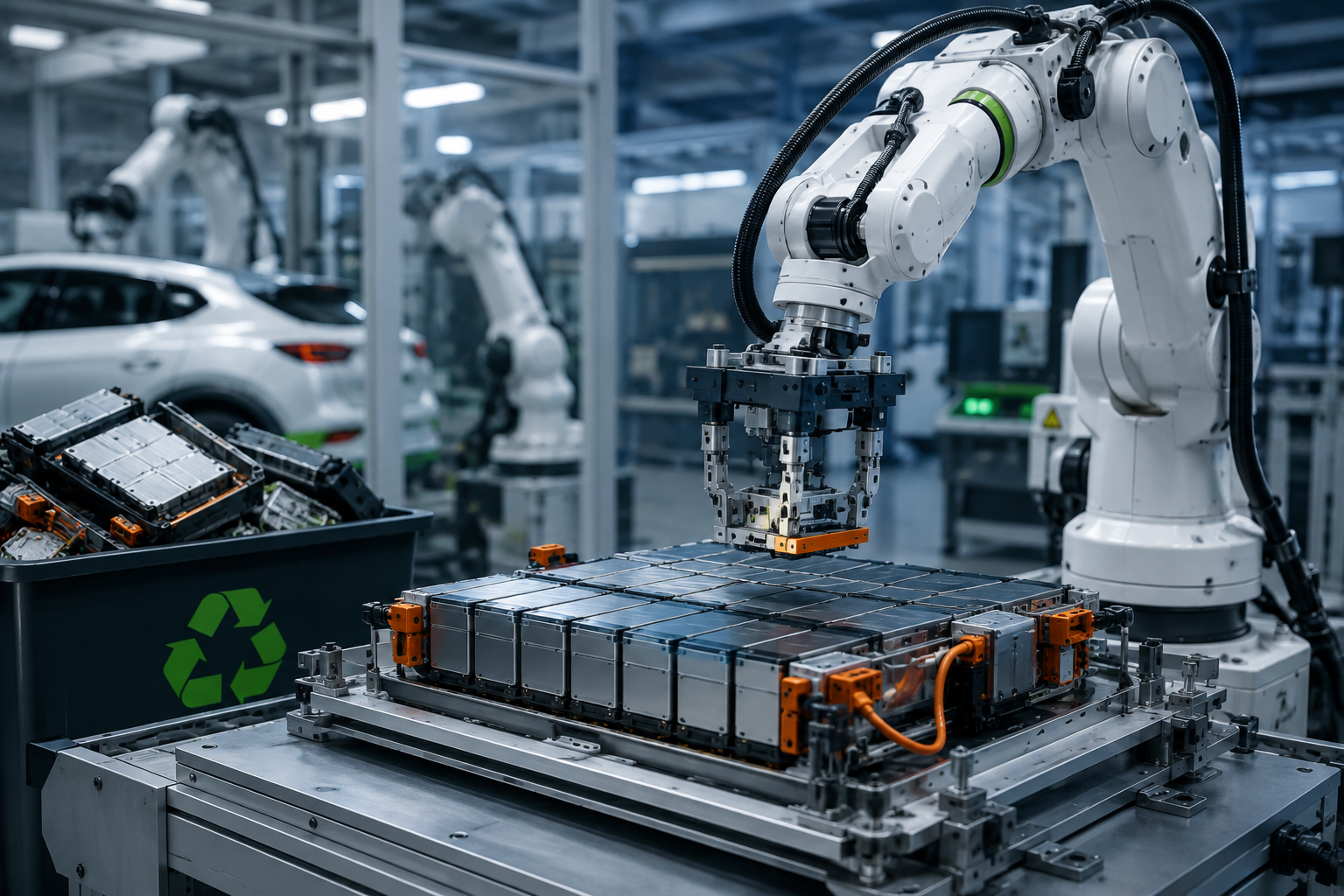
By 2030, roughly 240 million electric vehicles will be on the road worldwide, up from about 30 million in 2022. Every one of those cars carries a battery pack that will eventually need to be retired, and most of them today are still taken apart by hand, a slow, hazardous process involving high voltage and real fire risk. Posh Robotics exists to fix that specific, unglamorous, genuinely important problem, and it’s doing it with robotic arms and computer vision instead of workers in protective gear.
What Is Posh Robotics?
Posh Robotics is a San Mateo, California-based startup founded in 2021 that automates the disassembly of electric vehicle battery packs using robotic arms and computer vision. Its system is built to take on a job that’s currently done manually across most of the industry: safely disassembling retired EV battery packs so they can be qualified for reuse, refurbishment, or recycling.
The company was co-founded by Chung Hoang, whose background includes earlier work on restaurant robotics before shifting focus toward the mobility and battery recycling space. Posh Robotics raised a $3.8 million seed round in June 2022, backed by investors including Y Combinator, Pegasus Tech Ventures, Global Founders Capital, and WorldQuant Ventures, giving the company runway to develop and refine its automated disassembly platform.
It’s worth noting upfront that Posh Robotics is still a small, early-stage company, not a large, established employer. That matters for anyone considering a career there.
The Problem Posh Robotics Is Solving
Manual Disassembly Is Slow and Dangerous
Retired EV battery packs typically arrive at recycling facilities with roughly 80% of their original capacity still usable in some form, but taking them apart safely requires dealing with high-voltage components and real fire risk. Doing that work by hand is not only slow, it’s genuinely hazardous for the workers involved.
Battery Packs Aren’t Standardized
Unlike a lot of manufacturing automation problems, EV battery recycling has to deal with wide variation across manufacturers, models, and pack designs. Posh Robotics’ use of computer vision is specifically aimed at handling that inconsistency, letting a robotic system adapt to different pack layouts rather than requiring a rigid, single-purpose setup for every battery type.
The Scale of the Problem Is Growing Fast
With tens of millions of EV battery packs expected to reach end-of-life by 2030, the volume of batteries needing disassembly is set to far outpace what manual labor alone can realistically handle, one of the clearest arguments for automation in this specific corner of the recycling industry.
The EV Battery Recycling Market by the Numbers
| Metric | Figure |
| Global EV battery recycling market size (2026) | ~$4.88 billion |
| Projected market size by 2030 | ~$12.77 billion |
| Market CAGR (2026–2030) | ~27% |
| Projected global EVs on the road by 2030 | ~240 million |
| Approximate usable capacity remaining in retired EV batteries | ~80% |
| Posh Robotics total funding raised | $3.8 million (Seed, 2022) |
| Posh Robotics founded | 2021, San Mateo, California |
Market-size estimates vary significantly across research firms depending on how “EV battery recycling” is scoped; figures above reflect a commonly cited estimate range for the core EV-specific segment.
What Kinds of Careers Exist at a Company Like Posh Robotics
Given its small size, Posh Robotics’ team is likely to be lean and cross-functional, which is typical for a seed-stage hardware and robotics startup. Based on the nature of its technology and the broader hiring patterns at similarly sized robotics startups, roles at a company like this generally cluster around a few core areas.
Robotics and mechanical engineers design and refine the physical systems that handle battery pack disassembly, including the robotic arms and end-effectors that interact directly with the hardware. Computer vision and machine learning engineers build and train the perception systems that let the robot identify and adapt to different battery pack designs, a central technical challenge given the industry’s lack of standardization. Software and controls engineers write the code that governs how the robot moves, senses, and makes decisions during disassembly, the same kind of real-time, safety-critical programming work covered in more depth in a broader look at robotics programming as a discipline. Operations and manufacturing specialists help translate a working prototype into a reliable, repeatable industrial process, an especially important function for a hardware startup moving from lab demos to real deployment.
What to Expect From an Early-Stage Robotics Startup Career
Joining a company at Posh Robotics’ stage, small, seed-funded, and still proving out its core technology, comes with a very different set of tradeoffs than joining an established robotics company like FANUC or ABB.
The upside tends to include broader ownership over your specific technical domain, direct exposure to the founding team, and the chance to shape core technical decisions early rather than working within a large, already-established engineering organization. Early employees at small robotics startups often end up wearing multiple hats, doing hands-on hardware work one day and writing perception code the next, valuable if you want fast, hands-on skill development.
The tradeoffs are just as real. Early-stage startups carry genuine business risk, funding runway is finite, and a company that’s raised a single $3.8 million seed round faces a very different set of resource constraints than a company with hundreds of millions in funding. Compensation at this stage typically leans more heavily on equity relative to cash than it would at a larger, more established company, and job security is inherently less certain during a company’s early years.
For anyone weighing whether an early-stage robotics career like this fits their goals, it’s worth understanding the field more broadly first. A detailed look at robotics engineering as a career path breaks down the core skills, degrees, and typical salary ranges across the industry, useful context whether you end up at a small climate-tech startup or a large industrial player. And for a wider view of who else is building in this space, a roundup of today’s leading robotics companies covers the broader competitive landscape robotics careers exist within, from established manufacturing giants to fast-growing, mission-driven startups working on more specialized problems.
How to Actually Check Current Openings
Because Posh Robotics is a small, early-stage company, its hiring needs can shift quickly, and job board listings for smaller startups aren’t always kept fully up to date. The most reliable approach is checking the company’s own careers page and LinkedIn profile directly for current openings, rather than relying on third-party job aggregators, which have sometimes shown outdated or conflicting information for early-stage companies like this one.
Final Thoughts
Posh Robotics sits at an interesting intersection: a small, early-stage team working on a genuinely important, fast-growing problem in the broader shift toward electric vehicles and a circular battery economy. Its use of robotics and computer vision to automate a slow, hazardous manual process is exactly the kind of specific, well-scoped application that tends to define successful early robotics startups.
For anyone considering a career there, the honest framing is straightforward: it’s a real opportunity to work hands-on with robotics and AI inside a company solving a concrete, high-growth problem, paired with all the genuine uncertainty that comes with joining any company still early in its journey. Checking the company’s own current openings directly remains the best way to know exactly what roles are available today.
