

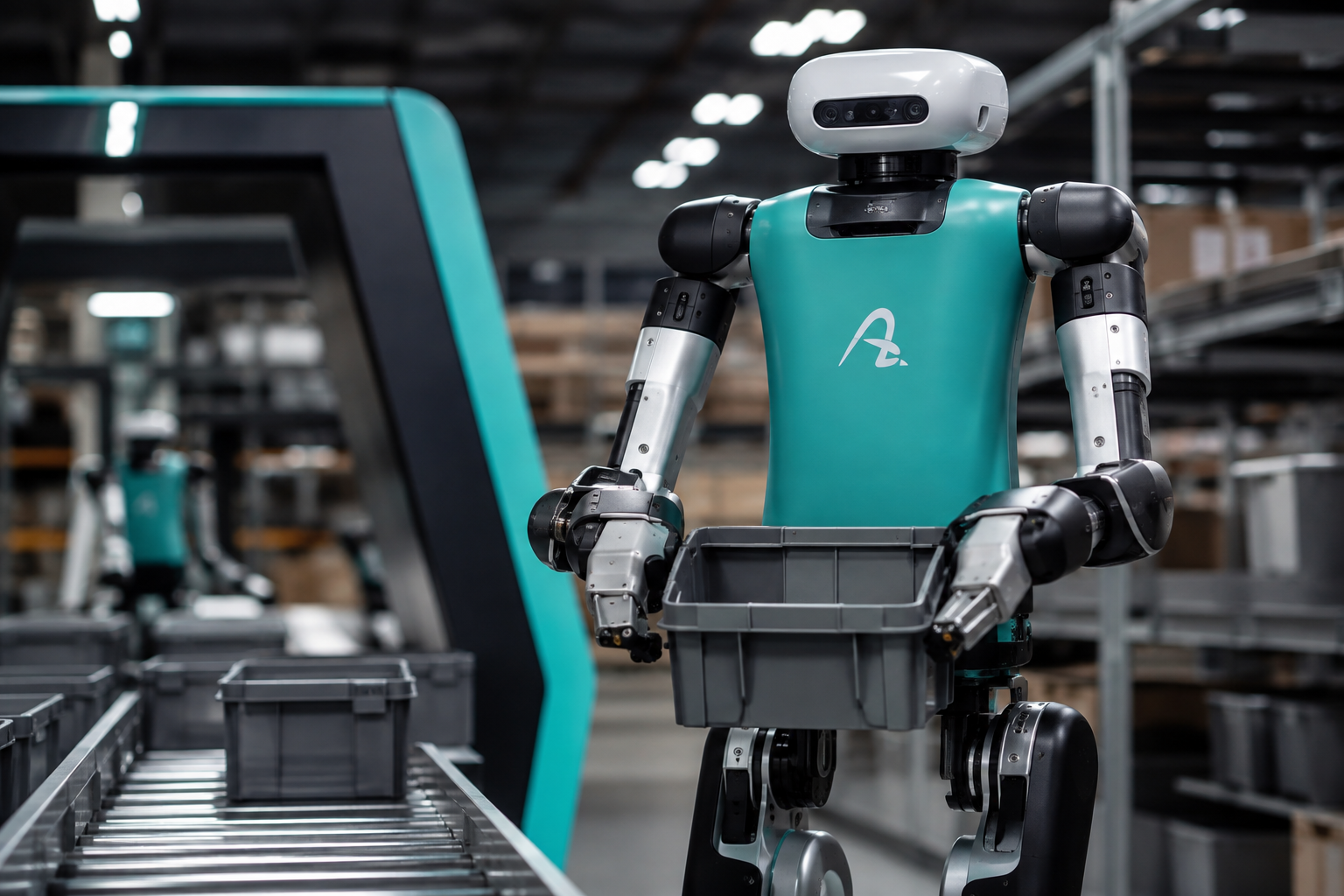
More than 65,000 hours. That’s how long Agility Robotics’ humanoid robot, Digit, has already spent working inside real commercial facilities. That’s not labs, not demo stages, actual warehouses and manufacturing floors run by companies like Amazon, Schaeffler, GXO, and Toyota. That kind of operating history is rare in humanoid robotics. It’s a big part of why Agility just agreed to become the first pure-play. A humanoid robotics company to trade on a major U.S. stock exchange.
Agility Robotics announced in June 2026 that it will go public through a $2.5 billion. That merger with Churchill Capital Corp XI, a deal expected to bring in more than $620 million in gross proceeds.
What Is Agility Robotics?
Agility Robotics is an Oregon-based humanoid robotics company spun out of Oregon State University’s Dynamic Robotics Laboratory in 2015 by co-founders Jonathan Hurst, Damion Shelton, and Mikhail Jones. Over more than a decade, the company has worked its way from early bipedal research into real, paying commercial deployments, a track record few humanoid startups can currently match.
The company’s mission, in its own words, is to build robot partners that augment the human workforce and help lead the broader adoption of humanoids across industry. Its flagship product, Digit, is described as a general-purpose, human-centric robot built specifically for work, currently operating in manufacturing, distribution, and logistics settings to help fill chronic physical labor shortages.
From Cassie to Digit: How Agility Got Here
Cassie: The Research Foundation
Before Digit, Agility develop Cassie, a bipedal research robot that help the company establish the core dynamic-balance and locomotion technology everything build on. Cassie is not design for commercial work, but the walking and balance breakthroughs it proved out became the technical backbone for Agility’s later, work-ready humanoid.
Digit: Built for Real Commercial Work
Digit is Agility’s answer to a genuinely practical question: what would a humanoid robot need to actually be useful in a warehouse or factory, not a demo video? It’s a general-purpose, human-centric robot designed to operate safely alongside people in environments originally built for human bodies, handling tasks tied to physical labor shortages that many industrial operators are struggling to staff.
Digit v5: The Next Generation
Agility’s newest version, Digit v5, is describ as the world’s first AI-enabled, cooperatively safe humanoid robot, built on a vertically integrated, general-purpose platform designed specifically for scaled deployment. The company has already secured more than $300 million in multi-year contracted orders for Digit v5, a meaningful signal that commercial demand exists well ahead of the robot’s full-scale rollout.
Agility’s Commercial Track Record
What sets Agility apart from a lot of the humanoid robotics hype cycle is the sheer amount of real-world operating history behind Digit. Across commitments spanning nine customer facilities, Digit has accumulated more than 65,000 hours of operation, demonstrating the ability to work safely and reliably in live production environments, not just controlled test settings.
Every one of those deployment hours feeds what Agility calls its “data flywheel,” a growing body of proprietary, real-world operational data used to improve the robot’s embodied AI systems and accelerate new capabilities. That flywheel effect, learning directly from paid, real-world deployments rather than simulation alone, is quickly becoming one of the clearest differentiators separating serious humanoid robotics companies from earlier-stage research projects.
Agility’s customer and partner roster reads like a shortlist of major industrial names: Amazon has tested Digit robots directly, and the company counts Schaeffler, GXO, and Toyota Motor Manufacturing Canada among its active commercial partners, alongside a broader investor and partner network including Nvidia, SoftBank Vision Fund 2, Foxconn, DCVC, and Playground Global.
Agility Robotics by the Numbers
| Metric | Detail |
| Founded | 2015, Corvallis, Oregon |
| Total private funding raised to date | ~$640 million |
| Most recent private round (2025 Series C) | $400 million, ~$2.1B post-money valuation |
| SPAC deal valuation (2026) | $2.5 billion pre-money |
| Expected gross transaction proceeds | $620 million+ |
| PIPE financing included | ~$200 million, led by Foxconn |
| Post-merger ticker | AGLT |
| Digit v5 contracted orders secured | $300 million+ |
| Cumulative Digit operating hours | 65,000+ |
| Active commercial deployment sites | 9 customer facilities |
| Commercially deployed robots (as of the SPAC announcement) | Fewer than 100 |
Why Agility Is Going Public Now
Agility’s leadership is direct about what the public listing is mean to accomplish. Proceeds from the transaction are earmark to fulfill existing customer orders, expand commercial deployments, scale production of Digit v5, and continue investing in robotics, physical AI, software, safety systems, and manufacturing infrastructure.
Agility CEO Peggy Johnson has framed the moment in broader terms too, describing humanoid robots as a critical driver of American technology leadership and the future of global industry. The deal is expect to make Agility the only U.S. publicly listed, pure-play humanoid robotics company with proven, active commercial deployments, a specific and fairly defensible claim given how much of the humanoid robotics field remains privately held or pre-commercial.
A Fair Look at the Road Ahead
It’s worth being clear eye about what this valuation actually represents. Agility has deployed fewer than 100 robots commercially so far, which means the $2.5 billion valuation is, by the company’s own framing and outside analysis alike, a serious bet on what humanoid robotics could become rather than a reflection of current, large-scale revenue. The SPAC valuation does represent a real step up, roughly 19% above the $2.1 billion mark set by Agility’s 2025 Series C round, but that gap between commercial partnership announcements and actual recurring revenue is exactly where the real story of Agility’s public market journey will be written over the coming quarters.
This is a familiar pattern across the humanoid and robotics investing landscape more broadly: strong technical milestones and real deployment data paired with genuine uncertainty about how quickly revenue scales to match the valuation- a tension worth understanding, the way an early-stage, publicly traded name like Richtech Robotics stock has had to navigate its own version of investor expectations running ahead of near-term financials.
This section is for informational purposes only and isn’t financial advice. SPAC deal terms and market conditions can change before closing, so check current, verified sources before making any decisions.
Agility Robotics vs Other Humanoid Robotics Companies
| Company | Deployment Status | Key Backers | Public Market Status |
| Agility Robotics | 65,000+ hours across 9 facilities | Nvidia, Amazon, SoftBank, Foxconn, DCVC | Going public via SPAC (2026), ticker AGLT |
| Figure AI | Early commercial trials | Major venture investors | Private |
| Boston Dynamics | Commercial deployment of Spot (quadruped) | Hyundai (owner) | Private |
| Tesla (Optimus) | Internal factory testing | Tesla | Public (via Tesla stock) |
The Bigger Picture: Humanoids Entering the Workforce
Agility’s public listing arrives at a moment when humanoid robotics is shifting from a research narrative into a genuine industrial one. The kind of AI-driven adaptability built into Digit v5- robots that can operate safely alongside people and learn from real deployment data rather than fixed instructions- reflects the same broader transition happening across robotics programming more generally, where software and real-time decision-making increasingly matter as much as the mechanical hardware itself.
That shift is also reshaping what it takes to build a career in this field. The specialized blend of AI, controls, and mechanical engineering behind a robot like Digit is exactly the kind of cross-disciplinary skill set covered in a deeper look at robotics engineering as a career path, and Agility’s rise is very much part of the broader competitive landscape mapped out across today’s leading robotics companies more broadly.
Final Thoughts
Agility Robotics has built something genuinely uncommon in the humanoid robotics field: over a decade of technical development backed by real, paid, multi-year commercial deployments rather than demo footage alone. Its shift toward public markets, backed by a strategic investor list spanning AI, industrial, and consumer electronics giants, marks a real inflection point for the humanoid robotics category as a whole.
The path ahead still carries real execution risk; scaling from fewer than 100 deployed robots to a valuation built on much bigger ambitions is no small task. But with Digit v5 already carrying $300 million in contracted orders and a data flywheel built on 65,000-plus hours of real-world learning, Agility Robotics enters public markets with a stronger operational foundation than most of its humanoid robotics peers can currently claim.
