

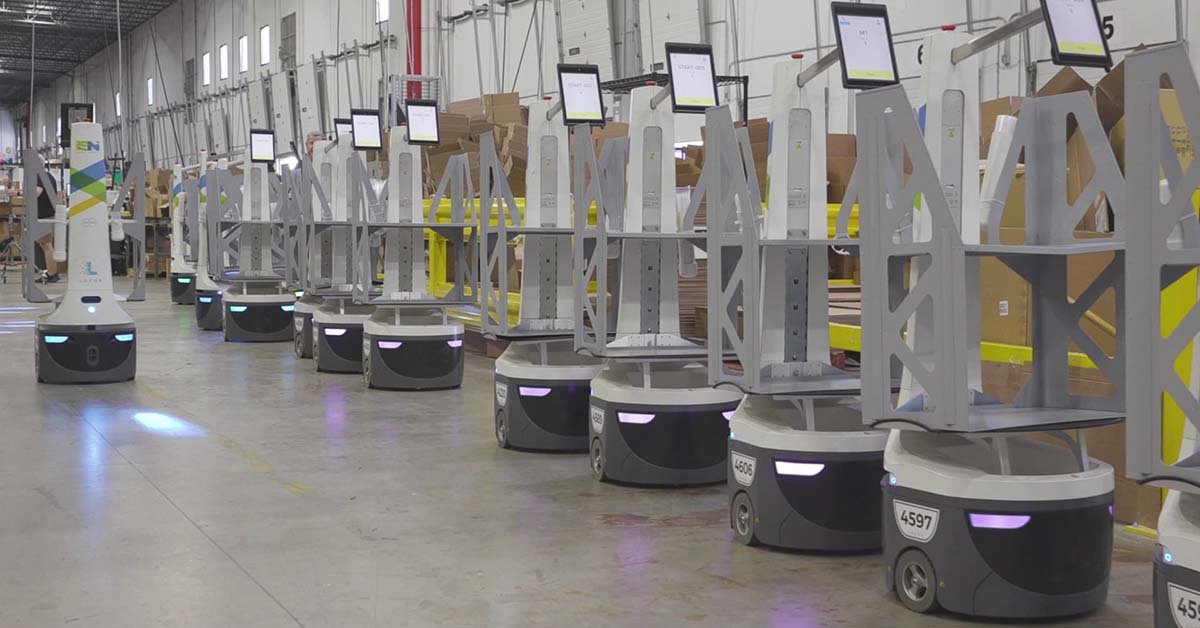
Six billion. That’s how many individual item picks Locus Robotics’ warehouse robots have completed, and the company reached that number faster than ever before in its history. Just months later, it teamed up with fulfillment partner Radial to cross another huge milestone: 25 million picks completed together, as demand for fast, scalable order fulfillment keeps climbing. Behind those numbers sits one of the most established names in warehouse robotics, a company whose fleet now moves goods through some of the busiest fulfillment centers in the world.
Locus Robotics builds autonomous mobile robots, called LocusBots, that work side by side with human warehouse workers to pick, transport, and put away inventory. Instead of replacing people, Locus robots are build to make people faster, cutting down the walking and searching that eats up so much time on a warehouse floor.
What Is Locus Robotics?
Locus Robotics is a Massachusetts-based company that builds autonomous mobile robots, or AMRs, for warehouses and fulfillment centers. Founded in 2014, it has grown into one of the most widely deployed names in the “goods-to-person” style of warehouse automation, where robots handle the walking and travel between pick locations while human workers focus on the parts of the job robots still can’t do as well, like carefully picking a specific item off a shelf.
Its robots use computer vision and sensor fusion to navigate warehouse floors on their own, receiving instructions directly from a warehouse management system and guiding workers along the most efficient picking routes. Locus robots are already deployed inside facilities run by major logistics and retail operators, including DHL, ASDA, and CEVA, handling the kind of high-volume order fulfillment that keeps online shopping running smoothly.
How Locus Robotics Technology Works
At its core, Locus Robotics runs on a collaborative model, humans and robots working the same floor, each doing what they’re best at.
LocusBots handle the travel:
Instead of a worker walking miles across a warehouse each shift to fill orders, a LocusBot navigates to the right location and waits for a human to place the item onboard, then moves to the next stop.
Locus Array pushes further into full autonomy:
The company’s newer Robots-to-Goods system, called Locus Array, is built to handle picking, putaway, induction, and replenishment with even less manual involvement, aiming to cut picking and putaway labor by more than 90% in the right kind of high-volume operation.
LocusONE ties it all together:
Locus’s software platform acts as a control layer connecting robots, workflows, and warehouse management systems, letting operators manage fleets, track performance, and adjust workflows without needing to overhaul their entire facility.
The whole system runs on a subscription model:
Rather than requiring warehouses to buy robots outright, Locus uses a Robots-as-a-Service pricing structure, charging a per-robot monthly fee. This lowers the upfront cost of automation significantly and lets warehouses scale their robot fleet up or down as demand shifts, especially useful during busy seasonal peaks.
Locus Robotics by the Numbers
| Metric | Detail |
| Founded | 2014, Wilmington, Massachusetts |
| Total funding raised | ~$400–438 million |
| Estimated annual recurring revenue (mid-2026) | ~$180 million |
| ARR growth from late 2025 | Up from ~$165 million |
| Lifetime picks completed | Over 6 billion |
| Typical robot fleet size per facility (2026) | ~35 robots, up from 15 in 2024 |
| Productivity increase for warehouse workers | 2x–3x |
| Approximate hardware cost per robot | ~$35,000 |
| Approximate monthly subscription per robot | ~$1,990 |
| Fastest-growing deployment segment | 50–100 robot fleets, up 42% year-over-year |
Why Warehouses Are Turning to Robots Like Locus
A few forces are pushing warehouse automation, and companies like Locus, into serious growth right now.
E-commerce keeps climbing:
Global e-commerce sales surpassed $6.5 trillion in 2025, and every one of those online orders eventually has to be picked, packed, and shipped from somewhere. That volume puts real pressure on fulfillment centers to move faster without sacrificing accuracy.
Labor has gotten harder to find and keep:
Warehouse work is physically demanding, and staffing shortages have pushed many operators toward automation that makes existing workers more productive rather than trying to hire around the gap.
Same-day delivery expectations keep rising:
Customers expect orders faster than ever, and manual, walk-heavy picking processes simply can’t keep pace at scale the way a coordinated robot fleet can.
The payback period is short:
AMR fleets like Locus’s typically pay for themselves within 18 to 24 months by replacing slower, manual cart-based picking workflows, a fast enough return to invest an easy sell for many operators.
This same underlying shift, robots increasingly running on real-time AI and software rather than simple pre-set instructions, is the same trend reshaping robotics programming more broadly, not just in warehouses.
Locus Robotics vs Other Warehouse Robot Companies
| Company | Focus | Standout Strength |
| Locus Robotics | Collaborative AMRs, goods-to-person picking | Deep 3PL and retail deployment base |
| GreyOrange | Fulfillment automation, vendor-agnostic software | GreyMatter orchestration across mixed robot fleets |
| Geek+ | Global AMR provider | Largest global AMR market share by unit volume |
| 6 River Systems | Collaborative picking robots | Backed by Shopify’s e-commerce ecosystem |
| Exotec | High-density storage robotics | Strong vertical storage and throughput gains |
| Amazon Robotics | In-house fulfillment automation | 750,000+ robots across Amazon’s own network |
A Fair Look at the Risks
No robotics company’s story is without a few bumps, and it’s worth covering these honestly rather than glossing over them.
Locus Robotics filed for Chapter 11 bankruptcy protection in February 2023. Later emerging through a financial restructuring that let the company refocus on its core logistics customer base. Since then, its picks-per-year growth and revenue have climbed steadily. That suggests the restructuring achieved what it set out to do, but it’s a data point worth knowing.
The company also hasn’t raised new funding since its November 2022 Series F round, meaning its roughly $2 billion valuation from that round hasn’t been independently re-tested by the market in several years. And competition in warehouse robotics is intense, with GreyOrange, Geek+, and Amazon’s in-house robotics program. These several other well-funded players are all pushing into the same space. For anyone comparing how public versus private robotics companies weigh these kinds of risks, smaller names like Richtech Robotics stock can swing far more wildly on far less certain footing than an established private operator like Locus with a large existing customer base.
Final Thoughts
Locus Robotics has built one of the most established track records in warehouse automation. That is backed by billions of completed picks, a growing customer base among major logistics operators. A subscription pricing model that makes automation accessible without a massive upfront cost. Its recovery from a 2023 bankruptcy restructuring into a company now generating an estimated $180 million in annual recurring revenue is a genuine growth story worth paying attention to.
With e-commerce volume still climbing, labor challenges showing no signs of easing, and warehouse fleets growing larger at more facilities every year, Locus Robotics looks well-positioned to keep playing a major role in how the world’s packages actually get picked, packed, and shipped.
