

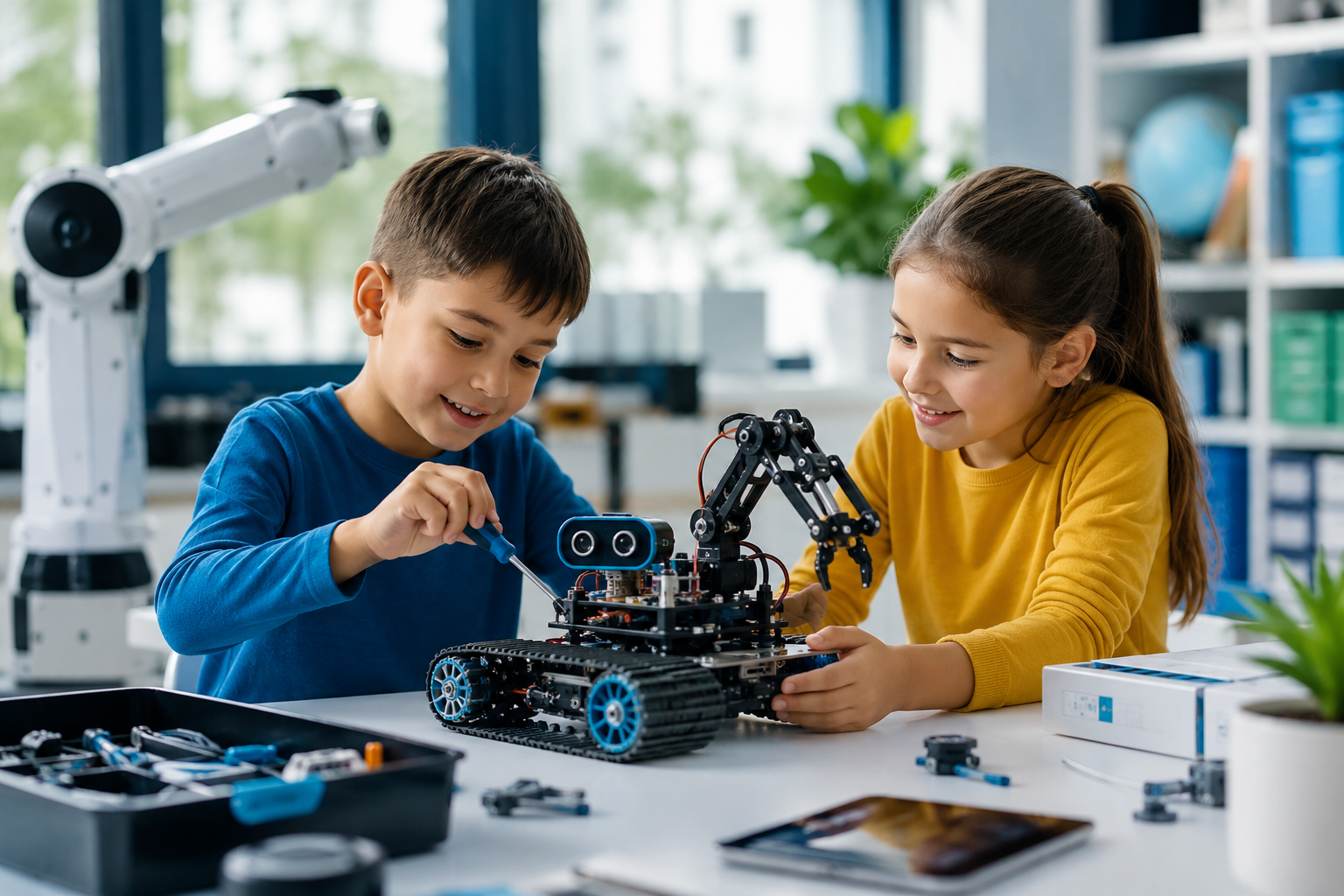
Somewhere in a classroom right now, a group of eight-year-olds is cheering because a small robot they built and programmed just successfully rolled across a table without falling off. That small, joyful moment is playing out in more classrooms every year. The global educational robot market is worth well over $2 billion in 2026 and is growing at a rate of 15% to nearly 20% a year, one of the fastest-growing corners of the entire education technology industry.
Robotics for kids isn’t just a trendy classroom gadget anymore. It’s becoming a genuine part of how children learn to think, build, and solve problems, often before they’ve even learned long division.
What Does “Robotics for Kids” Actually Mean?
Robotics for kids covers any activity where children build, program, or control a robot to complete a task. It sits at the intersection of a few subjects at once: basic engineering, since kids assemble physical parts, computer science, since many robots require simple code or commands, and problem-solving, since almost every robotics activity involves trial, error, and adjustment.
It doesn’t require a lab coat or a complicated setup. For younger children, robotics for kids might mean pressing colored buttons on a toy robot to make it walk forward. For older kids, it might mean writing lines of actual code to make a robot navigate a maze or pick up a small object. The activities scale with age, but the underlying goal stays the same: turning an abstract idea into something physical and observable.
Why Robotics Matters for Kids
Building Real Problem-Solving Skills:
When a robot doesn’t do what a child expects, that “failure” becomes the lesson. Kids learn to look at what went wrong, adjust their instructions, and try again, a skill that transfers directly to math, science, and everyday problem-solving.
Making Abstract Concepts Concrete:
Coding and engineering can feel abstract when they’re only taught on a screen or in a textbook. Robotics gives kids something physical to interact with, turning ideas like “sequence,” “loop,” and “cause and effect” into something they can literally watch move across a table.
Encouraging Teamwork and Communication:
Most robotics activities, especially in classrooms or clubs, involve working in small teams. Kids have to explain their thinking, divide tasks, and combine ideas, all useful social skills wrapped inside a technical activity.
Supporting Different Kinds of Learners:
Robotics tends to appeal to kids who learn best by doing rather than by reading or listening. Educational robots have also shown particular value for students with disabilities, including some students with autism, who can respond well to the predictable, patient nature of robot interaction.
Preparing Kids for Future Careers:
Robotics, automation, and AI are already reshaping entire industries, and that trend isn’t slowing down. Early, low-pressure exposure to how robots and code work gives kids a head start, whether or not they end up pursuing a technical career later. For families curious how that career path actually looks years down the line, our guide to robotics engineering breaks down the skills, degrees, and salaries involved once kids grow into that field professionally.
Robotics for Kids by Age Group
| Age Group | Typical Activities | Skill Focus |
| Ages 4–6 | Button-controlled toy robots, simple sequencing games | Cause and effect, basic sequencing |
| Ages 7–9 | Beginner coding blocks, drag-and-drop robot programming | Logical thinking, following steps |
| Ages 10–12 | Building simple robot kits, block-based coding (like Scratch) | Assembly, basic programming logic |
| Ages 13–15 | Text-based coding, sensor-based robots, competitions | Real programming, debugging, teamwork |
| Ages 16+ | Advanced kits, Python or C++ basics, robotics clubs | Applied engineering, early specialization |
Popular Robotics Tools and Kits for Kids
A wide range of robotics kits and platforms are built specifically for different ages and skill levels.
For younger children, robots like Dash and Cue from Wonder Workshop are designed to appeal directly to early learners. Dash responds to voice commands and can sing and dance, making it approachable for younger kids, while Cue offers more advanced interaction for slightly older children, both built to teach coding, engineering, and STEM concepts through play rather than lecture.
For elementary and middle school kids, block-based coding platforms let children snap together visual instruction blocks instead of typing code, removing the intimidation factor of a blank coding screen while still teaching real programming logic.
For teenagers and advanced learners, more serious kits introduce text-based coding languages and sensor-based robotics, closer to what a beginner robotics engineer might actually use. Learning a language like Python, the same starting point recommended for adult beginners in a breakdown of robotics programming, is a natural next step once a child has outgrown block-based tools.
The Educational Robot Market: A Quick Snapshot
| Metric | Figure |
| Global educational robot market size (2026) | Roughly $2–2.8 billion, depending on source |
| Projected market size by early 2030s | $4.5–8 billion+ |
| Typical annual growth rate (CAGR) | 12%–19% |
| Robotics kits and tools adoption growth (recent years) | +20% year-over-year in schools |
| Educational robots projected to include AI features | ~45% |
| Robots expected to include AR/VR features by 2026 | ~30% |
| Region with largest market share | Asia-Pacific and North America |
Market estimates vary across research firms depending on how “educational robot” is defined, but the growth direction is consistent across every major report.
How Robotics Fits Into STEM Education
Robotics has become one of the clearest, most hands-on ways schools deliver on the broader push toward STEM education, short for science, technology, engineering, and math. Rather than treating these subjects as separate lessons, a single robotics activity naturally blends several of them at once. Building a robot’s frame touches engineering. Programming its movement touches technology and math. Testing why it doesn’t work touches scientific reasoning.
This is a big part of why robotics competitions have grown so popular in schools worldwide. Teams of students design, build, and program robots to complete specific challenges, combining everything they’ve learned into one competitive, collaborative project. These competitions have become one of the fastest-growing drivers of classroom robotics adoption, according to recent industry reporting, alongside the broader trend of robotics kits being built into school curricula directly.
It’s also worth zooming out on why this investment is happening at a national and industry level in the first place. As robotics and automation reshape how physical work gets done, from warehouses to factories, the top robotics companies are part of the same broader shift schools are now trying to prepare students for early.
Tips for Parents Getting Started
If you’re a parent looking to introduce robotics at home rather than waiting for a school program, a few simple starting points work well.
Start with your child’s actual interests rather than the most advanced kit available. A child who loves animals might enjoy a robot pet more than an engineering-focused building kit, and either path still builds the same underlying skills. Keep early sessions short and playful rather than lesson-like, since the goal at a young age is curiosity, not mastery. Let kids fail without rushing to fix it for them, since working through a robot that won’t cooperate is often where the real learning happens. And if your child shows real interest, look into local robotics clubs or competitions, which tend to offer far more structured, engaging progression than solo kit-building at home.
Final Thoughts
Robotics for kids has grown from a niche classroom activity into a fast-growing, genuinely valuable part of modern education, backed by a global market expanding well into the double digits every year. It teaches far more than just how to build a robot: problem-solving, teamwork, patience, and a comfort with technology that will only become more useful as kids grow older.
Whether it’s a four-year-old giggling at a singing robot or a teenager debugging their first real line of code, robotics gives kids something rare in education: a chance to see their own thinking come to life, one small, rolling, occasionally wobbly robot at a time.
