

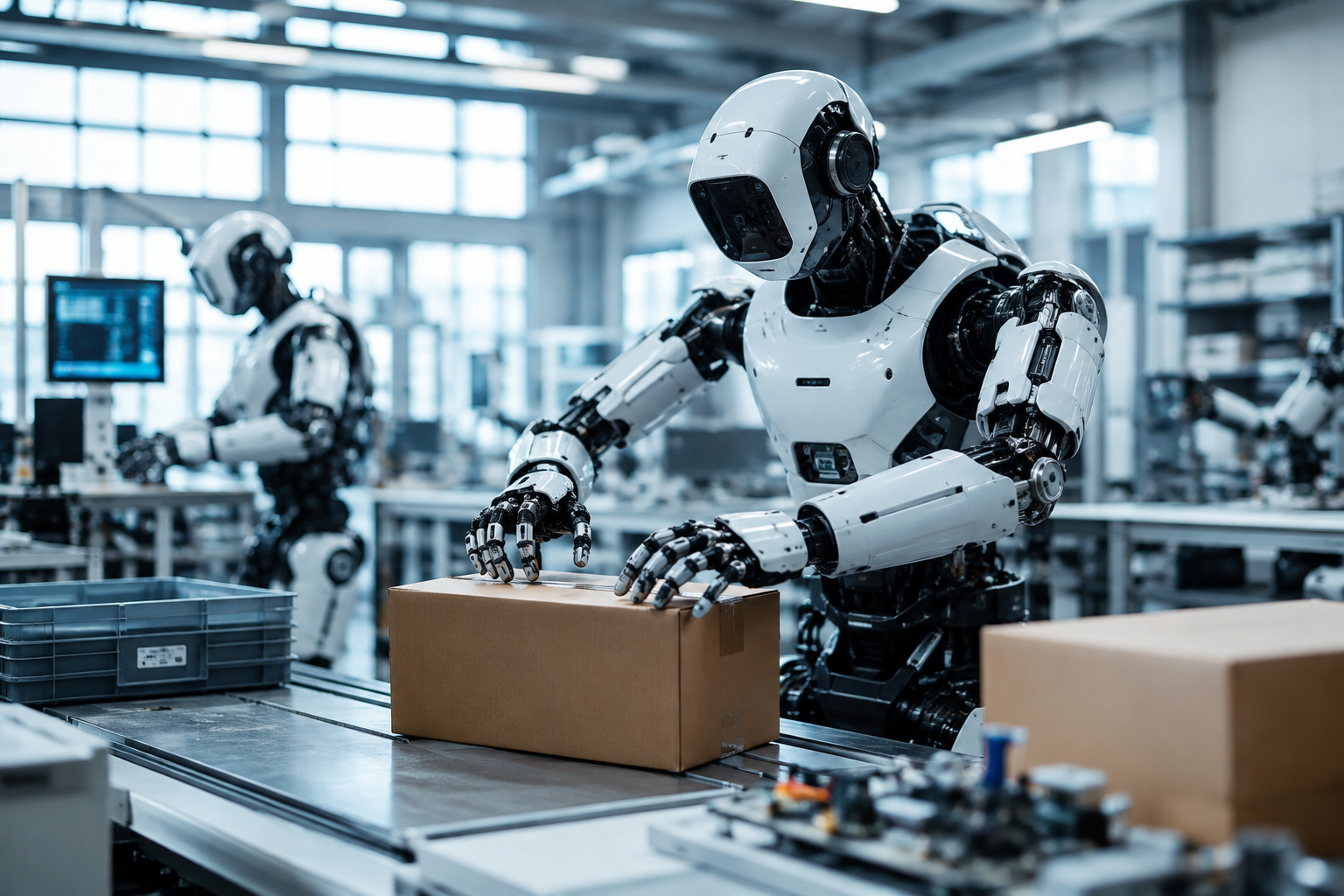
A robot that runs for 24 straight hours without stopping and still gets the job right more than 99% of the time sounds like a demo reel exaggeration. For Dyna Robotics, it’s an actual, verified result, and it’s the achievement that convinced a group of investors, including Nvidia, Amazon, and Salesforce, to hand the company $120 million in a single funding round.
Dyna Robotics is barely two years old, founded in 2024, and it’s already being talked about as one of the most credible contenders in the race toward what its founders call physical artificial general intelligence, AI capable enough to handle real, varied physical tasks the way a human worker would.
What Is Dyna Robotics?
Dyna Robotics is a Redwood City, California-based startup building foundation models for robots, AI systems trained to control robotic arms and complete real, physical tasks across different environments, rather than being narrowly programmed for a single, fixed job.
The company was founded in 2024 by Lindon Gao, a repeat AI hardware founder, alongside a team focused on bridging the gap between robotics research and real, paying commercial deployments. Rather than chasing flashy humanoid demos, Dyna has focused on something narrower and, so far, more immediately commercial: getting stationary robotic arms to reliably handle tasks like folding and food preparation in real businesses, then scaling that reliability into a broader, general-purpose model over time.
How Dyna’s Technology Works
A Single-Weight, General-Purpose Foundation Model
Dyna describes itself as the first company to build a single-weight, general-purpose foundation model capable of performing diverse daily tasks at commercial scale across varied environments. In plain terms, that means one core AI model, rather than a separate, custom-trained model for every individual task or location, can generalize across different jobs and settings.
DYNA-1: The Breakthrough Model
The company’s flagship model, DYNA-1, is the technical achievement behind its rapid rise. In testing, DYNA-1 pushed robot performance to a success rate of over 99% during 24 hours of continuous, non-stop operation, a benchmark few robotics AI companies have matched publicly. According to the company’s own technical writing, DYNA-1 has already reached 60% of human throughput at a strict quality bar, which it describes as a milestone unmatched elsewhere in the industry today.
Learning From Real Deployments, Not Just Simulation
Dyna’s model continues learning and improving from actual, on-the-job customer deployments rather than relying solely on simulated training environments. Company leadership has specifically highlighted this real-world generalization, describing robots that work correctly in new environments straight out of the box, without needing additional site-specific training data.
Built for the Whole Robot Stack, Not Just the Model
Dyna’s own engineering team has been notably direct about a limitation they see in competitors: model-only companies struggle in the physical world because real commercial performance depends on the entire robot stack working together- data, inference, control, and hardware, not just a strong AI model bolted onto someone else’s hardware.
Dyna Robotics’ Commercial Traction
In its first year alone, Dyna moved from a research concept to real, paying deployments. Within six months of launching DYNA-1, the company’s robots were running sixteen hours a day inside hotels, restaurants, laundromats, and gyms, industries where repetitive, physically demanding tasks are common, and labor can be hard to staff consistently.
The company frames its ultimate return-on-investment pitch in refreshingly practical terms: customers don’t ask about success rates directly; they ask about ROI. Dyna’s own analysis holds that for a robotics foundation model business to succeed, total cost of ownership, including hardware, durability, maintenance, and downtime, has to stay below a threshold like $50,000, or human labor simply remains the cheaper option. That kind of cost-conscious framing has helped the company court commercial customers who care less about research milestones and more about whether the technology actually pencils out.
Dyna Robotics by the Numbers
| Metric | Detail |
| Founded | 2024, Redwood City, California |
| Total funding raised | ~$144 million across two rounds |
| Seed round (March 2025) | $23.5 million |
| Series A round (September 2025) | $120 million |
| Key investors | RoboStrategy, CRV, First Round Capital, Salesforce Ventures, NVentures (Nvidia), Amazon Industrial Innovation Fund, Samsung Next, LG Technology Ventures |
| Flagship model | DYNA-1 |
| Success rate (24-hour continuous operation) | 99%+ |
| Throughput vs. human workers | ~60% at a strict quality bar |
| Robot daily operating hours (six months post-launch) | 16 hours/day |
| Employee count (mid-2026) | ~126 |
| Early deployment industries | Hotels, restaurants, laundromats, gyms |
Why Dyna’s Investors Are Paying Attention
Dyna’s Series A drew participation from a notably strategic mix of backers, and each one signals something slightly different about where the company is headed. Nvidia’s venture arm, NVentures, points to deep interest in the compute and hardware side of embodied AI. The Amazon Industrial Innovation Fund suggests real interest in warehouse and logistics-adjacent applications. Salesforce Ventures, Samsung Next, and LG Technology Ventures join a diverse group of investors from enterprise software, consumer electronics, and industrial manufacturing, demonstrating that they view Dyna’s technology as valuable across multiple industries rather than a single vertical.
RoboStrategy CEO Andrew Kang, whose firm led the round, has pointed to the sheer breadth of demand for robotic automation across nearly every industry as a core reason for backing Dyna specifically, framing the company as positioned at the forefront of meeting that demand with a genuinely general-purpose foundation model.
Dyna Robotics vs Other Embodied AI Startups
| Company | Approach | Standout Focus |
| Dyna Robotics | Single-weight general-purpose foundation model | Full-stack control: data, inference, control, hardware |
| Figure AI | Humanoid general-purpose robots | Bipedal, human-form-factor robots for logistics |
| Physical Intelligence | Foundation models for diverse robot hardware | Cross-platform generalist AI models |
| Skild AI | General-purpose robot “brain” | Hardware-agnostic AI layer for multiple robot types |
| Covariant | AI for warehouse picking robots | Deep specialization in logistics and fulfillment |
This same shift toward AI systems that learn and adapt, rather than follow fixed, pre-programmed instructions, is the broader trend reshaping robotics programming across the industry, and it’s exactly the kind of foundation-model approach Dyna has built its entire company around. For readers curious about the people actually building these systems, a guide to robotics engineering breaks down the skills and career paths behind companies like Dyna, while a roundup of top robotics companies covers the wider competitive landscape Dyna is emerging into.
What Makes Dyna’s Approach Different
A few choices set Dyna apart from some of the more headline-grabbing names in robotics right now.
It started narrow on purpose:
Rather than chasing a general-purpose humanoid from day one, Dyna’s early focus on specific, well-defined tasks like folding and food preparation gave the company a faster path to real commercial deployments and real-world training data.
It prioritizes cost discipline:
Dyna’s public framing around the $50,000 total cost of ownership threshold reflects an unusually grounded, business-first mindset for a company operating at the frontier of embodied AI research.
It’s chasing generalization, not just performance:
The company’s emphasis on a single-weight model that works across new environments without additional training data is a meaningfully different bet than building separate, task-specific models for every deployment.
Final Thoughts
Dyna Robotics has moved unusually fast for a company still in its second year, going from a $23.5 million seed round to a $120 million Series A in roughly six months, backed by a genuinely diverse and strategically meaningful group of investors. Its DYNA-1 model’s 99%+ success rate over 24 hours of continuous operation is a real, independently notable technical achievement, not just a marketing figure.
With robots already earning their keep in hotels, restaurants, laundromats, and gyms, and a cost-disciplined, full-stack approach that sets it apart from model-only competitors, Dyna Robotics looks like one of the more credible near-term contenders in the increasingly crowded race toward genuinely general-purpose, physical AI.
